Why do we need a “next Myspace” anyway? At the last edition of SF MusicTech, I heard a great quote which I’m not sure who to attribute to (sorry), but someone stated that the music industry is trying to find “new ways to do old things, while it should be finding new ways to do new things”. The rise of the internet has meant a fragmentation and loss of control over the music landscape. MySpace was a stronghold for online music for a while, until that landscape got further fragmented too. The closest we will ever get to a “next MySpace” will be either a music network or a social network that manages to gather, organise and integrate the fragments in spectacular fashion. That, however, is still radically different, since it only unites the decentralized. Meanwhile further fragmentation is unpreventable.
A while ago I posted a case-study about The Ugly Dance on here as an excerpt of my thesis about marketing music in the digital age. After I published the case-study, the band replied to an email of mine, so I decided to write an expanded version of the case-study for Techdirt.
TheUglyDance.com was actually not a result of some great promotional master plan. It just happened.
On May 17 we released fuldans.se and sent the link to some friends. When I checked the stats a couple of days later a few thousand people had made their own dancers. I could feel something was about to happen. Just the day after someone shared a link on a Swedish blog, and it generated a tsunami of visitors. 30 000 people rushed in in just a few hours. The week after we hade a few hundred thousand hits, and it was a continous struggle to keep the server alive. Two weeks after the release, and 700 000 visitors later, I thought everything was under control. Then the Americans came.
TheUglyDance.com have had 7 milllion completely unique visitors. A few very kind people have donated, but they are very few. If we should have done anything differently, we should probably have sold T-shirts or something. Something real for the massive amount of visitors to buy.
.
Obviously I have one or two ideas of what they could have done and still can do:
They did a spectacular and exemplary job at getting people’s attention and making the initial connection, but there appears to be no focus at all on retention. There appears to be no link to the band’s MySpace, which they were trying to promote. Due to the fact that most people are on Facebook and Twitter now, I think it would have been a better idea to put those links in the foreground, but most importantly; there has to be a way for people to connect. A simple Facebook ‘Like’ button below the Flash application would have gone a long way.
From a marketing perspective, asking for a donation or getting people to buy your music out of sympathy is a bad business model. As Mike always says, it’s about giving fans a reason to buy. A good thought experiment is to imagine a totally selfish consumer and to see what you could offer them so that they spend money on you. They should spend it for themselves, not for you.
This means making sure you retain as much of the original traffic as you can without getting obtrusive. This means shining a light on the early followers and encouraging them in what they do, because they’re helping you amplify your message and are providing social proof. At the same time you should connect these people to each other, forming an ecosystem.
The business models simply come from listening to the ecosystem and playing into their desires (just like Younger Brother did).
.
In the end, giving fans a great reason to buy is the ultimate way of connecting with them.
But seriously, just head over to Techdirt and check out the full version. While you’re at it, let’s connect: Twitter | Quora | LinkedIn (be sure to include the fact that you found me via my blog when adding me on LinkedIn).
I go through huge amounts of links and information each day when it comes to the music business, but this is by far the coolest and funniest way of getting your music discovered I’ve seen in a very long time. (OK Go, eat your heart out)
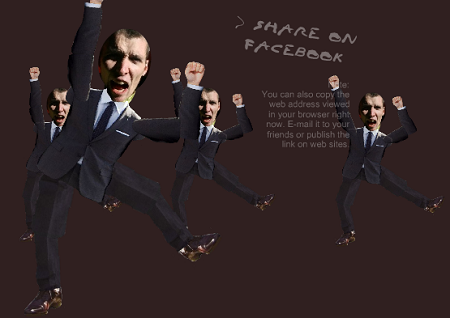
The idea of The Ugly Dance is very simple. You go to the site, upload your picture and you can choose all kinds of maniacal ways of dancing. Here’s me dancing like nobody’s watching:
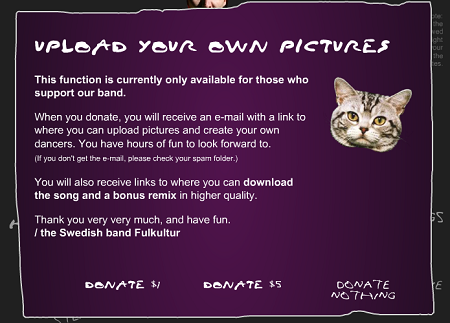
It’s a project by Swedish band Fulkultur and appears to have been around for about half a year now. Obviously, this type of thing spreads. Getting your music heard by a lot of people (and what a catchy song it is). When I wanted to create a second dancer (to send to a friend), I got the following message:
A very reasonable thing to ask… and since I was in such a great mood and figured the donation would not be much effort anyway, I went ahead and gave them some money, even though I think clicking the Donate Nothing button would still allow you to create more dancers (can anyone verify this?).
These videos are the result of the ECOSYSTEM at work!
Perfect example of using something viral to getting your music discovered, but also creating a movement which is easy to join, because it’s obvious what you have to do to participate (also read Derek Sivers’ post about this). Not sure if they’re making any money out of it directly (from the donations), as it might take quite some bandwith to keep this site online, but at least indirectly, by creating an ecosystem and giving them what they want (new music, live shows, merchandise, signed albums, perhaps an Ugly Dance at your own party?).
I’ve been writing a lot about the concept of the ecosystem lately (don’t worry if you haven’t been following, it’s explained again in this post), but only applied to the music business. Obviously, this can be applied to any type of brand, service or product which has a ‘fan’ potential.
A good example of this application of the ecosystem is with companies stimulating their employees to blog. In a reply to a question about this on Quora (GO SIGN UP!), I wrote the following:
What has been enabled in recent years, is the socialization of brands.
It’s no longer about one-way communication via TV and other media, not even about two-way communication (like customer service, mail, emails), but about non-linear many-to-many communication. This creates a new situation.
What few companies could successfully do pre-digital age, almost any company can do now. Starbucks had a massive following and ‘fanbase’ before the digital age, but now all of the members of this following (or ecosystem as I like to call it) can be connected to each other.
The following can be turned into a community. Now, why is it good that large organisations encourage their employees to blog?
These organisations have to be part of their own ecosystem. This works best when it’s done authentically and genuinely (such as via employees). This will strengthen the ties between your ecosystem and the brand, which adds tremendous value for the brand (as well as the customers). It’s a bit of a cliché phrase, oft-repeated by ‘social media experts’, but one has to be part of the conversation.
A brand that is well-connected with their users or customers, is a flexible brand. In times of rapid change, the greatest strength if flexibility. No matter how strong your pillars are… If they’re rigid and get torn down, they will break and shatter.
James Hargreaves made a good addition, which simplifies it even further:
Just to add in more laymen’s terms, a blogging employee adds the ‘human’ element to the ‘face’ of the business, showing a non-corporate means of communicating with consumers, clients, etc.
I firmly believe that anything that can be done digitally will change the system it’s part of, whether that’s a political, economic or social system. The ecosystem is one of the basic rules and models for success in the digital age (if one thoroughly understands the concept, which is easier for digital natives than others). This is not just about the music industry; if your industry has not been impacted yet and part of it is digitizable, then it will be impacted.
With this post I hope to address some of the misunderstanding and fear mongering which surrounds Google SideWiki and other annotation services. First of all, let me explain what Google SideWiki is exactly. Basically, it’s a plugin that you install (via the Google Toolbar) that enables a sidebar on the left side of your browser. In this sidebar, you can comment on any website you visit – whether that site has enabled comments on their own site or not. This means that the website author loses control over the comments placed on the website. The video below shows how it works.
This is not the only annotation service (I prefer AddATweet), but is catching most of the attention since Google’s name is attached to it.
The response to SideWiki has been very mixed. Especially small entrepreneurs seem to be worried, voicing concerns like “what if my competitors start leaving fake negative reviews”.
Here’s how I see it…
It was never your RIGHT to control comments in the first place.
The Internet enabled this and now it’s disabling the control again. In real life, you cannot control what people say about you or your business. Since the Internet makes sharing ones opinions and reviews so easy, you better make sure you adapt to it and do a great job for others and always stay ethical! If not, sooner or later you will be called on it. This is why I also think we shouldn’t worry about competitors that try to spam your site’s SideWiki with negative comments – because if that’s their business mentality, the Web will destroy their reputation.
Google SideWiki and other annotation services make a more transparent web.
For instance, go to any hotel’s website and usually you can see customer reviews. Of course the hotels moderate these reviews, but with the Internet becoming more central to our lives by its increasing mobility (laptops, netbooks, mobile devices), it will get harder and harder to rip people off by not delivering what you promise. You have to meet expectations and exceed them if you want to succeed in a transparent world.
It’s inevitable.
To be honest, I think the cries for a ‘ban’ of Google SideWiki are absolutely ridiculous and show a complete lack of understanding of the Internet. Within the next ten years, augmented reality will become common. This would let people aim the camera of their mobile device at a restaurant and instantly receive reviews in an overlay on the screen of their mobile device – but this will be possible for every and anything. For an example of this, check out Layar in the video below.
People are already leaving comments about your business in channels you don’t own or control.
For instance on Twitter. It was just a matter of time before someone brought the reviews and the subjects of the reviews together. AddATweet has doen that, which is why I prefer AddATweet over Google’s SideWiki; it combines existing social networks with annotation… plus it doesn’t require me to download some toolbar I really don’t need or want.
The problems will solve themselves.
Yes, anonymous commenters might be a nuisance, but how much weight do people really give to such comments compared to a non-anonymous comment? Also, your personality reflects in everything that you do, so if you’re a troll, people will have trouble trusting your business and they’ll leave non-anonymous comments about this through annotation services. Perhaps there are other concerns – let’s talk about them, leave a comment!
In the end, I think these annotation services will do many times more good than bad (if they’ll do any bad at all, besides create a little more clutter to sift through).
So in short, here’s how I think annotation services, like Google SideWiki, will make the world a better place:
– Increased transparency; you can no longer say A and do B. The web will catch up with you.
– Democratization; we get to say what we want, about who we want and make others listen.
– Creating conversation; this will force any business to converse with and listen to its (potential) consumers.
– Collaboration; you can leave helpful hints for others on any website. For instance, if a website is unclear, you can point others in the right direction.
So, suck it up people. You no longer control the conversation – and you never have. If you’re worried about this, adapt your business model to something more ethical and aim to exceed expectations. Be confident! 🙂
Comments? Let’s have a discussion. You can also reach me on Twitter.
UPDATE
Within minutes of posting this, somebody called “SidewikiSux” already tweeted that there’s a lot of “BS” here in his or her honest opinion. Not sure why. Figured I would share this to show the amount of animosity towards Google’s annotation service. Opinions don’t convince me, arguments do… Let’s DISCUSS like mature people.
Recently I released a paper titled the best practices of the online promotion of new musical content. I pushed it through some networks and sent it to contacts I’ve made while studying the music business and the results have been phenomenal. Giving away something good for free really does work! Some highlights.
I submitted it to Techdirt, probably my favourite technology blog, where Mike Masnick blogged about it. This blog post was then mentioned in the daily newsletter of the ASCAP, the American Society of Composers, Authors and Publishers.
It was also posted to the great Make It In Music blog, as a guestpost. Students of the music business course at the NYU were given this paper to read. Someone is even making a Spanish version of it to increase the reach of the paper, especially in Latin America. Thanks Pp! I’ve also been spreading it around LinkedIn with some pretty good results.
Wow!
To be honest, part of the strategy of my thesis was to build some momentum, release it, make it go viral and brand myself as an expert on this topic, but even this paper is making some ripples.
The ironic thing is that in the paper I say that giving away something of value for free can be a great promotional tool… especially if what you’re giving away is easily reproduced and easy to share. The reception of the paper proves exactly that.
Extremely motivated to get that thesis done asap and start utilizing the momentum I’ve built! More soon! 🙂
As the regular readers of my blog probably know, I’m writing my graduation thesis about the future of music distribution. Due to some setbacks and unforseen circumstances, this thesis has suffered some delays. However, using the knowledge and insight I gained in the past month, while studying my thesis’ topic, I have compiled a paper called the Best Practices of the Online Promotion of New Musical Content.
It looks at artists like Radiohead, Nine Inch Nails, Danger Mouse and Sparklehorse, Mos Def, and Groove Armada, and analyzes what they’ve been doing right and wrong and why they’ve been doing it in the first place.
So while you wait for the thesis and the launch of FutureOfMusicDistribution.com, how about going through this 20 page paper? 🙂
To download and read the whole paper, just use this link:
As the regular readers here know very well, I’m quite the techy and invest a lot of time in the social web and the web 2.0 landscape. Doing that, I realize we sometimes take things for granted, so to speak. We feel like YouTube or Facebook have been around for an eternity, but neither of them are more than 5 years old (or open to the public for that amount of time).
The web changes, fast and so does the world around us (which this video reminds us of). Many bloggers and web fanatics, see search engine optimization (SEO) as something holy. If you just figure out the right keywords, manipulate your site’s content in such a way so that the search spiders will crawl your site and give you high traffic rankings, then you’ll be successful.
One of the most important ways in which Google gives page rankings, is links! If your content is linked to often, then it’s worth more than content that is not talked about a lot. To Google, the only content more valuable than that is the content whose publishers will pay for to promote it. Basically, Google assumes that your content is worth talking about, based on the links. The problem that arises now however, is that Google’s becoming less and less able to track the links coming from the most valuable conversations: those on social networks.
Earlier I mentioned Facebook. If you click a link on Facebook, it sends you to the page with a nice and shiny Facebook bar above it. On Facebook a link to this post would look something like this:
Popular social bookmarking service Digg also does something similar. Actually, they’re worse, because Digg is actually hijacking traffic.
Probably the most common SEO killer is the Short URL. Services like TinyURL, Bit.ly, is.gd and tr.im make URLs shorter so they fit into the 140 characters that Twitter offers, or just so that long and ugly URLs look more elegant or are easier to paste somewhere (sometimes email clients tend to mess up really long URLs).
Where will this lead?
Google’s PageRank algorhithm depends on determining what’s worth talking about.
Google tracks this by the number of incoming links and their weight.
Short URLs are becoming increasingly popular, making it increasingly difficult for Google to track what’s worth talking about.
As Google starts having trouble determining what’s worth talking about, people will start using other ways to search for relevant content.
Half the time I’m looking for something, I use Twitter’s search engine. Why? Well, it’s time relevant, personal, let’s you interact with those that share the content and it can reveal trends. Twitter’s engine is still a bit basic and I expect to see some marvellous services that will start rivalling Google in the coming years. OneRiot could be such an engine. Maybe it will be Friendfeed if they reach critical mass so that Friendfeed will not be just for techies anymore.
What do you think? Will social networks mean the death of SEO as we know it?What is SEO anno 2009 and what will it be five years from now?What role will social media play in this?
Share this story on Twitter or Facebook! Here’s the short URL: http://bit.ly/QJ4u0
The influence of new media on current day politics
An essay by Bas Grasmayer
The 20th century was the age of mass media. The impact of radio during the first half of the century and that of television during the second brought politics closer to home. Starting from people grouping around the one radio in their neighbourhood, to the radio in their street, until the point that everyone had a radio in their home. The same happened for television and through these media politics entered the living room. Through sound at first, but later through moving images which became more detailed and more accurately coloured over the course of the last century.
We’re now close to ten years into the new century. Television and radio are still important, but there is a new player in the field of mass media: the internet. This essay will look at how the internet has already influenced politics and hopes to answer, in part, the following question:
How is the World Wide Web as a medium influencing
politics and the government right now?
New Media
In the 2008 US Presidential elections, politicians were seen embracing new media. Barack Obama became microblogging service Twitter’s most followed user and YouTube set up a site called You Choose ’08 dedicated to the elections. On the latter, campaign teams posted videos hoping they would go ‘viral’, a term used to describe the phenomenon of certain content on the internet being spread out through huge networks of users, which is often initially an exponential process. Ron Paul, who was running to become the Republican presidential candidate, had so much support on the internet that TIME magazine at one point commented that due to “his success recruiting supporters through new social media channels” he was “the new 2.0 candidate”.
This is a blog about countries, travel, life abroad, culture shock. Yet this post is about technology. About Twitter, to be exact. Why?
I’ve been “using” Twitter off and on for over a year now, but it was only up until very recently that I really got it. I love it. They only thing I don’t love about it is that many of my friends, readers, family, acquaintances are not using it and I’d LOVE to interact with you via Twitter.
Briefly, Twitter is a service where you can share your thoughts in micro-blogs of max. 140 characters. These messages are shared with your followers who get your updates. They can then choose to interact with you. You can also follow other people for their updates.
Friendsourcing. Got a question? A problem? Let’s say you want to know what the cheapest airline to travel to a particular location in Europe is. Before doing a lot of research, post it on Twitter. Let your friends help you out.
Network inside your niche. Are you a travel blogger? A PR expert in France? A Norwegian expat? An amateur photographer wanting to go pro? You can follow other people in the same position, but also experts in your niche and stay up to date with them. Through Twitter I’ve communicated with Guy Kawasaki, DoshDosh, had some email exchanges with Michael Arrington, got linked by John Chow, (yes, I’m namedropping) and became acquainted with Andy from CommentLuv – he even commissioned me to produce a DJ mix for him. I also met many fellow expats from around the world through Twitter!
Learn about the every day lives of others. You might be a medical student, about to graduate soon, maybe you’d be glad to follow doctors and see what their everyday lives are like as a preparation of your professional life.
It’s the easiest way to stay up to date with friends’ daily lives. Yes, you probably don’t feel like reading all about people’s daily lives. Don’t worry, some people leave maybe 1 tweet per day… and even if you get a lot, you’re not expected to read each and every tweet.
Stay up to date on current events. Twitter was my main source of updates during the recent Mumbai terrorist acts.
Maybe I convinced you… Maybe you just need to try it out and see for yourself. Here’s what you need to do to get a good start on Twitter:
Install Twhirl. After signing up with Twitter, please do yourself a favour and use Twhirl. Nearly nobody uses just the web interface of Twitter… and those that do are the sporadic users (like me, in the past). If you’re doing it right, you’re going to be receiving a lot of Tweets from a lot of different people (Tweeple). Using Twhirl keeps it manageable and pleasurable!
Start following! First of all, find people you know. Have you seen that the authors of blogs you like reading use Twitter? Visit their blog and find out where to follow them on Twitter! Also, use Twitter Search and look for specific things you find interesting. Start following people that write about them. Don’t worry about them possibly not being interesting. It’s fine to unfollow them if they annoy you or you get bored of them. Just grab a lot of people now. Then start selecting later. Here’s a bunch of interesting people to get you started. Oh, and don’t forget to follow me!
Interact. This is where Twitter really gets fun and offers an awesome value. You can communicate with experts in almost any field through Twitter. You see someone posting an interesting Tweet? Reply to them (here’s how).
Tweet! Write about what could fascinate others. Found an interesting link? Share it. Pondering an interesting thought? Put it out there. Need some help? Tweet it! The world is listening.
Promote the fact that you’re Tweeting. Share it on your blog, put it in your email signature, your Facebook status, et cetera. Maybe more people you know are already using Twitter… if not, maybe you’re usage might motivate them to join up. The more, the merrier. After all, that’s why I wrote this post.

 A while ago I posted a