Hurriyet Daily News reports the following:
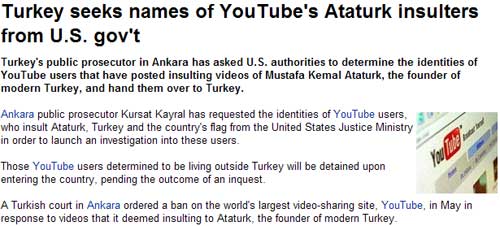
Excuse me? Is this the Soviet Union I’m living in? In the past I’ve made a comparison between Turkey and China regarding the freedom of the press and I also said at the time that it was an exaggerated comparison, as Turkey’s press enjoys a lot more freedom than China’s. But this, this has not been equaled by China, I believe.
This summer we saw American Tibetan activists hold demonstrations in China during the Olympic games; they could not have done that if they got detained upon entering the country. Yes, they were arrested and deported, but only after committing a criminal fact in China. Most of their names could have and should have been known to the Chinese government. They write about the Tibetan cause publicly.
What this prosecuter is asking for is detestable and I am shocked and outraged.
“Those YouTube users determined to be living outside Turkey will be detained upon entering the country.”
Detained and then what? Imprisoned for insulting Turkey? They did not commit any illegal acts if they published these videos outside of Turkey, unless they are Turkish citizens, which might make it illegal. If I were to say “the US is a big pile of smelly cowdung”, I cannot be arrested upon entering the US. If I however threaten someone in the US, particularly government officials, there’s a good case for them to find out my name and to detain me upon entering the country. What this prosecutor is asking for is to limit the freedom of speech with matters pertaining to Turkey worldwide.
The whole YouTube ban is pointless anyway. Research in Alexa.com’s traffic ranking system has shown that YouTube is the 10th most popular site in Turkey. Turkish Prime Minister Erdogan surprised everyone when he stated that even he uses YouTube.
In other news Hurriyet reports the following:
““There was a vigorous internal debate between Wong and her colleagues at the top of Google’s legal pyramid.” Wong, who had to play mediator, decided that Google, by using a technique called IP blocking, would prevent access to videos that clearly violated Turkish law, but only in Turkey. For a time, this solution seemed to work for the Turkish judges, who reopened access to YouTube.
But last June a Turkish prosecutor made a demand that Google block access to the offending videos all over the world, to protect the rights and sensitivities of Turks living outside the country. Google refused, arguing that one nation’s government should not be able to set limits of speech for Internet users worldwide. As a result Youtube has remained blocked in Turkey.”
Me: Hey Twitter! Some guy on your network said my site sucks and used some profanity. I feel really insulted. Can you ban the entire network from saying bad things about me? Oh you can just make it so that my IP address can not see it anymore? Well, I’ll be using proxies to see it anyway, but I’d prefer if you would make any insulting depictions of my site invisible all around the world.
FAIL.
The vice president of the European Parliament’s Human Rights Sub-Committee, Howitt, criticized the ban, saying that around 1,000 websites are blocked in Turkey and this places the country alongside some of the world’s worst nations for cyber censorship.
The information age is here and it’s never going away. You’re a really marvelous country Turkey, but it’s time to do something about these ridiculous prosecutions.
BasBasBas.com is about a Dutch student living in Istanbul. I regularly write about my adventures in Istanbul and travels in the region. If you’d like to stay up to date, you can subscribe to my RSS feed or get email updates in your inbox. You can also follow me on Twitter.