Tag: cwf

  • Catching Up: Ecosystem Music Marketing, Internet Filters, The Clouds and DIY Tips

    Just like a few weeks ago, it’s time to bring you up to date with what I’ve been doing. Showcasing some articles I wrote for Official.fm, Techdirt and Hypebot.

    I did some more writing, but these are the most relevant. Enjoy!

    Keep up with me on Twitter or Tumblr (or Facebook if we have ever physically met).

  • A Catch-Up: DNA-databases, NYT Paywall, DJs Connecting with Fans, and Official.fm

    The busier I get with blogging, the less time I find to blog on here. Classic good news, bad news combination.

    So here’s a quick recap of the articles I wrote, on other blogs, in recent weeks.

    If you really want to keep up with me… Follow me on Twitter or Tumblr (or Facebook if we have ever physically met).

  • The Ugly Dance Case-Study Expanded – Now On Techdirt

    Bas doing the Ugly DanceA while ago I posted a case-study about The Ugly Dance on here as an excerpt of my thesis about marketing music in the digital age. After I published the case-study, the band replied to an email of mine, so I decided to write an expanded version of the case-study for Techdirt.

    You can read the full version over there.

    Here are some excerpts from the band’s email:

    TheUglyDance.com was actually not a result of some great promotional master plan. It just happened.
    On May 17 we released fuldans.se and sent the link to some friends. When I checked the stats a couple of days later a few thousand people had made their own dancers. I could feel something was about to happen. Just the day after someone shared a link on a Swedish blog, and it generated a tsunami of visitors. 30 000 people rushed in in just a few hours. The week after we hade a few hundred thousand hits, and it was a continous struggle to keep the server alive. Two weeks after the release, and 700 000 visitors later, I thought everything was under control. Then the Americans came.
    TheUglyDance.com have had 7 milllion completely unique visitors. A few very kind people have donated, but they are very few. If we should have done anything differently, we should probably have sold T-shirts or something. Something real for the massive amount of visitors to buy.
    .
    Obviously I have one or two ideas of what they could have done and still can do:

    They did a spectacular and exemplary job at getting people’s attention and making the initial connection, but there appears to be no focus at all on retention. There appears to be no link to the band’s MySpace, which they were trying to promote. Due to the fact that most people are on Facebook and Twitter now, I think it would have been a better idea to put those links in the foreground, but most importantly; there has to be a way for people to connect. A simple Facebook ‘Like’ button below the Flash application would have gone a long way.

    From a marketing perspective, asking for a donation or getting people to buy your music out of sympathy is a bad business model. As Mike always says, it’s about giving fans a reason to buy. A good thought experiment is to imagine a totally selfish consumer and to see what you could offer them so that they spend money on you. They should spend it for themselves, not for you.

    This means making sure you retain as much of the original traffic as you can without getting obtrusive. This means shining a light on the early followers and encouraging them in what they do, because they’re helping you amplify your message and are providing social proof. At the same time you should connect these people to each other, forming an ecosystem.

    The business models simply come from listening to the ecosystem and playing into their desires (just like Younger Brother did).
    .
    In the end, giving fans a great reason to buy is the ultimate way of connecting with them.

    But seriously, just head over to Techdirt and check out the full version. While you’re at it, let’s connect: Twitter | Quora | LinkedIn (be sure to include the fact that you found me via my blog when adding me on LinkedIn).

  • Thesis Excerpt: Connecting With Fans deadmau5-style (Mini-Case Study)

    When I first heard deadmau5‘ work 3 or 4 years ago, I was immediately excited. Here was a guy doing something new, developing a sound that was completely his own. Even though he was only known by perhaps a few dozen people per country, it was obvious that this guy was going to be influential and blow up.

    He has pulled it off in a spectacular way (awesome branding) and when I finally started following him on Facebook, I was thrilled with his level of engagement with his fanbase, or ecosystem (remember?).

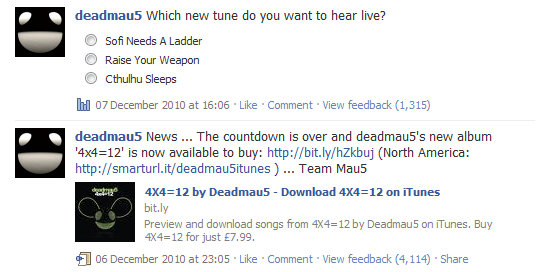
    In the beginning of December, this interesting development took place, where deadmau5′ marketing team decided they should get involved in communicating to his fans.

    Poll: what is your favorite track on the new deadmau5 album?

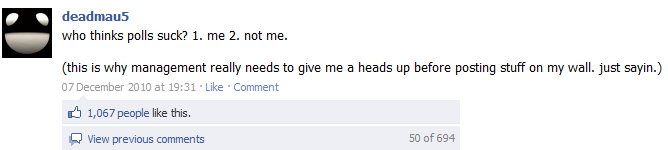
    Apparently deadmau5 didn’t like the fact that his management was disturbing the trust and rapport he had built up with the ecosystem, because those status updates were followed by deadmau5’s:

    Who thinks polls suck? 1. Me. 2. Not me.

    Then he checked the backend of his Facebook page…

    deadmau5 removing page admins

    Excellent choice, in my opinion. This is the best thing he could do to earn back the trust of the ecosystem, because you really don’t want to get on the bad side of the ecosystem. The ecosystem can reject you, the ecosystem can move on, the ecosystem doesn’t need YOU in order to survive.

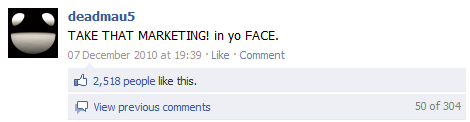
    And the cool thing is, he wasn’t thinking about marketing or self-preservation or strategy in the process of making his choices. It’s just him, genuinely. And I guess the status update he posted 1 minute later shows just that:

    Take that marketing, in yo face!

    Lesson learned: keep it personal and have fun in the process!

    Oh, and I do not recommend everyone to get into a fight with their management, because you can get fired from your label, but maybe you’re better off without that particular label anyway.

    Now, let’s chat on Twitter.


    P.S. Ok, it’s not a thesis excerpt, but it will find its way into my thesis somehow. Click here to subscribe to email updates on my thesis (for excerpts, subscribe to this blog or just bookmark it).

    P.P.S. Yeah, the formatting and text sizes are a bit off. I suck at screenshots, sorry. 😉

  • Music Biz 2.0: A Lesson on Interactivity

    I just came across a blog post which compared the music industry to the gaming industry and made some very valid points. A short excerpt:

    Just as the video game industry has continually adapted and reinvented itself in the last few decades – arcades to consoles to mobile to online to apps to ad-supported and so on – the music industry must learn to quickly spot new consumer trends and behaviors, and then adapt the technology and business models to turn those trends into new revenue streams.

    • Consumers like to be social while they are entertained. This was always true to a degree, but now even the solo-music device (the portable player) has been flipped to become the most social device (thank you, iPhone apps).
    • Consumers expect to personalize everything. We always saw it in mix tapes and remixes, but that was the domain of hardcore music lovers. Now, personalization is just an expected standard feature.
    • Consumers don’t simply want to socialize, they want to compete. Socializing isn’t simply about talking to each other and sharing, it’s about showing who is king of the hill.

    My thoughts: YES! Exactly.

    The huge advantage games have over music, is that games are designed to be interactive (since games were invented), while music has lost much of its interactivity since the invention of recording technologies. While the gaming industry has always had its eyes on interactivity, the music biz completely forgot about this, which brought out a very awkward situation when it was forced upon the music biz (eg. suing fans, going bankrupt, stifling innovation).

    I think the best business model is an INTERACTIVE business model. This doesn’t mean that the music itself has to be interactive, but the experience of the music, the music-fan, the artist-fan, the label-fan, and the fan-fan relationship should be as interactive as possible. This interactivity is much easier to monetize and much more rewarding for fans to engage in (and also for the artists).

    Some examples:
    Music to fan, fan to music interactivity: a service that easily lets people make a mixtape of their favourite songs. Free to stream and share, and very cheap to download for high quality audio. Eg. 1 or 2 dollars per half hour / 7 songs. The service automatically detects intro’s, outro’s, bpm’s and keys and decides how best to merge them, if people don’t like it, they can edit it themselves via an interface such as the MixMeister one. This is not really viable for a label (not the core business), but a great idea to license one’s music to if such a service was developed.

    But as a label you could also just create a site where people can buy an album in the original version, or play with the a capella’s and (extra) instrumentals, to personalize it in their own way and then buy that version. If you create something awesome, you inspire others to want to create as well, so give them a hand 🙂

    Something I noticed after making this write-up, the blog’s author company does a great job at providing this music-fan interactivity too. Go check MXP4 out!

    Artist-fan interactivity: wow, so many business models can be tied to this one! First of all, one should always be connecting with fans, because you can monetize the relationship. Attach freemium models and you’re getting somewhere. Example: give away your album for free, sell a high quality digital copy for cheap, sell a traditional CD with cool booklet for double, sell it with an autograph for 50% more… want a special greeting from the band’s favourite member on YouTube (see the Old Spice channel for examples)? Buy 2 CD’s! Or whatever (play around with the formula’s to see what works best for you). Endless opportunities.

    Label-fan interactivity: many many possibilities here. For instance, invite people to actively participate in the development of new artists… Every label can have its own ‘X-Factor’ type of stuff. Get that sponsored, get income. Get people actively involved, and committed to getting their favourite artist signed (or new album developed and released) and they’ll do the promotion for you and probably spend money on some premium product too (or you can give it away if you’re really impressed by the job they’re doing as promoters).

    Fan-fan interactivity: create a tribe, as Seth Godin would put it. When Die Antwoord suddenly blew up, everyone was going to their website to check out the album, because they could stream it there, but it was not yet for sale. The missed opportunity there: they had all those people sharing the same enthusiasm and passion at the same time, but they were left unconnected. What you could do for an online album release party: make a stream of the album that is set to start at a certain time. The stream is static, but you let users chat with one another. To chat, they have to use Facebook Connect or Twitter to log in (making it easier to connect with one another). If fans are connected, they will stimulate each other’s passion.

    Of course you could also make some badge system, as a label, where you give people badges for attending x shows by label artists, buying x stuff from the website, getting x new active members to the community, etc etc. The badges can then be cashed in for a guest list spot (let them bring a friend, to create a new fan) or for % off, on the merchandise.

    Plus you can keep leaderboards and do some very special things for the biggest fans!

    Man, the music biz could be so awesome right now. It is time to WAKE UP!

    Thoughts? Feel free to comment, or hit me up on Twitter.

    More? Read my paper on the best practices of the online promotion of new musical content (don’t worry, it’s free).
Related Posts Widget for Blogs by LinkWithin