Tag: censorship

  • Training Our Kids to Be Hackers

    Due to the recent case against The Pirate Bay in The Netherlands, which could render The Pirate Bay inaccessible to Dutch internet subscribers, I decided to look at ways that I could access the site if it were to get banned. Not because I want to download copyrighted material from it, but because it’s one of the best ways to distribute my DJ sets to fans. If it were to get banned, the Dutch court would sever a great distribution channel that can be (and IS) used in legal ways too.

    It’s not just this case that makes me wonder, but also the fact that Dutch ISPs are required to store the surfing history of their clients for 12 months. They are required to keep a whole list of information, which can be seen at the previous link. Since I don’t trust my backwards, Christian democrat government with my data, let alone the possibility of a right-wing extremist gaining access to it after the next parliamentary elections, I decided to look into proxies.

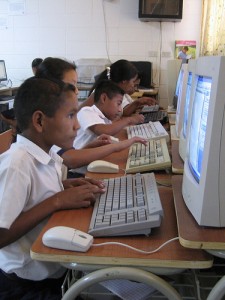
    Then I realized something. Monitoring users and infringing on their privacy, but especially restricting a medium like the internet, turns users into hackers. For instance, a lot of kids are fascinated by hackers – not just because of the picture Hollywood paints of them, but also because they face a lot of restrictions on the internet. Filters on their computer or browsers at home, even worse filters at libraries or their schools, etc. So they figure out how to dodge these filters.

    It’s no coincidence that in countries like Iran, or China, which have some of the most restricted internet connections in the world, there are very high amounts of hackers. This should be a warning to those trying to control the flow of information on the internet by banning sites: we, the Internet users, will become better at dodging your filters and will become even less trackable than we are now.

    What this means to the content industries (movies, music) is that right now there’s a huge database of information on the use and downloading of music. If the ‘pirates’ weren’t so scared of the industries, they wouldn’t be so anonymous and the information would be even more useful for things like testing popularity of music, but also marketing music to the right people.

    Another example are the recent calls in Germany to block right-wing extremist websites. The problem with this is that it will only drive this movement underground, making it harder to track them and to prevent hate crimes. They’re already getting more internet savvy. Instead of spending so much time discussing how they can censor such websites (which will NOT decrease the amount of people with right-wing extremist tendencies), maybe they should look at how they can profile different types of people that fall prey to extremist thoughts and think of ways to integrate them into society, instead of alienating them further and making them more extreme.

    By blocking our access, we’re turned into hackers. We go underground. At that point, you lose your opportunity to monetize or to influence us via our favourite medium. You’re not disconnecting us from our favourite sites, you’re disconnecting yourself from us.

    Image by LShave, shared under a Creative Commons license on Flickr.

    If you liked this post, consider subscribing to my RSS feed (Firefox users, check out Feedly) or follow me on Twitter @Spartz.
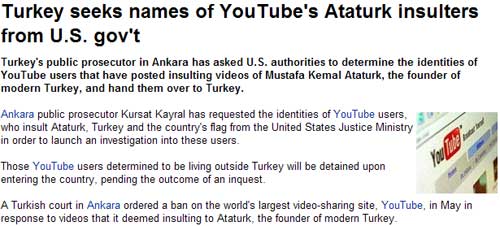
  • Turkey seeks names of YouTube’s Ataturk insulters from U.S. government

    Hurriyet Daily News reports the following:

    Turkey seeks names of YouTube's Ataturk insulters from U.S. gov't article

    Excuse me? Is this the Soviet Union I’m living in? In the past I’ve made a comparison between Turkey and China regarding the freedom of the press and I also said at the time that it was an exaggerated comparison, as Turkey’s press enjoys a lot more freedom than China’s. But this, this has not been equaled by China, I believe.

    This summer we saw American Tibetan activists hold demonstrations in China during the Olympic games; they could not have done that if they got detained upon entering the country. Yes, they were arrested and deported, but only after committing a criminal fact in China. Most of their names could have and should have been known to the Chinese government. They write about the Tibetan cause publicly.

    What this prosecuter is asking for is detestable and I am shocked and outraged.

    “Those YouTube users determined to be living outside Turkey will be detained upon entering the country.”

    Detained and then what? Imprisoned for insulting Turkey? They did not commit any illegal acts if they published these videos outside of Turkey, unless they are Turkish citizens, which might make it illegal. If I were to say “the US is a big pile of smelly cowdung”, I cannot be arrested upon entering the US. If I however threaten someone in the US, particularly government officials, there’s a good case for them to find out my name and to detain me upon entering the country. What this prosecutor is asking for is to limit the freedom of speech with matters pertaining to Turkey worldwide.

    The whole YouTube ban is pointless anyway. Research in Alexa.com’s traffic ranking system has shown that YouTube is the 10th most popular site in Turkey. Turkish Prime Minister Erdogan surprised everyone when he stated that even he uses YouTube.

    In other news Hurriyet reports the following:

    “There was a vigorous internal debate between Wong and her colleagues at the top of Google’s legal pyramid.” Wong, who had to play mediator, decided that Google, by using a technique called IP blocking, would prevent access to videos that clearly violated Turkish law, but only in Turkey. For a time, this solution seemed to work for the Turkish judges, who reopened access to YouTube.

    But last June a Turkish prosecutor made a demand that Google block access to the offending videos all over the world, to protect the rights and sensitivities of Turks living outside the country. Google refused, arguing that one nation’s government should not be able to set limits of speech for Internet users worldwide. As a result Youtube has remained blocked in Turkey.”

    Me: Hey Twitter! Some guy on your network said my site sucks and used some profanity. I feel really insulted. Can you ban the entire network from saying bad things about me? Oh you can just make it so that my IP address can not see it anymore? Well, I’ll be using proxies to see it anyway, but I’d prefer if you would make any insulting depictions of my site invisible all around the world.

    FAIL.

    The vice president of the European Parliament’s Human Rights Sub-Committee, Howitt, criticized the ban, saying that around 1,000 websites are blocked in Turkey and this places the country alongside some of the world’s worst nations for cyber censorship.

    The information age is here and it’s never going away. You’re a really marvelous country Turkey, but it’s time to do something about these ridiculous prosecutions.

    BasBasBas.com is about a Dutch student living in Istanbul. I regularly write about my adventures in Istanbul and travels in the region. If you’d like to stay up to date, you can subscribe to my RSS feed or get email updates in your inbox. You can also follow me on Twitter.

  • Germany Shuts Down Wikipedia, Earthquake Hits Sofia, Brazilian Bloggers Take To Streets

    Thank God I didn’t wake up with a hangover today. Where to begin!

    Germany Shuts Down Wikipedia

    Censorship’s creeping up on us. Just 3 weeks ago I wrote about Turkey’s ban of Blogger/Blogspot, which I didn’t write about because I specifically care about Turkey’s internet, but because I care about the freedom of the internet. I’m sure a lot of visitors were able to stay detached from the situation and not care so much, maybe this time the news will have more impact because even Germany is guilty of web censorship now.

    Lutz Heilmann, a German parliament member, took legal action against Wikipedia, because of an article mentioning his alleged involvement in the Stasi, Eastern Germany’s secret police during communist time. Great job in proving you’ve not been a member or showing that you’ve changed by getting the web censored, it’s almost like if the police called for web censorship after being accused of Gestappo practices. Oh wait, that actually happened.

    What happened in Germany is that www.wikipedia.de no longer links to wikipedia.org, the main site of wikipedia. The German version of Wikipedia is still available through de.wikipedia.org.

    It looks like Heilmann realized what kind of shitstorm his legal procedures were starting to bring down on him and before accidentally flushing his future political career down the toilet and he issued a press release (in German) saying that Wikipedia can make Wikipedia.org accessible via Wikipedia.de again. He also adds that it wasn’t about censorship for him. Hey, guess what, this is exactly what China says too. Good job, Lutz.

    More at TechCrunch.

    Earthquake Hits Sofia, Bulgaria

    Last night after coming home from meeting with Hans, a Dutch expat and international communication specialist in Istanbul, I had an email in my inbox from my girlfriend telling me that there was an earthquake in Sofia. She’s fine, her family’s fine and I believe my friends are all safe, since I already spoke to those living closest to the epicenter. It was a 4.0-magnitude (Richter scale) earthquake lasting 2.3 seconds.

    This morning there was an aftershock, which was less heavy.

    More at Novinite.

    Brazilian Bloggers Take To Streets

    Coming back to the topic of internet freedom, Brazilian bloggers and internet junkies (in the good sense of the word) took to the streets in São Paolo to demonstrate against the Digital Crimes Bill, which defines cyber-crimes and stipulates penalties accordingly. Bloggers feel the bill, which was passed by the Brazilian Senate in July, is too loosely formulated and might lead to over-surveillance of the internet at the cost of freedom of speech and expression.

    More at Global Voices.

    What are some of the best initiatives you have seen regarding the freedom of speech on the internet? Or, completely unrelated, have you ever been in an earthquake?

    Stay updated. Follow my Twitter feed, or subscribe to this blog by RSS or email.

  • Dutch Police Union Head Calls for Web Censorship

    In response to the intimidation of a Dutch police woman, both on- and offline, head of police union ACP, Geert van de Kamp, has called for web censorship.

    An investigation has been launched into the intimidation of the police woman, who works for the foreign police of The Netherlands. In the night of Monday to Tuesday, unknown people vandalized the front door of the police woman’s house with red paint.

    Also, the tires of the police woman’s car were slashed.

    A group called the Winterschilders (Winterpainters) claimed responsibility for the act by posting a message on indymedia.nl, which included the full name and address of the police woman (and a picture, claims the police union). Their message reads:

    Tonight The Winterpainters visited XXX, foreign police, XXX, XXX. (XXX replacing her personal data which have been removed by indymedia)

    Her frontdoor got some red paint on it; symbol for the blood of the people that suffer due to the practices of the foreigner police.
    We also made sure she couldn’t get to her work quickly today (flat tires).
    This is a warning to all her colleagues of the modern gestapo (foreign police, immigration and naturalisation service, justice dept.).

    You are responsible for what you are doing.
    Stop it.

    The Winterpainters

    Gerrit van de Kamp, head of police union ACP, calls the incident “unheard of”, saying this “absolutely cannot and may not happen again.” And what better way to react to Gestapo accusations than calling for censorship?

    Van de Kamp wants to ask the ministers of Justice and Internal Affairs to make it impossible to publish messages like the above on the internet, saying it should be “technologically possible” to filter such messages.

    Gerrit van de Kamp, you are either unaware of what exactly is “technologically possible” or you are calling for censorship. In a statement on ACP’s website, you call for “preventive measures to prevent name & address data of police people to be posted on the internet”. That’s a lot more nuanced and understandable, yet it is impossible to put such filters in place without seriously endangering the freedom of the citizens you’re serving. You are asking for ISPs to filter what their users are posting to the internet:

    • Should the ISPs report every filtered instance to the police?
    • How will the “technologically possible” filter prevent innocent people from being censored?
    • What prevents the government from adding more and more terms to the filter once it is in place?

    Such a filter would be a step towards fascism. Yes, you have the duty to protect police staff, as do we, as Dutch citizens, but you are calling for a very extreme measure. The internet shall not be filtered, instead, prosecute websites or people that post this data on the internet. Call for tough laws and higher penalties to discourage people from committing these acts. That way it will be the websites’ responsibilities to filter the content posted to them.

    Also, there have been many reports over the last 5 years about ill-treated asylum seekers and there has been a lot of protests about this, this incident being the most extreme protest thus far. Maybe it actually is time for the government to have another look at what’s going on and punish those responsible for incidents.

    The suggested measure in your reaction is disproportionate. Please reconsider.

    That will be all.

    Spread the news! Digg or Stumble this post or use any other service using the Bookmark button below.

    If you would like to stay up to date to this and more, please subscribe to my RSS feed or email updates.

  • Blogger/Blogspot unblocked in Turkey while court awaits missing evidence

    Right now, Blogger and *.blogspot.com domains are available again while courts await further evidence backing Digiturk’s claims. Great. Let’s hope it stays that way. After YouTube got unbanned, it got banned again, so who knows what will happen.

    The ban has been lifted by the Turkish court that previously blocked Blogger last Friday. They have requested “missing evidence” but made it clear that the ban could be reintroduced after the legal procedure is completed by the prosecutor.

    Digiturk, Turkish license holder for the broadcasts of Turkish football league games, asked for blogs with links to pirated streams to be removed. Blogger did not reply and Digiturk went to court, getting millions of innocent blogs blocked. The statement that “Blogger did not reply” makes me think all Digiturk did was send out an email – and as some of us know, if you email Google services, be prepared to wait two weeks. They should have called.

    The law that allows for the blocking of domain names still stands. Many popular sites are still blocked. Blogger can be blocked again. It’s not over, but at least Blogger’s available again. Yet still we can expect to see more of this:

    And the protest banner posted on Turkish (as well as international) blogs hosted at blogspot.com:

    Thanks to Hans for his useful tip!
    Thanks to the Istanbulian for further information.

    Help get the news out. Stumble, Digg, Slashdot, Reddit or Tweet it!


    Stay updated. Follow my Twitter feed, or subscribe to this blog by RSS or email.

  • Digiturk causes Turkish ban of Blogger/Blogspot

    Since Friday, it’s been impossible to access popular blogging platform Blogger or any *.blogspot.com domain from a Turkish IP address, due to a ban imposed by a court in the south east of Turkey.

    Previously it was rumoured that Adnan Oktar, by some considered the leading Muslim advocate for creationism, might have caused the new ban, since he successfully got WordPress and Google Groups banned in the past, as well as evolutionary biologist Richard Dawkins’ website. However, this rumour was refuted by someone pointing out that Oktar operated in Istanbul courts and the verdict banning Blogger was passed in Diyarbakır, at the other side of Turkey.


    Blogger's banned in Turkey screenshot 

    Click to enlarge.

    It’s now reported that it is not Oktar that got Blogger banned, but Digiturk, a subscription based digital TV platform that owns the rights to the live broadcasting of Turkish football league games. Apparently, Digiturk asked Blogger to take several blogs or blog entries down containing links to pirated transmissions of the live games. Blogger did nothing, Digiturk went to court and under Turkish intellectual property law, they managed to get Blogger banned completely, effectively banning millions of websites that have nothing to do with Turkish football or pirating.

    Digiturk’s court cases in the past have managed to block Justin.tv and MyP2P TV for the same reasons.

    Turkey’s NATO membership and EU ambitions seem paradoxical to the infringement on the freedom of press and speech of its citizens, residents and visitors by banning sites like Blogger and YouTube. The EU’s making a blacklist of censoring countries and are creating software for people in these countries to use to bypass the censorship (see: Global Online Freedom Act).

    Thanks to safak for his tip about Digiturk!

    Some useful links to unblock YouTube/Blogger (blogspot)/other blocked pages in Turkey:

    Help get the news out. Stumble, Digg, Slashdot, Reddit or Tweet it!

    Stay updated. Follow my Twitter feed, or subscribe to this blog by RSS or email.

  • Turkey Bans Blogger

    UPDATE!! — It is now known why Blogger is banned in Turkey. Click here for the new article.

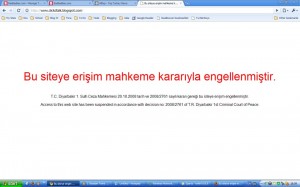
    Since today, whoever tries to access Blogger or any *.blogspot.com domain from Turkey will get the following message on my screen:

    Blogger's banned in Turkey screenshot

    Click to enlarge.

    This is the same message we get if we try to visit YouTube, which is also banned in Turkey. In the past blogging platform WordPress.com has been banned as well (read more), to much dismay of many Turkish bloggers.

    It was suspected that the reason for this has something to do with Adnan Oktar, by some considered the leading Muslim advocate for creationism, who has in the past managed to get WordPress, Google Groups, as well as Richard Dawkins’ website banned. It was then suggested however, that Oktar was active in Istanbul courts and this verdict was passed in Diyarbakır in South East Turkey.

    UPDATE – It is now known that it was Digiturk, not Adnan Oktar, that caused the ban. Read the new article here: 
    http://www.basbasbas.com/blog/2008/10/26/digiturk-causes-turkish-ban-of-bloggerblogspot/

    Turkey’s EU ambitions seem paradoxical to the infringement on the freedom of press and speech of its citizens, residents and visitors by banning sites like this. This is not China. This has to stopped. Good thing the EU’s making a blacklist of censoring countries and are creating software for people in censoring countries to use to overcome the censorship (Global Online Freedom Act).

    The court order of the ban on Blogger is also in very stark contrast to yesterday’s court approval of gay and group sex. Turkey’s a country of opposites.

    Some useful links to unblock YouTube/Blogger (blogspot)/other blocked pages in Turkey:

    Help get the news out and Digg this article or Stumble it or Buzz it!

    Stay updated. Follow my Twitter feed, or subscribe to this blog by RSS or email.

Related Posts Widget for Blogs by LinkWithin