Tag: US

  • Turkey seeks names of YouTube’s Ataturk insulters from U.S. government

    Hurriyet Daily News reports the following:
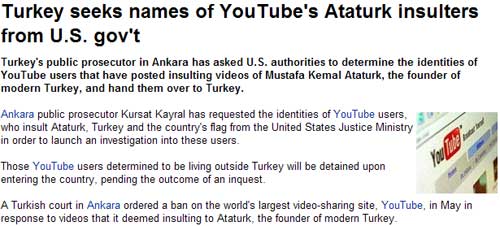
    Turkey seeks names of YouTube's Ataturk insulters from U.S. gov't article

    Excuse me? Is this the Soviet Union I’m living in? In the past I’ve made a comparison between Turkey and China regarding the freedom of the press and I also said at the time that it was an exaggerated comparison, as Turkey’s press enjoys a lot more freedom than China’s. But this, this has not been equaled by China, I believe.

    This summer we saw American Tibetan activists hold demonstrations in China during the Olympic games; they could not have done that if they got detained upon entering the country. Yes, they were arrested and deported, but only after committing a criminal fact in China. Most of their names could have and should have been known to the Chinese government. They write about the Tibetan cause publicly.

    What this prosecuter is asking for is detestable and I am shocked and outraged.

    “Those YouTube users determined to be living outside Turkey will be detained upon entering the country.”

    Detained and then what? Imprisoned for insulting Turkey? They did not commit any illegal acts if they published these videos outside of Turkey, unless they are Turkish citizens, which might make it illegal. If I were to say “the US is a big pile of smelly cowdung”, I cannot be arrested upon entering the US. If I however threaten someone in the US, particularly government officials, there’s a good case for them to find out my name and to detain me upon entering the country. What this prosecutor is asking for is to limit the freedom of speech with matters pertaining to Turkey worldwide.

    The whole YouTube ban is pointless anyway. Research in Alexa.com’s traffic ranking system has shown that YouTube is the 10th most popular site in Turkey. Turkish Prime Minister Erdogan surprised everyone when he stated that even he uses YouTube.
    In other news Hurriyet reports the following:

    “There was a vigorous internal debate between Wong and her colleagues at the top of Google’s legal pyramid.” Wong, who had to play mediator, decided that Google, by using a technique called IP blocking, would prevent access to videos that clearly violated Turkish law, but only in Turkey. For a time, this solution seemed to work for the Turkish judges, who reopened access to YouTube.

    But last June a Turkish prosecutor made a demand that Google block access to the offending videos all over the world, to protect the rights and sensitivities of Turks living outside the country. Google refused, arguing that one nation’s government should not be able to set limits of speech for Internet users worldwide. As a result Youtube has remained blocked in Turkey.”

    Me: Hey Twitter! Some guy on your network said my site sucks and used some profanity. I feel really insulted. Can you ban the entire network from saying bad things about me? Oh you can just make it so that my IP address can not see it anymore? Well, I’ll be using proxies to see it anyway, but I’d prefer if you would make any insulting depictions of my site invisible all around the world.

    FAIL.

    The vice president of the European Parliament’s Human Rights Sub-Committee, Howitt, criticized the ban, saying that around 1,000 websites are blocked in Turkey and this places the country alongside some of the world’s worst nations for cyber censorship.

    The information age is here and it’s never going away. You’re a really marvelous country Turkey, but it’s time to do something about these ridiculous prosecutions.

    BasBasBas.com is about a Dutch student living in Istanbul. I regularly write about my adventures in Istanbul and travels in the region. If you’d like to stay up to date, you can subscribe to my RSS feed or get email updates in your inbox. You can also follow me on Twitter.
  • Drugs, Prostitution and Same-Sex Marriage

    That’s the title of a 10-15 minute presentation I’m giving soon for my Intercultural Communication classes at Yeditepe University, here in Istanbul. I designed it in such a way that it can also be enjoyed without my vocal explanations and here it is!

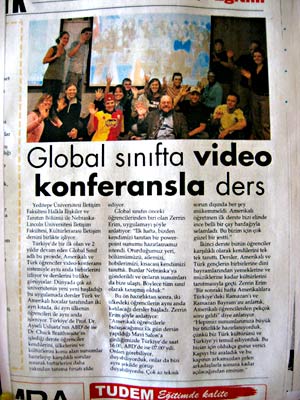
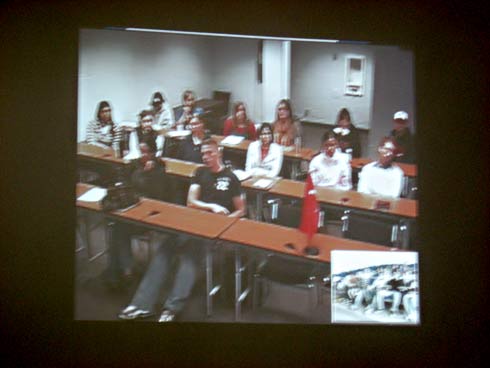
    The Intercultural Communication course is likely to be the most innovative course I’ve taken during my higher education (sadly — universities should make more use of modern technologies). Every Tuesday, we get into a classroom at 4 o’ clock in the afternoon and have a video conference with a class in Lincoln, Nebraska, US. We present ourselves, our culture, customs, daily lives and our countries to each other. It’s fascinating, because both the Turkish class as well as the American class have students from many different backgrounds.

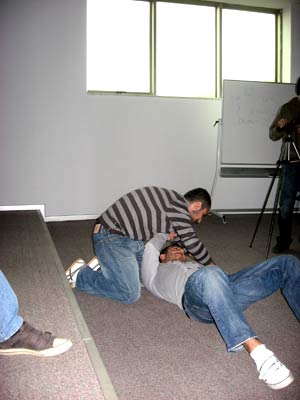
    This part of the Intercultural Communication course, called Global Classroom, has been quite fun so far. We’ve managed to make 2 students from the Nebraskan class dance in front of the camera and they’ve managed to make 2 of our students wrestle in front of the camera (or was it Jiu-Jitsu?).

    There’s only a few sessions left, so I hope I actually get to do my presentation, as our lecturer wanted everyone to prepare one, but there will be no time to actually execute all of them.

    I hope the presentation has given you an insight into Holland’s liberal policies and if you have any questions please feel free to reply. I love answering questions about these issues.

    How about in your countries, how is your government dealing with these issues? What is your personal opinion on these matters? Has the war on drugs failed? Is same-sex marriage morally wrong or is keeping it illegal a form of discrimination? What about prostitution?

  • Obama Elected, The World Rejoices – Turkey, Macedonia Perhaps Not So Much

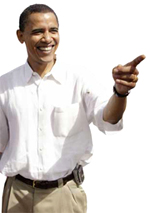
    Even though sentiments are mixed in the US, around the whole world people have reacted enthusiastically about Obama‘s election. People around the world have had more than enough of Bush’ policies and were hoping for a change. Change being the keyword of Obama’s campaign and McCain being associated with Bush, caused the most people to be more favourable towards Barack Obama. The website If the world could vote? shows that all over the globe, more people were rooting for Obama than for McCain.

    Obama is young, ‘black’, a Democrat and instills hope, whereas McCain was seen as very similar to Bush, partly due to employing similar tactics to the ones of former Republican campaigns.

    One country that seemed significantly pro-McCain on aforementioned If the world could vote? is Macedonia. Why? The Republic of Macedonia borders Bulgaria, Greece, Albania, Serbia and Kosovo. Not the easiest region for a country. Greece refuses to recognize ‘Macedonia’ as their name, one of the reasons being a similarly named province in northern Greece, and Macedonia is thus referred to in the UN as The Former Yugoslavic Republic of Macedonia (FYRM). It’s a very complex issue. McCain has been very outspoken about recognizing Macedonia by its constitutional name, whereas Obama has been more careful about it.

    Randy Scheunemann, a McCain adviser said the following about NATO membership bids:

    On Albania, Croatia and Macedonia, Senator McCain has been strongly outspoken in support for including them. They are ready. In the case of Macedonia, they’ve been a membership action plan for eight or nine cycles.

    With respect to the Greek concerns, the United States recognizes Macedonia under its constitutional name.

    And he certainly hopes that there’s not going to be this throwback to the 19th century style of Balkan politics, and the Greeks throw a red card on the membership of Macedonia.

    Since this is a very big issue in Macedonia, as territorial, cultural and national integrity always are in the Balkans, it’s no wonder people in Macedonia were hoping for McCain to win.

    As for Turkey, people might be happy to see a change in government. Bush’ unpopular policies have led to an increase in anti-Americanism around the world. In June, a Pew poll found that out of 47 countries, Turkish people had the least favourable view of the United States (source: The New York Observer). In that sense, Obama will be a welcome change.

    It is hoped that the new President will aid Turkish efforts against the PKK and the Kurdish insurgency in the Iraqi border area, support the EU’s membership bid and put pressure on European politicians, and support Turkey in its process of becoming a modern, democratic country. It’s not expected that Obama will aid Turkey’s military efforts or put significant pressure on the EU to get them to admit Turkey.

    Moreover, just one day before the elections, Obama renewed his commitment to recognize the Armenian genocide, a very sensitive issue in Turkey. McCain “never pledged to label the Armenian killings as genocide and is seen by the U.S. Armenian community as a politician against or indifferent to Armenian matters” (Turkish Daily News).

    Turkey’s foreign policy adviser to Prime Minister Recep Tayyip Erdoğan said “the formal recognition by the United States of genocide would seriously damage U.S.-Turkish ties and hurt Turkey’s efforts for reconciliation with Armenia” after meeting Phil Gordon last week, a senior foreign policy adviser to Obama.

    Turkey is an important ally (NATO member) and trade partner to both the US and EU, as it has a stabilizing presence in the Middle East, often mediating in Arabic-Israeli talks.

    Looks like Obama will have a lot on his hands when he takes office in January.

    Increase your understanding! Here’s some useful links:

    Like this post? Please give it a Stumble or a Digg or use the +Bookmark button below to add it to any popular social bookmarking service!

    What are your perspectives on this? Have your say in the comments!

    More about Turkey? Subscribe to this blog’s RSS feed or follow me on Twitter! You can also subscribe for email updates.

Related Posts Widget for Blogs by LinkWithin