Category: society

  • Why the announcement that radicals would hijack Dutch student protests is just spin-doctoring

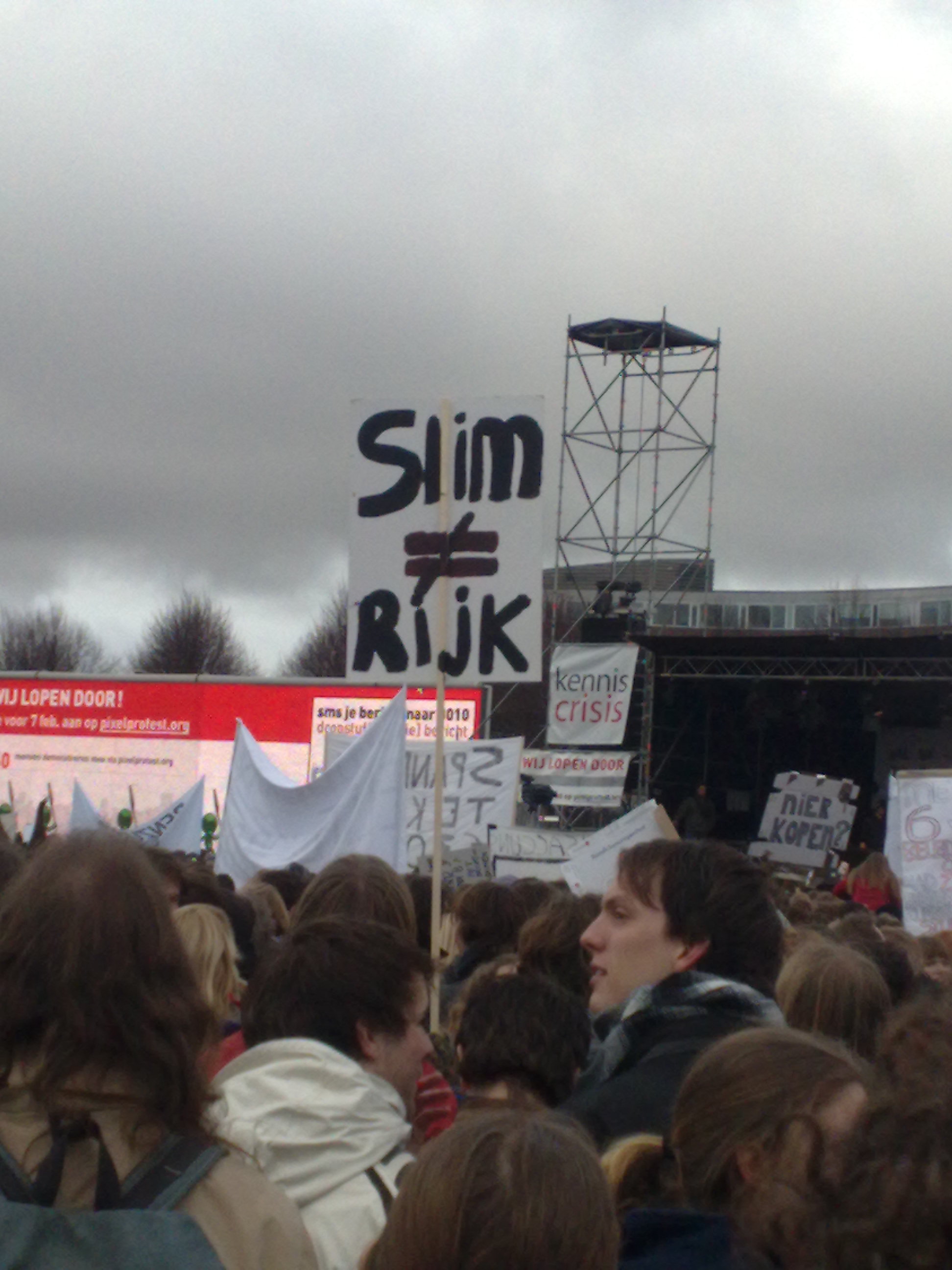
    Protester holds a sign that says "smart does not equal rich"Leading up to the organized student manifestation against the financial cuts in higher education, there were a bunch of news reports about there being ‘signals‘ that radicals would come and hijack the protest and try to create riots. Radicals was obviously never defined, but at the time I didn’t think much of it. A little while later, I realized what a genius piece of spin-doctoring it had been.

    What the message did, was create an expectation of radicals getting violent. For one, radicals can mean football hooligans, for another it can be anarchists, or communists, or foreigners, or anything else which they perceive as dramatically different than them. The manifestation itself was more like a political rally more suitable for election time. When students decided to go to the political quarters to let themselves be heard, they were met by police and violence ensued.

    The spin makes it seem like the violence was caused by radicals. I think it was caused by upset students. The difference?

    For any government, it’s important to create the impression that the general population is content with the government. The label ‘radicals’ was defined by a set of actions and expectations (mainly disobedience and perhaps violent actions or rioting), so when normal people acted this way, they became radicals. This makes sure that ‘normal people’ don’t identify with these radicals (formerly known as normal people).

    Identification creates understanding creates support. The last thing a government which plans to make drastic financial cuts and reforms wants, is people supporting a disobedient protest movement.

    Most of the (25) people arrested last Friday were obviously not radicals. They were students. They were normal people (they still are). They were people like you and me.
  • Companies, employee blogs and the ecosystem

    I’ve been writing a lot about the concept of the ecosystem lately (don’t worry if you haven’t been following, it’s explained again in this post), but only applied to the music business. Obviously, this can be applied to any type of brand, service or product which has a ‘fan’ potential.

    A good example of this application of the ecosystem is with companies stimulating their employees to blog. In a reply to a question about this on Quora (GO SIGN UP!), I wrote the following:

    What has been enabled in recent years, is the socialization of brands.

    It’s no longer about one-way communication via TV and other media, not even about two-way communication (like customer service, mail, emails), but about non-linear many-to-many communication. This creates a new situation.

    What few companies could successfully do pre-digital age, almost any company can do now. Starbucks had a massive following and ‘fanbase’ before the digital age, but now all of the members of this following (or ecosystem as I like to call it) can be connected to each other.

    The following can be turned into a community. Now, why is it good that large organisations encourage their employees to blog?

    These organisations have to be part of their own ecosystem. This works best when it’s done authentically and genuinely (such as via employees). This will strengthen the ties between your ecosystem and the brand, which adds tremendous value for the brand (as well as the customers). It’s a bit of a cliché phrase, oft-repeated by ‘social media experts’, but one has to be part of the conversation.

    A brand that is well-connected with their users or customers, is a flexible brand. In times of rapid change, the greatest strength if flexibility. No matter how strong your pillars are… If they’re rigid and get torn down, they will break and shatter.

    James Hargreaves made a good addition, which simplifies it even further:

    Just to add in more laymen’s terms, a blogging employee adds the ‘human’ element to the ‘face’ of the business, showing a non-corporate means of communicating with consumers, clients, etc.

    I firmly believe that anything that can be done digitally will change the system it’s part of, whether that’s a political, economic or social system. The ecosystem is one of the basic rules and models for success in the digital age (if one thoroughly understands the concept, which is easier for digital natives than others). This is not just about the music industry; if your industry has not been impacted yet and part of it is digitizable, then it will be impacted.

  • Yaarrr

    You might have noticed it’s gone a bit quiet here. That’s because I’m busy as communication manager for the Dutch Pirate Party which is aiming to get multiple seats in parliament with the June 9 election. More or less every moment of my day is spent doing things for the Pirate Party.
    Most of the regular readers know me as someone who’s quite involved in the music industry; these readers probably also know that the Pirate Party aims to drastically reform copyright (and other intellectual property laws). I believe the Pirate Party serves the needs of music creators and fans/consumers better than the current industry lobbies and with reforming laws, it will do a much better job facilitating ‘music 2.0’ and the recording industry has (see: Spotify, imeem, Pandora, Last.fm or all those other struggling music 2.0 initiatives).

    More important than that, is civil liberties. We live in an age of digitalisation; an age that has made copyrights impossible to maintain without seriously infringing on the rights of civilians and destroying the openness of the internet. We have a choice. Either we jump into the digital revolution and safeguard our liberties, or we let the big corporations convince the government to ‘industrialize’ the digital. The industrial revolution is over, it’s time for a new reality.

    To further understand why I’m involved in this worlwide movie, check out the video below and the website of the Dutch Pirate Party (in Dutch).

    Uppsala Declaration
    http://int.piratenpartei.de/Uppsala_Declaration
    Important instruction for all pirates
    http://www.youtube.com/watch?v=zUe-Ebe8dWU
    Pirate Manifesto parties at a glance
    http://int.piratenpartei.de/Pirate_Manifesto_parties_at_a_glance

    Edit – Oh yeah, and I’m also a Pirate Party candidate for parliament 😉
    http://twitter.com/Spartz

  • A small stretch of your imagination…

    “Imagine no possessions
    I wonder if you can
    No need for greed or hunger
    A brotherhood of man
    Imagine all the people
    Sharing all the world”

    Oh, the irony. If only words could sum up what I think about this. Someone is frantically rolling in his grave right now…

    Found @ EHPO.

  • Training Our Kids to Be Hackers

    Due to the recent case against The Pirate Bay in The Netherlands, which could render The Pirate Bay inaccessible to Dutch internet subscribers, I decided to look at ways that I could access the site if it were to get banned. Not because I want to download copyrighted material from it, but because it’s one of the best ways to distribute my DJ sets to fans. If it were to get banned, the Dutch court would sever a great distribution channel that can be (and IS) used in legal ways too.

    It’s not just this case that makes me wonder, but also the fact that Dutch ISPs are required to store the surfing history of their clients for 12 months. They are required to keep a whole list of information, which can be seen at the previous link. Since I don’t trust my backwards, Christian democrat government with my data, let alone the possibility of a right-wing extremist gaining access to it after the next parliamentary elections, I decided to look into proxies.

    Then I realized something. Monitoring users and infringing on their privacy, but especially restricting a medium like the internet, turns users into hackers. For instance, a lot of kids are fascinated by hackers – not just because of the picture Hollywood paints of them, but also because they face a lot of restrictions on the internet. Filters on their computer or browsers at home, even worse filters at libraries or their schools, etc. So they figure out how to dodge these filters.

    It’s no coincidence that in countries like Iran, or China, which have some of the most restricted internet connections in the world, there are very high amounts of hackers. This should be a warning to those trying to control the flow of information on the internet by banning sites: we, the Internet users, will become better at dodging your filters and will become even less trackable than we are now.

    What this means to the content industries (movies, music) is that right now there’s a huge database of information on the use and downloading of music. If the ‘pirates’ weren’t so scared of the industries, they wouldn’t be so anonymous and the information would be even more useful for things like testing popularity of music, but also marketing music to the right people.

    Another example are the recent calls in Germany to block right-wing extremist websites. The problem with this is that it will only drive this movement underground, making it harder to track them and to prevent hate crimes. They’re already getting more internet savvy. Instead of spending so much time discussing how they can censor such websites (which will NOT decrease the amount of people with right-wing extremist tendencies), maybe they should look at how they can profile different types of people that fall prey to extremist thoughts and think of ways to integrate them into society, instead of alienating them further and making them more extreme.

    By blocking our access, we’re turned into hackers. We go underground. At that point, you lose your opportunity to monetize or to influence us via our favourite medium. You’re not disconnecting us from our favourite sites, you’re disconnecting yourself from us.

    Image by LShave, shared under a Creative Commons license on Flickr.

    If you liked this post, consider subscribing to my RSS feed (Firefox users, check out Feedly) or follow me on Twitter @Spartz.

  • What the Ban of The Pirate Bay could mean for The Netherlands

    This afternoon a Dutch court ruled in favour of Dutch copyright protectors, BREIN, in a case versus The Pirate Bay. Within ten days, The Pirate Bay must block access to all Dutch users. BREIN’s head honcho, Tim Kuik, is happy about the verdict, because The Pirate Bay (TPB), according to him, is simply illegal.

    What does this verdict change though? Internet users can make TPB’s servers think they’re not in The Netherlands simply by using a proxy. The less tech-savvy users can simply use one of The Pirate Bay’s clones. Those that are getting paranoid can be relieved that people are constantly working on increasing the quality of filesharing and making it harder to track (see this article about HydraTorrent, which, by the way, has already copied all of TPB’s torrents). Now that The Pirate Bay is gone, will the market for music in The Netherlands suddenly be a little bit bigger? No, no, no. Only the lawyers are profiting from this.

    So what does it achieve? It makes it easier for people to get websites banned if they disagree with the content. The Pirate Bay doesn’t host any copyrighted content, it links to it. It also hosts a lot of legal content, I personally use it to distribute my DJ sets, so thanks BREIN for killing one of my best distribution channels.

    While living in Turkey I witnessed horrible web censorship. I couldn’t use YouTube, one of the most popular sites on the web, unless I used a proxy or some other workaround that simply kills the user friendliness. Why was YouTube banned? Because the Turkish government didn’t like the content of one of the movies on YouTube, because it was against the law in Turkey. When YouTube didn’t remove it, the government had ALL of YouTube blocked via the courts. For years! In an older post I already mentioned that the whole YouTube ban is pointless anyway. Research in Alexa.com’s traffic ranking system has shown that YouTube is the 10th most popular site in Turkey. Turkish Prime Minister Erdogan surprised everyone when he stated that even he uses YouTube.

    Not only was YouTube banned, at some point ALL of blogger/blogspot was banned, because some blogs contained copyrighted material. The website of atheist Richard Dawkins was blocked, because somebody found it to be offensive.

    In Holland, blasphemy is also illegal, so is disturbance of the peace, or insulting people. These could all be precedents to take down websites now that that door has been opened. Tim Kuik is proud, but he’s only keeping lawyers paid and limiting the freedoms of the citizens of The Netherlands.

    The Pirate Bay’s Peter Sunde wants to appeal, but they’re looking for a lawyer that can do the job for free, since they’re out of money. Besides that, they’re suing Tim Kuik for slander, because he accused them of hacking BREIN’s website, which was a hoax by the way, BREIN was never hacked.

    Help us out. Spread the word. Understand that blocking sites like this does not help artists make more money, it only helps LAWYERS make more money. When they killed Napster, 10 things came in its place. There is no more stopping it. The business model needs to change. That’s the only way.

    Besides that, don’t buy from artists that support this. I personally won’t buy anything anymore from any artist supporting or represented by BREIN. Especially artists shouldn’t align themselves with freedom-infringing practices like this. Art is about expression, not repression and free expression only happens in free environments.

  • Amsterdam is a cesspool of corruption

    Someone on Twitter just sent me a video of conservomonster Bill O’Reilly using his errr… ‘talent’ on Amsterdam. Completely ridiculous, yet so awesome. I’ll let the video speak for itself.

    Don’t even mention us again, Billyboy.

    Thanks @panciuc.

  • Bulgaria’s inferiority complex?

    I’m sure I’ll offend someone with this; good. This needs to be said and people have to start becoming aware of this. The following is possibly the biggest hurdle for the Bulgarian people and it needs to be discussed.

    A few months ago I was on Bulgarian English-language news website Novinite.net, where I often got into discussions with other readers through their commenting system. One day one of the people argued that foreigners that come to live in Bulgaria must be the lowest of the low in their country. Why else would someone move to Bulgaria? Most of the commenters on the newsportal are Bulgarians that have moved abroad, mostly the USA. They are very hateful and find reason to despise just about everything. They point: the corruption is the fault of them, they hate parties on both sides of the political spectrum, except for the extreme right-wing party Ataka. It’s like they’re reading the news just to get an affirmation that their move abroad was a good choice. These people are among the most negative Bulgarians I’ve come across and  they mask their own insecurity and feelings of inferiority by pointing, pointing and pointing.

    Many people I meet have trouble understanding why someone from Holland would ever move to a country like this (twice!) and even bother to pick up a few words and sentences. To me, Holland is organized, linear, and everyone stays in their own bubble. To some that might sound appealing, but to me that sounds boring – and on top of that, the weather’s always shit. I went to Bulgaria to taste a little more of life. The food is better and more authentic, the people are not emotionless robots when they’re working, and they worry a bit less about their time. Whereas in Holland people look up the exact times of the bus and try to be at the busstop the minute before the bus comes, here people are more likely to simply go to the busstop and wait. That’s what I like, that’s why I’m here.

    But why I really believe there’s some type of underlying inferiority complex in the Bulgarian society is the expressions of powerlessness people give. They feel their vote won’t change a thing, they feel it doesn’t matter who they vote for, they feel corruption can’t be solved….. They feel completely powerless to change anything about Bulgaria. That’s why I believe this is a more important thing to handle than fixing corruption, the justice system, or anything else. People have to believe they can make a difference; and then they will. The state of Bulgaria is improving, but slowly and with a determination to make a difference, from person to person, this process could speed up ten-fold.

    People need to stop pointing at politicians, politicians need to stop pointing at each other, companies should stop pointing at politicians and politicians should stop pointing at companies. We ALL live in this country and we ALL want to have the best we can get; every time you point a finger, you can also pick up some of the litter on the streets and make a real difference.

    Life’s not perfect people, nor will it ever be. Stop expecting to get something great, while you don’t believe other people deserve something great to happen to them. You are part of those other people, we are one society. Now stop pointing or holding out your hand and DO something. Anything at all. Make a difference today.

    BasBasBas.com is about my life abroad. I regularly write about my adventures in Istanbul, Bulgaria and travels in the region, but like to ponder about the future also. If you’d like to stay up to date, you can subscribe to my RSS feed or get email updates in your inbox. You can also follow me on Twitter.

  • Bulgarian employees sick a lot, Turkish not – Work mentalities compared

    Graph of average annual sick days taken per employee around the worldResearch done by consultancy firm Mercer for The Economist has shown that out of their selected countries for research, Bulgarians take the most sick days per year.

    Have a look at the graph on the right, you can click it for a larger version.

    Coincidentally, I  don’t just live in the country with the highest number of sick days, but have also lived in the country with the lowest number of sick days taken per year; Turkey. Whereas Bulgarians take an average of 22 sick days per employee per year, Turks take just 5. This might be due to very different work mentalities.

    In Bulgaria there is a saying: “They pretend to be paying me and I pretend to be working.” As you probably know, Bulgaria is a rather poor nation (the poorest of the EU), but besides that I’ve also noticed something else in the work mentality of many people. I’ve heard a lot of expressions of powerlessness. People believe they can’t change things, things are just the way they are… This is logical, given the history of Bulgaria, which consists of 500 years of Ottoman occupation, about 40 years of freedom, followed by roughly 50 years of a communist system.

    I’m not saying everyone in Bulgaria is like this, but having worked in Bulgaria, I completely understand the above mentality… The pay for most jobs is quite low and when you try to make a difference, it’s really tough to seriously get things done. The high number of sick days could also be explained in a different way also. Since Bulgaria is a country with a very tough climate and it’s also quite poor, maybe the national health level is not so high. Who knows (research firm Mercer doesn’t).

    For Turkey it’s very different. When I started a job in a restaurant, they wanted me to spend all the time that I wasn’t in university in the restaurant. I was working from 10 in the morning until 10 in the night on Friday, Saturday and Sunday, and was working from 3 in the afternoon until 10 at night on Wednesday and Thursday. I had class from 9 to 5 on Monday and Tuesday and from 9 until 2 on Wednesday and Thursday. Every day I started early in the morning and finished late at night. It was very exhausting. This is the work mentality in Turkey though. They’re not the most effective workers, but they work a lot and they work very hard generally – even when they’re sick.

    It’s a rather dangerous thing comparing Turkey to Bulgaria, so let me add that I don’t think either of the work mentalities is better than the other. The Turkish work mentality is quite fanatical and insane, although worthy of admiration. People seem very stressed and they need a break (come on, let people take a day off when they’re sick). The Bulgarian work mentality is generally lazy and a bit powerless. Most people I know here would agree with me. Bulgarians need to be given the feeling that they can actually change something, can actually make a difference, can actually achieve something, plus they shouldn’t feel like their bosses are “pretending to be paying” them.  The Bulgarians I know that feel like this, are achieving great things and inspire me constantly. An injection of motivation would be great for the work mentality and with recent protests of farmers and students, things are looking up, because who would take to the streets when they feel powerless?

    Bulgarian protestPhoto by kozzmen

    Is your country listed? How do you think your country racks up? What’s the work mentality in your country? Does it match with your own work mentality?

    BasBasBas.com is about my life abroad. I regularly write about my adventures in Istanbul, Bulgaria and travels in the region, but like to ponder about the future also. If you’d like to stay up to date, you can subscribe to my RSS feed or get email updates in your inbox. You can also follow me on Twitter.

  • I’m Fasting in Solidarity with the People of Zimbabwe

    The situation is getting very bad in Zimbabwe. Hyperinflation, lack of clean drinking water or food, violent oppression of citizens, Mugabe is destroying his country through clinging on to his power. We’ve all seen the images.

    I got word from Avaaz that hundreds of activists, including Desmond Tutu, have started a hunger strike in solidarity with the 11 million people in Zimbabwe who can have only one meal per day, or less.

    It’s time for a change. This Sunday, February 1, heads of state are meeting in Ethiopia. A call has gone out for people to fast in solidarity during that day. The pledge is as follows:

    We, the undersigned, pledge to fast for a day in solidarity with the Zimbabwean people. We call on leaders throughout Africa—and the world—to act now to decisively support their struggle for justice, democracy, and survival.

    The fast is just from sun up to sun down. I’ve always wondered about fasting, about ascetics, or Muslims during Ramazan/Ramadan, what they go through. I’m quite sure I won’t enjoy the fast, but it’s for a great cause and after all, I have a choice. Many people around the world do not.

    Take the pledge. Do it with me and 25,000 others. Just for one day, between sun up and sun down, how hard can that be?

    Go to take the pledge now!

    Photo by Sokwanele – Zimbabwe, shared under a Creative Commons license.

    Are you in? Why is this worth fasting for?

    Keep in touch with me next Sunday to see how I’m doing. Follow me on Twitter.

Related Posts Widget for Blogs by LinkWithin