Category: politics

  • Why the announcement that radicals would hijack Dutch student protests is just spin-doctoring

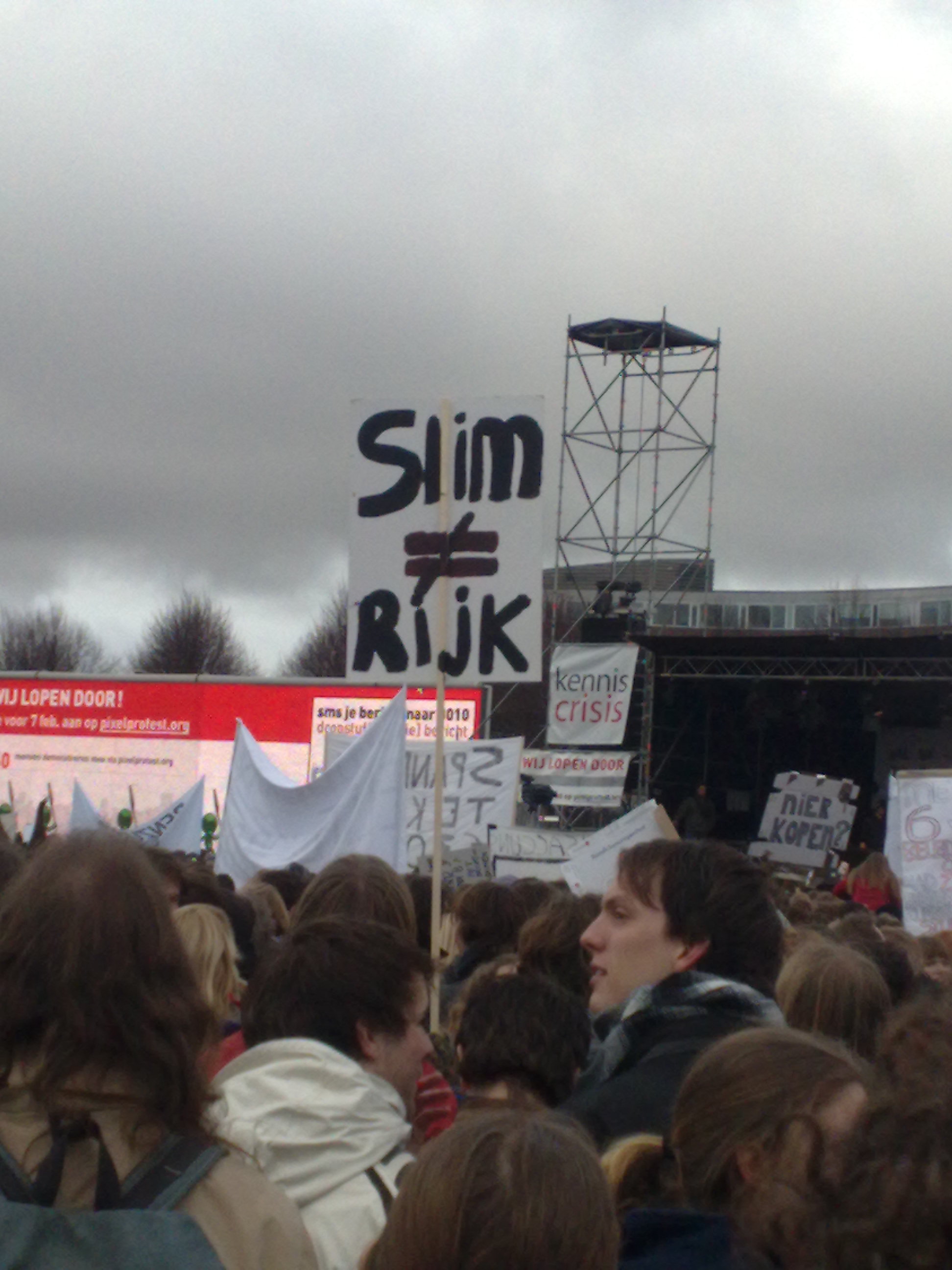
    Protester holds a sign that says "smart does not equal rich"Leading up to the organized student manifestation against the financial cuts in higher education, there were a bunch of news reports about there being ‘signals‘ that radicals would come and hijack the protest and try to create riots. Radicals was obviously never defined, but at the time I didn’t think much of it. A little while later, I realized what a genius piece of spin-doctoring it had been.

    What the message did, was create an expectation of radicals getting violent. For one, radicals can mean football hooligans, for another it can be anarchists, or communists, or foreigners, or anything else which they perceive as dramatically different than them. The manifestation itself was more like a political rally more suitable for election time. When students decided to go to the political quarters to let themselves be heard, they were met by police and violence ensued.

    The spin makes it seem like the violence was caused by radicals. I think it was caused by upset students. The difference?

    For any government, it’s important to create the impression that the general population is content with the government. The label ‘radicals’ was defined by a set of actions and expectations (mainly disobedience and perhaps violent actions or rioting), so when normal people acted this way, they became radicals. This makes sure that ‘normal people’ don’t identify with these radicals (formerly known as normal people).

    Identification creates understanding creates support. The last thing a government which plans to make drastic financial cuts and reforms wants, is people supporting a disobedient protest movement.

    Most of the (25) people arrested last Friday were obviously not radicals. They were students. They were normal people (they still are). They were people like you and me.

  • To fail or not to fail… Piratenpartij 2.0

    I’m writing this post in English for two reasons. The first is that I find it easier to express myself in English, having lived abroad a lot over the last years. The second is that the eyes of pirates worldwide are upon us!

    For the last few months I’ve been the campaign manager for the Dutch Pirate Party. Even though last night’s results are disappointing in one way, we’ve accomplished something to be proud of. From being a very small group of people, we’ve formalised a political organisation, jumping all the bureaucratic hurdles along the way. We made it. With hardly no grassroots activity (except for in Brabant) and almost no funds, we’ve managed to convince thousands of voters (exact number unsure at this moment) and to reach millions of people. As a communication specialist I have to say that’s a spectacular result, even though it didn’t get us a seat in parliament.

    If you look at the below map, you can see there are pirates almost everywhere in The Netherlands!

    Via twlevo.

    Now we face a choice. To fail or not to fail. So we didn’t get seats in parliament, which isn’t easy to accept, seeing the fact that some of us sacrificed their lives for this, over the last months. What we do have is national awareness and support! We cannot let our ideas, our principles, our vision go to waste.

    What we need to do is ORGANISE. In my eyes, the most fundamental challenge in our campaign was having to cope with almost zero grassroots activism. That’s why I believe the main focus of the Pirate Party in the next months, should be on setting up local chapters that are self-organised modules in a lean mean Pirate machine. The idea of local groups is to give our formal organisation a more informal character and base. This informal character will attract a lot more people that can support the organisation in a lot of ways. These local groups will have FUN first and they’ll combine it with activism. That’s the opposite from what a lot of us have been doing in the last months: work hard first and hopefully have fun along the way.

    We cannot let our new government ignore the fact that copyrights and the patent system are up for reform. We cannot let them take away more privacy without being challenged. We need to get the local organisations growing, so that we can group together whenever it is most needed.

    We’ve worked hard. We can be proud of ourselves.
    We said we wanted to remix politics; now we’ll have to!

    For a free information society.

    Yaaarrs truly,
    Bas

    P.S. Let’s support the people of Piracy Festival (June 19, Utrecht). They still need some volunteers. See you there!

    (this post is a crosspost from the Pirate Party blog)

  • Yaarrr

    You might have noticed it’s gone a bit quiet here. That’s because I’m busy as communication manager for the Dutch Pirate Party which is aiming to get multiple seats in parliament with the June 9 election. More or less every moment of my day is spent doing things for the Pirate Party.

    Most of the regular readers know me as someone who’s quite involved in the music industry; these readers probably also know that the Pirate Party aims to drastically reform copyright (and other intellectual property laws). I believe the Pirate Party serves the needs of music creators and fans/consumers better than the current industry lobbies and with reforming laws, it will do a much better job facilitating ‘music 2.0’ and the recording industry has (see: Spotify, imeem, Pandora, Last.fm or all those other struggling music 2.0 initiatives).

    More important than that, is civil liberties. We live in an age of digitalisation; an age that has made copyrights impossible to maintain without seriously infringing on the rights of civilians and destroying the openness of the internet. We have a choice. Either we jump into the digital revolution and safeguard our liberties, or we let the big corporations convince the government to ‘industrialize’ the digital. The industrial revolution is over, it’s time for a new reality.

    To further understand why I’m involved in this worlwide movie, check out the video below and the website of the Dutch Pirate Party (in Dutch).

    Uppsala Declaration
    http://int.piratenpartei.de/Uppsala_Declaration
    Important instruction for all pirates
    http://www.youtube.com/watch?v=zUe-Ebe8dWU
    Pirate Manifesto parties at a glance
    http://int.piratenpartei.de/Pirate_Manifesto_parties_at_a_glance

    Edit – Oh yeah, and I’m also a Pirate Party candidate for parliament 😉
    http://twitter.com/Spartz

  • Bulgaria’s inferiority complex?

    I’m sure I’ll offend someone with this; good. This needs to be said and people have to start becoming aware of this. The following is possibly the biggest hurdle for the Bulgarian people and it needs to be discussed.

    A few months ago I was on Bulgarian English-language news website Novinite.net, where I often got into discussions with other readers through their commenting system. One day one of the people argued that foreigners that come to live in Bulgaria must be the lowest of the low in their country. Why else would someone move to Bulgaria? Most of the commenters on the newsportal are Bulgarians that have moved abroad, mostly the USA. They are very hateful and find reason to despise just about everything. They point: the corruption is the fault of them, they hate parties on both sides of the political spectrum, except for the extreme right-wing party Ataka. It’s like they’re reading the news just to get an affirmation that their move abroad was a good choice. These people are among the most negative Bulgarians I’ve come across and  they mask their own insecurity and feelings of inferiority by pointing, pointing and pointing.

    Many people I meet have trouble understanding why someone from Holland would ever move to a country like this (twice!) and even bother to pick up a few words and sentences. To me, Holland is organized, linear, and everyone stays in their own bubble. To some that might sound appealing, but to me that sounds boring – and on top of that, the weather’s always shit. I went to Bulgaria to taste a little more of life. The food is better and more authentic, the people are not emotionless robots when they’re working, and they worry a bit less about their time. Whereas in Holland people look up the exact times of the bus and try to be at the busstop the minute before the bus comes, here people are more likely to simply go to the busstop and wait. That’s what I like, that’s why I’m here.

    But why I really believe there’s some type of underlying inferiority complex in the Bulgarian society is the expressions of powerlessness people give. They feel their vote won’t change a thing, they feel it doesn’t matter who they vote for, they feel corruption can’t be solved….. They feel completely powerless to change anything about Bulgaria. That’s why I believe this is a more important thing to handle than fixing corruption, the justice system, or anything else. People have to believe they can make a difference; and then they will. The state of Bulgaria is improving, but slowly and with a determination to make a difference, from person to person, this process could speed up ten-fold.

    People need to stop pointing at politicians, politicians need to stop pointing at each other, companies should stop pointing at politicians and politicians should stop pointing at companies. We ALL live in this country and we ALL want to have the best we can get; every time you point a finger, you can also pick up some of the litter on the streets and make a real difference.

    Life’s not perfect people, nor will it ever be. Stop expecting to get something great, while you don’t believe other people deserve something great to happen to them. You are part of those other people, we are one society. Now stop pointing or holding out your hand and DO something. Anything at all. Make a difference today.

    BasBasBas.com is about my life abroad. I regularly write about my adventures in Istanbul, Bulgaria and travels in the region, but like to ponder about the future also. If you’d like to stay up to date, you can subscribe to my RSS feed or get email updates in your inbox. You can also follow me on Twitter.

  • I’m Fasting in Solidarity with the People of Zimbabwe

    The situation is getting very bad in Zimbabwe. Hyperinflation, lack of clean drinking water or food, violent oppression of citizens, Mugabe is destroying his country through clinging on to his power. We’ve all seen the images.

    I got word from Avaaz that hundreds of activists, including Desmond Tutu, have started a hunger strike in solidarity with the 11 million people in Zimbabwe who can have only one meal per day, or less.

    It’s time for a change. This Sunday, February 1, heads of state are meeting in Ethiopia. A call has gone out for people to fast in solidarity during that day. The pledge is as follows:

    We, the undersigned, pledge to fast for a day in solidarity with the Zimbabwean people. We call on leaders throughout Africa—and the world—to act now to decisively support their struggle for justice, democracy, and survival.

    The fast is just from sun up to sun down. I’ve always wondered about fasting, about ascetics, or Muslims during Ramazan/Ramadan, what they go through. I’m quite sure I won’t enjoy the fast, but it’s for a great cause and after all, I have a choice. Many people around the world do not.

    Take the pledge. Do it with me and 25,000 others. Just for one day, between sun up and sun down, how hard can that be?

    Go to take the pledge now!

    Photo by Sokwanele – Zimbabwe, shared under a Creative Commons license.

    Are you in? Why is this worth fasting for?

    Keep in touch with me next Sunday to see how I’m doing. Follow me on Twitter.

  • Politics 2.0

    The influence of new media on current day politics

    An essay by Bas Grasmayer

    The 20th century was the age of mass media. The impact of radio during the first half of the century and that of television during the second brought politics closer to home. Starting from people grouping around the one radio in their neighbourhood, to the radio in their street, until the point that everyone had a radio in their home. The same happened for television and through these media politics entered the living room. Through sound at first, but later through moving images which became more detailed and more accurately coloured over the course of the last century.

    We’re now close to ten years into the new century. Television and radio are still important, but there is a new player in the field of mass media: the internet. This essay will look at how the internet has already influenced politics and hopes to answer, in part, the following question:

    How is the World Wide Web as a medium influencing
    politics and the government right now?

    New Media

    In the 2008 US Presidential elections, politicians were seen embracing new media. Barack Obama became microblogging service Twitter’s most followed user and YouTube set up a site called You Choose ’08 dedicated to the elections. On the latter, campaign teams posted videos hoping they would go ‘viral’, a term used to describe the phenomenon of certain content on the internet being spread out through huge networks of users, which is often initially an exponential process. Ron Paul, who was running to become the Republican presidential candidate, had so much support on the internet that TIME magazine at one point commented that due to “his  success  recruiting  supporters  through  new  social  media  channels” he was “the  new  2.0  candidate”.

    (more…)

  • Dutch Journalists Tricked by ‘Magic’ Mushroom Ban Opponents

    You would think that journalists’ intelligence and street smarts prevents them from falling for hoaxes, but recent attempts to show the insanity of the Dutch ‘magic’ mushroom ban by opponents of the ban show otherwise.

    Ridiculing the mushroom ban, a website called PaddoBestrijding.nl (Shroom Removal) has been created promoting a service that supposedly helps keep innocent people safe from the long arm of the law. PaddoBestrijding’s press release reports that home-, land- and gardenowners as well as nature preservation organisations risk prosecution over ownership of one of the 186 mushroom types banned in The Netherlands, starting the 1st of December. This could lead to sentence of up to 6 year imprisonment or a 740,000 euro fine.

    The ban is quite controversial as I’ve stated before in the following two articles:

    One of the mushrooms getting banned is the Fly Agaric, or Amanita muscaria (picture below, by Roger B.), a popular mushroom in European folklore (and in Super Mario), one of our nature’s beauties, and a popular sacrament in ritual shamanic use. Looks like the Christian Democrats are still on a witchhunt, with the aid of the Labour Party.

    The Fly Agaric is one of the mushrooms illegalized in the Netherlands

    It took me a second to figure out that PaddoBestrijding was an eleborate hoax, but three sections of the site really give it away and I’m stumped that journalists didn’t get the joke. Then again, the Dutch government did try to ban the use of satire once (1, 2, 3). The pages that really give the spoof away are the methods, testimonials and shroom of the month. Some translated quotes from the various pages:

    ShroomRemoval about methods:

    “Depending on the scale of infection and the soil type, we choose for a surface-, or a depth treatment. With the latter a fungicide is sprayed into the soil under high pressure as deep as 70 cm. Thankfully this is not always necessary and most of the time a surface spray can be utilized, after which the fungi killing substances slowly seep into the soil. Modern fungicides are extremely poisonous, meaning that only a small amount has to be used; a comforting thought.

    If that last sentence doesn’t give it away, maybe one of the silly testimonials might:

    “When we could access our garden again, eight weeks after the mushroom removal, all mushrooms were gone. We were warned about dead animals, but luckily it wasn’t that bad. The plantgrowth has recovered a bit by now and every now and then we’re also seeing some birds in our garden again. In a few years we will once again be able to safely eat from our garden.”

    Hellooooo gullible journalists… you got it yet?! No? How about the mushroom of the month, where an opposition to the new mushroom ban is subcommunicated. Strange, for a company that can profit so much from this, no? Here it goes:

    “Even though the ‘orange funnel’ (Rickenella fibula) doesn’t contain psylocibin or other related tryptamines, it has still been put on the list of banned mushroom types under the aged synonym ‘gerronema fibula‘.”

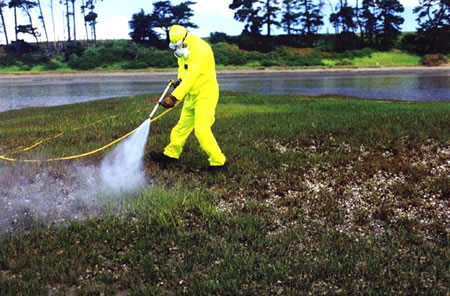
    All of this, combined with pictures of people in yellow suits and gas masks spraying toxic chemicals should raise some doubts in the mind of journalists, but nope, they fell for the hoax. An eleborate and modern version of the type of jokes Provo’s played on Dutch society, which I blogged about before.
    I must admit that as I started writing this article I wasn’t 100% sure about this being a joke. Since I don’t want to spread misinformation, I did some research, like any self-respecting journalist should. Through some very simple domain name research I found out that MushMush.nl registered PaddoBestrijding.nl. MushMush was selling magic mushroom growkits until the ban and talks about growing methods. So of course it is a hoax!

    So far ShroomRemoval has been featured in the following media:

    • Spits (Rush Hour), one of the biggest (if not the biggest) free newspapers in Holland. [web article, newspaper clipping (from the frontpage apparently)]
    • NOS Headlines on 3FM (Radio), one of Holland’s most popular radio stations. [online, direct download]
    • FunX (Radio), popular radio station for teenagers and other people with a poor taste in music. The two DJ’s spoke with a representative of PaddoBestrijding on the air and showed particularly gullible behaviour and nauseating stupidity. 😉 [direct download]

    Just shows how gullible the media is and makes one think twice about the trustworthiness of news. With one I mean me, and hopefully you too.

    BasBasBas.com is about a Dutch student living in Istanbul. I regularly write about my adventures in Istanbul and travels in the region. If you’d like to stay up to date, you can subscribe to my RSS feed or get email updates in your inbox. You can also follow me on Twitter.
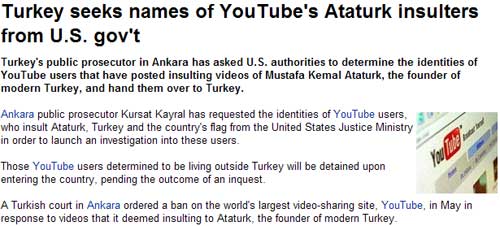
  • Turkey seeks names of YouTube’s Ataturk insulters from U.S. government

    Hurriyet Daily News reports the following:

    Turkey seeks names of YouTube's Ataturk insulters from U.S. gov't article

    Excuse me? Is this the Soviet Union I’m living in? In the past I’ve made a comparison between Turkey and China regarding the freedom of the press and I also said at the time that it was an exaggerated comparison, as Turkey’s press enjoys a lot more freedom than China’s. But this, this has not been equaled by China, I believe.

    This summer we saw American Tibetan activists hold demonstrations in China during the Olympic games; they could not have done that if they got detained upon entering the country. Yes, they were arrested and deported, but only after committing a criminal fact in China. Most of their names could have and should have been known to the Chinese government. They write about the Tibetan cause publicly.

    What this prosecuter is asking for is detestable and I am shocked and outraged.

    “Those YouTube users determined to be living outside Turkey will be detained upon entering the country.”

    Detained and then what? Imprisoned for insulting Turkey? They did not commit any illegal acts if they published these videos outside of Turkey, unless they are Turkish citizens, which might make it illegal. If I were to say “the US is a big pile of smelly cowdung”, I cannot be arrested upon entering the US. If I however threaten someone in the US, particularly government officials, there’s a good case for them to find out my name and to detain me upon entering the country. What this prosecutor is asking for is to limit the freedom of speech with matters pertaining to Turkey worldwide.

    The whole YouTube ban is pointless anyway. Research in Alexa.com’s traffic ranking system has shown that YouTube is the 10th most popular site in Turkey. Turkish Prime Minister Erdogan surprised everyone when he stated that even he uses YouTube.

    In other news Hurriyet reports the following:

    “There was a vigorous internal debate between Wong and her colleagues at the top of Google’s legal pyramid.” Wong, who had to play mediator, decided that Google, by using a technique called IP blocking, would prevent access to videos that clearly violated Turkish law, but only in Turkey. For a time, this solution seemed to work for the Turkish judges, who reopened access to YouTube.

    But last June a Turkish prosecutor made a demand that Google block access to the offending videos all over the world, to protect the rights and sensitivities of Turks living outside the country. Google refused, arguing that one nation’s government should not be able to set limits of speech for Internet users worldwide. As a result Youtube has remained blocked in Turkey.”

    Me: Hey Twitter! Some guy on your network said my site sucks and used some profanity. I feel really insulted. Can you ban the entire network from saying bad things about me? Oh you can just make it so that my IP address can not see it anymore? Well, I’ll be using proxies to see it anyway, but I’d prefer if you would make any insulting depictions of my site invisible all around the world.

    FAIL.

    The vice president of the European Parliament’s Human Rights Sub-Committee, Howitt, criticized the ban, saying that around 1,000 websites are blocked in Turkey and this places the country alongside some of the world’s worst nations for cyber censorship.

    The information age is here and it’s never going away. You’re a really marvelous country Turkey, but it’s time to do something about these ridiculous prosecutions.

    BasBasBas.com is about a Dutch student living in Istanbul. I regularly write about my adventures in Istanbul and travels in the region. If you’d like to stay up to date, you can subscribe to my RSS feed or get email updates in your inbox. You can also follow me on Twitter.

  • Drugs, Prostitution and Same-Sex Marriage

    That’s the title of a 10-15 minute presentation I’m giving soon for my Intercultural Communication classes at Yeditepe University, here in Istanbul. I designed it in such a way that it can also be enjoyed without my vocal explanations and here it is!

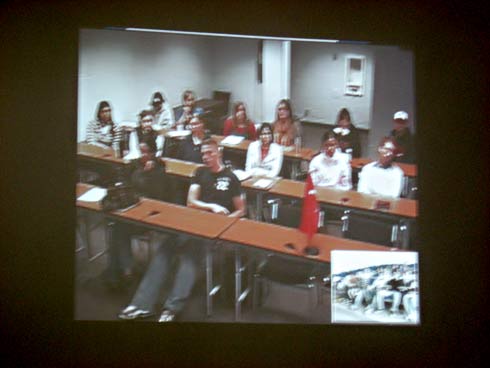
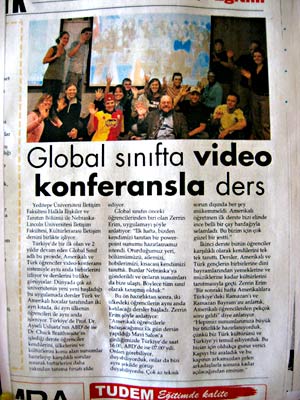
    The Intercultural Communication course is likely to be the most innovative course I’ve taken during my higher education (sadly — universities should make more use of modern technologies). Every Tuesday, we get into a classroom at 4 o’ clock in the afternoon and have a video conference with a class in Lincoln, Nebraska, US. We present ourselves, our culture, customs, daily lives and our countries to each other. It’s fascinating, because both the Turkish class as well as the American class have students from many different backgrounds.

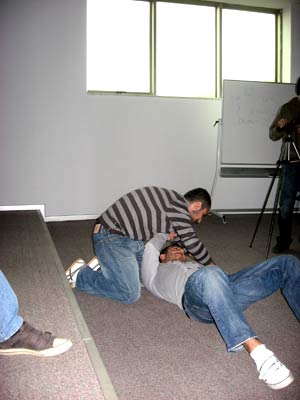
    This part of the Intercultural Communication course, called Global Classroom, has been quite fun so far. We’ve managed to make 2 students from the Nebraskan class dance in front of the camera and they’ve managed to make 2 of our students wrestle in front of the camera (or was it Jiu-Jitsu?).

    There’s only a few sessions left, so I hope I actually get to do my presentation, as our lecturer wanted everyone to prepare one, but there will be no time to actually execute all of them.

    I hope the presentation has given you an insight into Holland’s liberal policies and if you have any questions please feel free to reply. I love answering questions about these issues.

    How about in your countries, how is your government dealing with these issues? What is your personal opinion on these matters? Has the war on drugs failed? Is same-sex marriage morally wrong or is keeping it illegal a form of discrimination? What about prostitution?

  • Germany Shuts Down Wikipedia, Earthquake Hits Sofia, Brazilian Bloggers Take To Streets

    Thank God I didn’t wake up with a hangover today. Where to begin!

    Germany Shuts Down Wikipedia

    Censorship’s creeping up on us. Just 3 weeks ago I wrote about Turkey’s ban of Blogger/Blogspot, which I didn’t write about because I specifically care about Turkey’s internet, but because I care about the freedom of the internet. I’m sure a lot of visitors were able to stay detached from the situation and not care so much, maybe this time the news will have more impact because even Germany is guilty of web censorship now.

    Lutz Heilmann, a German parliament member, took legal action against Wikipedia, because of an article mentioning his alleged involvement in the Stasi, Eastern Germany’s secret police during communist time. Great job in proving you’ve not been a member or showing that you’ve changed by getting the web censored, it’s almost like if the police called for web censorship after being accused of Gestappo practices. Oh wait, that actually happened.

    What happened in Germany is that www.wikipedia.de no longer links to wikipedia.org, the main site of wikipedia. The German version of Wikipedia is still available through de.wikipedia.org.

    It looks like Heilmann realized what kind of shitstorm his legal procedures were starting to bring down on him and before accidentally flushing his future political career down the toilet and he issued a press release (in German) saying that Wikipedia can make Wikipedia.org accessible via Wikipedia.de again. He also adds that it wasn’t about censorship for him. Hey, guess what, this is exactly what China says too. Good job, Lutz.

    More at TechCrunch.

    Earthquake Hits Sofia, Bulgaria

    Last night after coming home from meeting with Hans, a Dutch expat and international communication specialist in Istanbul, I had an email in my inbox from my girlfriend telling me that there was an earthquake in Sofia. She’s fine, her family’s fine and I believe my friends are all safe, since I already spoke to those living closest to the epicenter. It was a 4.0-magnitude (Richter scale) earthquake lasting 2.3 seconds.

    This morning there was an aftershock, which was less heavy.

    More at Novinite.

    Brazilian Bloggers Take To Streets

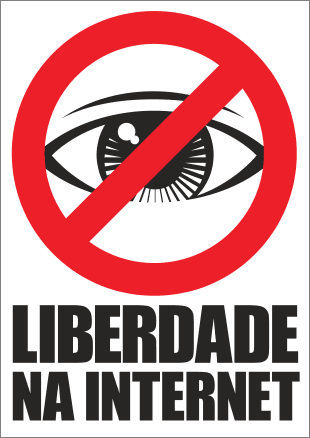
    Coming back to the topic of internet freedom, Brazilian bloggers and internet junkies (in the good sense of the word) took to the streets in São Paolo to demonstrate against the Digital Crimes Bill, which defines cyber-crimes and stipulates penalties accordingly. Bloggers feel the bill, which was passed by the Brazilian Senate in July, is too loosely formulated and might lead to over-surveillance of the internet at the cost of freedom of speech and expression.

    More at Global Voices.

    What are some of the best initiatives you have seen regarding the freedom of speech on the internet? Or, completely unrelated, have you ever been in an earthquake?

    Stay updated. Follow my Twitter feed, or subscribe to this blog by RSS or email.

Related Posts Widget for Blogs by LinkWithin