Category: thoughts

  • Dutch smartshops take legal action against ban on magic mushrooms

    This is a follow-up article on “Netherlands to ban ‘magic’ mushrooms starting December 1“.

    Amsterdam, Saturday 8th November 2008

    The Association of Smartshopowners has been surprised and is disappointed about the decision of the government of last Friday to implement the intended ban on magic mushrooms as from December 1st. The Association will take legal action.

    The Association condemns the decision of the Government since both Ministers of Justice and of Public Health refuse to listen to the stream of warnings from the experts, scientists and from the Association. The warnings consistently refer to the increased dangers of unwanted side effects of such a ban. The Association was in regular discussions with the Government over the past ten years in order to properly regulate the market for hallucinogenic mushrooms and pleaded consistently for proper regulation rather than banning the ‘shrooms’. The Association deplores that, by the decision of the government, further co-operation is made impossible and that her members and their customers are facing an accomplished fact in a rather raw manner.

    The Dutch Opiumwet (druglaw) requires that there must be a proof of damage to the public health and the community at large. Against a yearly turnover of some 1,5 million portions of magic mushrooms there is only a very small amount of incidents. Moreover, these incidents cannot be traced back to the exclusive use of ‘shrooms’. There has been no scientific investigation of such incidents nor has there been any toxicological examination. The Minister ignores the clear advice of his own advisory body (CAM) and bases his decision on unfounded assumptions and takes his own suppositions for granted.

    The members of the Association are feeling highly derogated by this decision and by the clearly unreasonable attitude of the Minister.

    A general ban on the sale of shrooms will inevitably lead to the closure of many smartshops whilst the remaining shops will incur a sizable financial loss. This aspect was hardly discussed in the parliamentary discussions about the proposed ban.

    Stay updated. Follow my Twitter feed, or subscribe to this blog by RSS or email.
  • Netherlands to ban ‘magic’ mushrooms starting December 1

    Dutch Christian Democrat minister of Public Health, Ab Klink, has announced the ban of selling and growing ‘magic mushrooms’, or shrooms, will take place on December 1. This knee-jerk reaction follows a media and political hype caused last year by the suicide of a 17-year old French tourist who was said to be under the influence of mushrooms at that time. It was also her second suicide attempt.

    Politicians got riled up as the media started covering every mushroom mishap in Amsterdam. Since nobody really stopped campaigning since the last government was formed – as they’re doomed to fail – they saw this as a good chance to speak up, speak out and win votes. At the cost of liberty and sanity.

    Ab Klink, minister of Public Health, previously asked the Coördinationpoint for the Assessment and Monitoring of new drugs (CAM) to research illegalizing shrooms. They concluded that these are the risks involving mushrooms:

    • Health of the individual: no risk.
    • Public health / society: minimal risk.
    • Public order / safety: minimal risk.
    • Criminal involvement: no risk.

    The CAM advised against a ban on mushrooms for the following reasons:

    • The smartshops selling the mushrooms might replace them by substances which carry more risk;
    • It will lead to shrooms being sold in tablet-form, like XTC pills;
    • Users would pick mushrooms in nature, which could lead to serious problems if they mistake the wrong type of mushrooms for the ones they are looking for;
    • Users might switch to other drugs, which might be more interesting from a criminal perspective and possibly carry more risk for usage… Leading to more danger to the public;
    • The banning of mushrooms is a rather tough sanction given the current problems its causing;
    • Maintaining a ban would bring costs.

    What did Ab Klink do? Ban them! Of course. The CAM was surprised as this is the first time a minister has ignored the advice of this advice organ. Minister Klink is obviously tripping. Or maybe he’d like to see the Bible as our lawbook?

    Dutch ‘smartshops’ that sell magic mushrooms and other legal mind-altering substances are taking this to court. For updates on this matter you can follow Dutch blog Red De Paddo (Save The Shroom).

    Recently a Christian Democrat politician called for the closing of all coffeeshops in Holland and illegalizing cannabis. In a follow-up poll, Dutch citizens expressed their opinions about the Dutch policy regarding drugs. 36% want coffeeshops illegalized, but 34% wants to see them completely legalized. Coffeeshops in Holland are currently in a grey area, more can be read about this in the article below or on Wikipedia. In short the sale of softdrugs is legal in Holland, but supplying coffeeshops of them is not.

    Last year I wrote about the pending mushroom ban in several articles, one of which is reposted below, the others can be found via these links:

    Stay updated. Follow my Twitter feed, or subscribe to this blog by RSS or email.
    Below a repost of my article Dutch government to ban cultural identity. (more…)

  • Flickr Banned in Turkey? Nope.

    It appears to be a false alarm. Flickr’s working fine now. Disregard this post 😉

    Just received a message that popular photo management and sharing application Flickr is unavailable in Georgia. The sender asked me about the situation in Turkey, since a few weeks ago when Blogger/Blogspot was banned in Turkey, it was also unavailable in Georgia.

    Guess what? Flickr is unavailable in Turkey also. Could it be a new ban? Who knows.

    I guess we will find out soon. Either it will come back online, or we will see something like the below:


    Stay updated. Follow my Twitter feed, or subscribe to this blog by RSS or email.
  • Dutch Police Union Head Calls for Web Censorship

    In response to the intimidation of a Dutch police woman, both on- and offline, head of police union ACP, Geert van de Kamp, has called for web censorship.

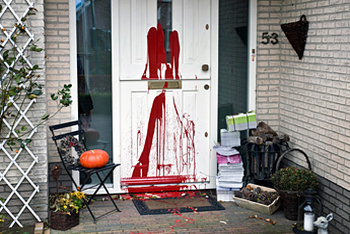
    An investigation has been launched into the intimidation of the police woman, who works for the foreign police of The Netherlands. In the night of Monday to Tuesday, unknown people vandalized the front door of the police woman’s house with red paint.

    Also, the tires of the police woman’s car were slashed.

    A group called the Winterschilders (Winterpainters) claimed responsibility for the act by posting a message on indymedia.nl, which included the full name and address of the police woman (and a picture, claims the police union). Their message reads:

    Tonight The Winterpainters visited XXX, foreign police, XXX, XXX. (XXX replacing her personal data which have been removed by indymedia)

    Her frontdoor got some red paint on it; symbol for the blood of the people that suffer due to the practices of the foreigner police.
    We also made sure she couldn’t get to her work quickly today (flat tires).
    This is a warning to all her colleagues of the modern gestapo (foreign police, immigration and naturalisation service, justice dept.).

    You are responsible for what you are doing.
    Stop it.

    The Winterpainters

    Gerrit van de Kamp, head of police union ACP, calls the incident “unheard of”, saying this “absolutely cannot and may not happen again.” And what better way to react to Gestapo accusations than calling for censorship?

    Van de Kamp wants to ask the ministers of Justice and Internal Affairs to make it impossible to publish messages like the above on the internet, saying it should be “technologically possible” to filter such messages.

    Gerrit van de Kamp, you are either unaware of what exactly is “technologically possible” or you are calling for censorship. In a statement on ACP’s website, you call for “preventive measures to prevent name & address data of police people to be posted on the internet”. That’s a lot more nuanced and understandable, yet it is impossible to put such filters in place without seriously endangering the freedom of the citizens you’re serving. You are asking for ISPs to filter what their users are posting to the internet:

    • Should the ISPs report every filtered instance to the police?
    • How will the “technologically possible” filter prevent innocent people from being censored?
    • What prevents the government from adding more and more terms to the filter once it is in place?

    Such a filter would be a step towards fascism. Yes, you have the duty to protect police staff, as do we, as Dutch citizens, but you are calling for a very extreme measure. The internet shall not be filtered, instead, prosecute websites or people that post this data on the internet. Call for tough laws and higher penalties to discourage people from committing these acts. That way it will be the websites’ responsibilities to filter the content posted to them.

    Also, there have been many reports over the last 5 years about ill-treated asylum seekers and there has been a lot of protests about this, this incident being the most extreme protest thus far. Maybe it actually is time for the government to have another look at what’s going on and punish those responsible for incidents.

    The suggested measure in your reaction is disproportionate. Please reconsider.

    That will be all.

    Spread the news! Digg or Stumble this post or use any other service using the Bookmark button below.

    If you would like to stay up to date to this and more, please subscribe to my RSS feed or email updates.

  • Obama Elected, The World Rejoices – Turkey, Macedonia Perhaps Not So Much

    Even though sentiments are mixed in the US, around the whole world people have reacted enthusiastically about Obama‘s election. People around the world have had more than enough of Bush’ policies and were hoping for a change. Change being the keyword of Obama’s campaign and McCain being associated with Bush, caused the most people to be more favourable towards Barack Obama. The website If the world could vote? shows that all over the globe, more people were rooting for Obama than for McCain.

    Obama is young, ‘black’, a Democrat and instills hope, whereas McCain was seen as very similar to Bush, partly due to employing similar tactics to the ones of former Republican campaigns.

    One country that seemed significantly pro-McCain on aforementioned If the world could vote? is Macedonia. Why? The Republic of Macedonia borders Bulgaria, Greece, Albania, Serbia and Kosovo. Not the easiest region for a country. Greece refuses to recognize ‘Macedonia’ as their name, one of the reasons being a similarly named province in northern Greece, and Macedonia is thus referred to in the UN as The Former Yugoslavic Republic of Macedonia (FYRM). It’s a very complex issue. McCain has been very outspoken about recognizing Macedonia by its constitutional name, whereas Obama has been more careful about it.

    Randy Scheunemann, a McCain adviser said the following about NATO membership bids:

    On Albania, Croatia and Macedonia, Senator McCain has been strongly outspoken in support for including them. They are ready. In the case of Macedonia, they’ve been a membership action plan for eight or nine cycles.

    With respect to the Greek concerns, the United States recognizes Macedonia under its constitutional name.

    And he certainly hopes that there’s not going to be this throwback to the 19th century style of Balkan politics, and the Greeks throw a red card on the membership of Macedonia.

    Since this is a very big issue in Macedonia, as territorial, cultural and national integrity always are in the Balkans, it’s no wonder people in Macedonia were hoping for McCain to win.

    As for Turkey, people might be happy to see a change in government. Bush’ unpopular policies have led to an increase in anti-Americanism around the world. In June, a Pew poll found that out of 47 countries, Turkish people had the least favourable view of the United States (source: The New York Observer). In that sense, Obama will be a welcome change.

    It is hoped that the new President will aid Turkish efforts against the PKK and the Kurdish insurgency in the Iraqi border area, support the EU’s membership bid and put pressure on European politicians, and support Turkey in its process of becoming a modern, democratic country. It’s not expected that Obama will aid Turkey’s military efforts or put significant pressure on the EU to get them to admit Turkey.

    Moreover, just one day before the elections, Obama renewed his commitment to recognize the Armenian genocide, a very sensitive issue in Turkey. McCain “never pledged to label the Armenian killings as genocide and is seen by the U.S. Armenian community as a politician against or indifferent to Armenian matters” (Turkish Daily News).

    Turkey’s foreign policy adviser to Prime Minister Recep Tayyip Erdoğan said “the formal recognition by the United States of genocide would seriously damage U.S.-Turkish ties and hurt Turkey’s efforts for reconciliation with Armenia” after meeting Phil Gordon last week, a senior foreign policy adviser to Obama.

    Turkey is an important ally (NATO member) and trade partner to both the US and EU, as it has a stabilizing presence in the Middle East, often mediating in Arabic-Israeli talks.

    Looks like Obama will have a lot on his hands when he takes office in January.

    Increase your understanding! Here’s some useful links:

    Like this post? Please give it a Stumble or a Digg or use the +Bookmark button below to add it to any popular social bookmarking service!

    What are your perspectives on this? Have your say in the comments!

    More about Turkey? Subscribe to this blog’s RSS feed or follow me on Twitter! You can also subscribe for email updates.

  • The Inheritance of Loss

    I got tagged by a dear StumbleUpon friend, shpongolina. Usually I don’t participate in this type of things, but because it offers something interesting and it comes from a great person, I’ll make an exception. 😉

    The rules are as follows:

    1. Pick up the nearest book (of at least 123 pages).
    2. Open the book to page 123.
    3. Find the fifth sentence.
    4. Post the next three sentences.
    5. Post a comment and then tag five more people.

    The Inheritance of Loss

    by Kiran Desai

    Gyan was twenty and Sai sixteen, and at the beginning they had not paid very much attention to the events on the hillside, the new posters in the market referring to old discontents, the slogans scratched and painted on the side of government offices and shops. “We are stateless,” they read. “It is better to die than live as slaves,” “We are constitutionally tortured. Return our land from Bengal.”

    I wrote about this book a while ago. I’m ashamed to admit that I’m still reading it. Worse yet, I’m not even halfway through, even though it’s a great book. My excuse is that I’m an expat in Istanbul and there’s just so much to see and do here. 😉

    I love this book, because it talks about life in India at the foot of Mount Kanchenjunga in the north-eastern Himalayas around the time of the Nepalese independence movement in the mid-80s. This is something I knew nothing about in terms of facts, let alone in terms of experience. That’s the awesome thing about books; they let you experience something like you’re there. It’s the power of writing. It’s a very moving story and has many elements in it. Classes/castes, love, freedom, happiness, travel, work, study, war, conflict, poverty – many things which I either have never been in contact with, or that I have always taken for granted.

    You can read more about the author, Kiran Desai, on Wikipedia. Check out the book, including reviews, at Amazon.

    I would like to tag Dori (From A Yellow House In England), Chris (Beyond Taiwan), PJA64X, Emm (Emm in London) and lala (Coastal Commentaries).

    Want to stay up to date on my Istanbul adventures? Follow my Twitter feed, or subscribe to this blog by RSS or email.
  • Blogger/Blogspot unblocked in Turkey while court awaits missing evidence

    Right now, Blogger and *.blogspot.com domains are available again while courts await further evidence backing Digiturk’s claims. Great. Let’s hope it stays that way. After YouTube got unbanned, it got banned again, so who knows what will happen.

    The ban has been lifted by the Turkish court that previously blocked Blogger last Friday. They have requested “missing evidence” but made it clear that the ban could be reintroduced after the legal procedure is completed by the prosecutor.

    Digiturk, Turkish license holder for the broadcasts of Turkish football league games, asked for blogs with links to pirated streams to be removed. Blogger did not reply and Digiturk went to court, getting millions of innocent blogs blocked. The statement that “Blogger did not reply” makes me think all Digiturk did was send out an email – and as some of us know, if you email Google services, be prepared to wait two weeks. They should have called.

    The law that allows for the blocking of domain names still stands. Many popular sites are still blocked. Blogger can be blocked again. It’s not over, but at least Blogger’s available again. Yet still we can expect to see more of this:

    And the protest banner posted on Turkish (as well as international) blogs hosted at blogspot.com:

    Thanks to Hans for his useful tip!
    Thanks to the Istanbulian for further information.

    Help get the news out. Stumble, Digg, Slashdot, Reddit or Tweet it!


    Stay updated. Follow my Twitter feed, or subscribe to this blog by RSS or email.

  • Georgia affected by Turkey’s ban on Blogger

    Apparently Caucasus Online, an internet provider in Georgia, uses Turkey’s service network, as it is reported that internet users in Georgia are now also unable to visit sites from Blogger and *.blogspot.com domains.

    A solution for Windows users to “unblock” Blogger and YouTube has been posted here:

    Find the file named “hosts” under windows/system32/drivers/etc/
    folder.
    Open this file with Notepad

    Append those lines

    72.14.207.191 blogger.com
    209.85.165.191 www.blogger.com
    208.117.236.69 youtube.com www.youtube.com
    208.117.236.70 youtube.com www.youtube.com

    Save and close it.

    This solved my problems, I posted as if there is no ban.

    More about this solution can be read by clicking here.

    So, no more this:

    This is bad though. It’s one thing that Turkey decides to ban a whole domain based on poor logic, but it affecting people in another country makes it a lot worse.

    Some useful links to unblock YouTube/Blogger (blogspot)/other blocked pages in Turkey (and Georgia):

    Help get the news out. Stumble, Digg, Slashdot, Reddit or Tweet it!

    Stay updated. Follow my Twitter feed, or subscribe to this blog by RSS or email.
  • Digiturk causes Turkish ban of Blogger/Blogspot

    Since Friday, it’s been impossible to access popular blogging platform Blogger or any *.blogspot.com domain from a Turkish IP address, due to a ban imposed by a court in the south east of Turkey.

    Previously it was rumoured that Adnan Oktar, by some considered the leading Muslim advocate for creationism, might have caused the new ban, since he successfully got WordPress and Google Groups banned in the past, as well as evolutionary biologist Richard Dawkins’ website. However, this rumour was refuted by someone pointing out that Oktar operated in Istanbul courts and the verdict banning Blogger was passed in Diyarbakır, at the other side of Turkey.


    Blogger's banned in Turkey screenshot 

    Click to enlarge.

    It’s now reported that it is not Oktar that got Blogger banned, but Digiturk, a subscription based digital TV platform that owns the rights to the live broadcasting of Turkish football league games. Apparently, Digiturk asked Blogger to take several blogs or blog entries down containing links to pirated transmissions of the live games. Blogger did nothing, Digiturk went to court and under Turkish intellectual property law, they managed to get Blogger banned completely, effectively banning millions of websites that have nothing to do with Turkish football or pirating.

    Digiturk’s court cases in the past have managed to block Justin.tv and MyP2P TV for the same reasons.

    Turkey’s NATO membership and EU ambitions seem paradoxical to the infringement on the freedom of press and speech of its citizens, residents and visitors by banning sites like Blogger and YouTube. The EU’s making a blacklist of censoring countries and are creating software for people in these countries to use to bypass the censorship (see: Global Online Freedom Act).

    Thanks to safak for his tip about Digiturk!

    Some useful links to unblock YouTube/Blogger (blogspot)/other blocked pages in Turkey:

    Help get the news out. Stumble, Digg, Slashdot, Reddit or Tweet it!

    Stay updated. Follow my Twitter feed, or subscribe to this blog by RSS or email.

  • Turkey Bans Blogger

    UPDATE!! — It is now known why Blogger is banned in Turkey. Click here for the new article.

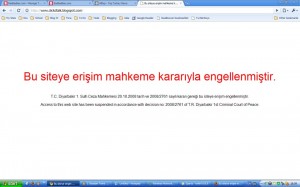
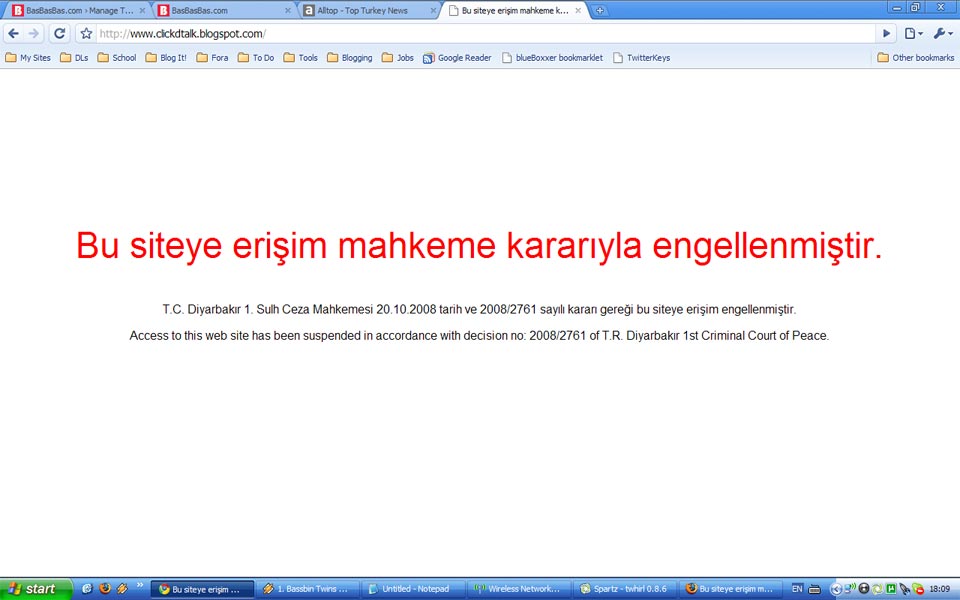
    Since today, whoever tries to access Blogger or any *.blogspot.com domain from Turkey will get the following message on my screen:

    Blogger's banned in Turkey screenshot

    Click to enlarge.

    This is the same message we get if we try to visit YouTube, which is also banned in Turkey. In the past blogging platform WordPress.com has been banned as well (read more), to much dismay of many Turkish bloggers.

    It was suspected that the reason for this has something to do with Adnan Oktar, by some considered the leading Muslim advocate for creationism, who has in the past managed to get WordPress, Google Groups, as well as Richard Dawkins’ website banned. It was then suggested however, that Oktar was active in Istanbul courts and this verdict was passed in Diyarbakır in South East Turkey.

    UPDATE – It is now known that it was Digiturk, not Adnan Oktar, that caused the ban. Read the new article here: 
    http://www.basbasbas.com/blog/2008/10/26/digiturk-causes-turkish-ban-of-bloggerblogspot/

    Turkey’s EU ambitions seem paradoxical to the infringement on the freedom of press and speech of its citizens, residents and visitors by banning sites like this. This is not China. This has to stopped. Good thing the EU’s making a blacklist of censoring countries and are creating software for people in censoring countries to use to overcome the censorship (Global Online Freedom Act).

    The court order of the ban on Blogger is also in very stark contrast to yesterday’s court approval of gay and group sex. Turkey’s a country of opposites.

    Some useful links to unblock YouTube/Blogger (blogspot)/other blocked pages in Turkey:

    Help get the news out and Digg this article or Stumble it or Buzz it!

    Stay updated. Follow my Twitter feed, or subscribe to this blog by RSS or email.

Related Posts Widget for Blogs by LinkWithin