Category: thoughts

  • Thesis excerpt: how Shpongle and Twisted Music are examples for the music business (Case Study)

    This case-study is about Shpongle, a much respected group of musicians, in a very specific niche: psychedelic chill-out, but attracting many fans of other genres too and is generally categorized as ‘electronica’.

    A while before they released their latest album ‘Ineffable Mysteries From Shpongleland’, it leaked onto filesharing networks and fans of Shpongle started discussing the new album on the internet forum of Shpongle’s record label, Twisted Music. Obviously, Simon Posford, the main person behind Shpongle and owner of the Twisted Music label, was very unhappy about this and lashed out:

    “So some fucker has released the album on the internet already…. thanks a lot, whoever it was… Maybe twisted will still recoup, maybe not… all i know is that we are teetering on bankruptcy, and are seeking deals elsewhere…. the 12 loyal fans on this forum are not enough to sustain a record label…. How much do you think Twisted has in the bank account? Have a guess? More than $10,000 ? More than $20,000 ? Well it is actually less than $1,000….. Raj and i haven’t even been paid our advance for this album…. All the artists on twisted are seeking deals with other labels now… We can’t pay a label manager, and we can’t pay the artists…. always putting our hope in ‘just ONE more release’…. “We’ll be ok if the DVD sells”….“Surely the Shpongle CD will sell, right?”

    […]

    This sucks, for Twisted, for myself and Raj who have spent 3 years working on the album…. Just as i started looking around and posting on this forum again, i remembered why i shouldn’t bother…. I’m outta here… Soon to be followed by Younger Brother [another project by Simon Posford] and probably Twisted…

    Enjoy.”

    He got understandably emotional, but misdirected his anger towards perhaps the most dedicated fans: those who really cannot wait until the release and decided to preview it. After all, Shpongle hadn’t released an album in four years and their following is quite fanatical about their music. Later in the same forum topic, he adds some more thoughts which are also relevant to this case study:

    “It’s all very well to speculate, but i can tell you as a fact, we made more money before file sharing… we could survive… now not so…. and i think you will find it the same all over the music business… the argument that “file sharing is promotion” is probably valid…. in fact, i agree…in a way it serves a similar purpose to radio…. but the argument that “file sharing is promotion and therefore you will sell more CDs” is clearly absolute bollocks, otherwise the music industry would be booming right now!

    […]

    Also i’m sorry that “And if it weren’t for the internet, I would have given up on music entirely”…. for me, the internet makes me want to give up music wink But i guess i’m from a different generation…. I started making some of the trance that probably fills your 100Gigs hard drive before i’d even heard of the internet… and i didn’t need the internet to find a deep love of music… the rush of buying a new vinyl, of collecting every release/picture disc by my favourite artists…. discovering new music i liked, all underground, no radio-plugged mix CDs or whatever… ALL without the internet!”

    Later on in the topic, which currently carries over 600 replies, fans started to suggest ideas to Simon. They encouraged each other to buy more merchandise, replace old t-shirts or hoodies, buy an extra album to give to a friend and they came up with ideas to help out Simon Posford, Shpongle, and Twisted Music.

    And it seems Simon has also learned from the fact that you indeed will not sell more CD’s even when filesharing is good promotion, as he noted. Being a fan myself, I was very delighted to receive a newsletter, one year after the leak, which featured some interesting new business models and experiments. It does a few things very well and I’ll highlight this bit by bit. The opening paragraph is as follows:

    “Dear Twisted fans,

    The new Prometheus album has been doing very well on Beatport with 4 of his tracks reaching the Top10 of the electronica charts. If you haven’t got your copy yet then Benji and Twisted would be happy if you could get onto Beatport and purchase at least the electronica tracks. We’d love to see him get to Number 1!

    Ott is beginning his 6 date tour of the USA starting tonight! You can see and buy tickets to all his tour dates at the bottom of this newsletter. You can also join his Facebook Fan Page here.

    We’ve also got two new tracks of Younger Brother and Shpongle available as a free download, keep reading to find out how to get hold of them.”

    What a dramatic change of tone, compared to the rants on the forum. This is how you connect with fans! First of all, it acknowledges fan support in terms of chart positions and makes a polite request (as opposed to lashing out or guilt-tripping fans, like on the forum). Also, it tries to unite the fans and give them a purpose; a mission. People love accomplishments, individually or in groups, if only for the little dopamine rewards our brains release.

    They then give the fans more information and ways to connect with one of the labels artist’s and finally reward fans with free music. That’s a great way to open a newsletter.

    As for the free tracks, the newsletter featured two images with links to the place to download the song. Once on the page, the page showed a download button, which when clicked, becomes a box in which people must enter their email address (as seen on the left). So actually, they can see which email addresses support which artists, but also, when people choose to use one of the share buttons, they help Twisted Music get more email addresses than just the ones they already had for the newsletter.
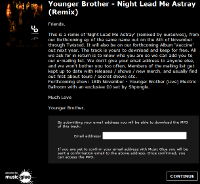
    Younger Brother’s page was a little more complex (see screenshot on the right), with more information, but basically boils down to the same thing.

    The newsletter then continues with another exciting way of dealing with the reality created by the internet, which is crowd-funding:

    “Many of you have already pledged on the Younger Brother album ‘Vaccine’ . We’re working with pledge to raise money and to set up the best possible foundation to promote and release the record next year.

    We’re calling on the loyal and faithful to help. In exchange we’re offering loads of interesting things from studio time with the band to limited artwork and access to rehearsals.”

    Again, a great way to involve fans and offer them something exciting. It basically offers them a reason to do it for themselves, instead of telling them to please buy a CD because the label needs it (see forum post). Some of the ‘items’ on the list for people that pledge: signed CD (£15), new album and entire back catalogue (£25), coming to one of their rehearsals (£40), studio workshop (£300), being in one of their videos (£150), a unique personal remix of your favourite track of the album (£600), and much more.

    The newsletter closes with more standard stuff, such as tour dates and the like.

    RECAP

    The strategy here is simple, yet complex. First of all, the label releases some very unique, high-quality music, which has given them a fanatical and evangelical following (Seth Godin would call this a tribe). Secondly, this following, together with the label, has turned into an ecosystem; when things were not going well, the ecosystem started figuring out ways in which it could survive as a whole. Thirdly, Simon Posford started paying close attention to his tribe and started catering directly to their needs. When reduced to a communication and business strategy, it becomes the formula of CwF (Connecting with Fans) and giving fans a RtB (Reason to Buy).

    Giving away free songs is a good example of connecting with fans by rewarding them. The clearest reasons to buy in this mailing are the mission to get one of the label’s artists to number 1, as well as all the rewards for pledging money for the new album.

    It is important to note that this should not be done to generate profit, but should genuinely be done to please the fans and to give them what they want. I thoroughly believe that if you betray your fans’ trust, you will lose them and your (potential) income.

    Stay tuned for more thesis excerpts. If you want to read more case studies, check out my paper about online promotion of music, if you haven’t already.

    If you’d like to stay in touch, you can follow me on Twitter.

    Click here to subscribe to email updates on my thesis.

  • Music Biz 2.0: A Lesson on Interactivity

    I just came across a blog post which compared the music industry to the gaming industry and made some very valid points. A short excerpt:

    Just as the video game industry has continually adapted and reinvented itself in the last few decades – arcades to consoles to mobile to online to apps to ad-supported and so on – the music industry must learn to quickly spot new consumer trends and behaviors, and then adapt the technology and business models to turn those trends into new revenue streams.

    • Consumers like to be social while they are entertained. This was always true to a degree, but now even the solo-music device (the portable player) has been flipped to become the most social device (thank you, iPhone apps).
    • Consumers expect to personalize everything. We always saw it in mix tapes and remixes, but that was the domain of hardcore music lovers. Now, personalization is just an expected standard feature.
    • Consumers don’t simply want to socialize, they want to compete. Socializing isn’t simply about talking to each other and sharing, it’s about showing who is king of the hill.

    My thoughts: YES! Exactly.

    The huge advantage games have over music, is that games are designed to be interactive (since games were invented), while music has lost much of its interactivity since the invention of recording technologies. While the gaming industry has always had its eyes on interactivity, the music biz completely forgot about this, which brought out a very awkward situation when it was forced upon the music biz (eg. suing fans, going bankrupt, stifling innovation).

    I think the best business model is an INTERACTIVE business model. This doesn’t mean that the music itself has to be interactive, but the experience of the music, the music-fan, the artist-fan, the label-fan, and the fan-fan relationship should be as interactive as possible. This interactivity is much easier to monetize and much more rewarding for fans to engage in (and also for the artists).

    Some examples:
    Music to fan, fan to music interactivity: a service that easily lets people make a mixtape of their favourite songs. Free to stream and share, and very cheap to download for high quality audio. Eg. 1 or 2 dollars per half hour / 7 songs. The service automatically detects intro’s, outro’s, bpm’s and keys and decides how best to merge them, if people don’t like it, they can edit it themselves via an interface such as the MixMeister one. This is not really viable for a label (not the core business), but a great idea to license one’s music to if such a service was developed.

    But as a label you could also just create a site where people can buy an album in the original version, or play with the a capella’s and (extra) instrumentals, to personalize it in their own way and then buy that version. If you create something awesome, you inspire others to want to create as well, so give them a hand 🙂

    Something I noticed after making this write-up, the blog’s author company does a great job at providing this music-fan interactivity too. Go check MXP4 out!

    Artist-fan interactivity: wow, so many business models can be tied to this one! First of all, one should always be connecting with fans, because you can monetize the relationship. Attach freemium models and you’re getting somewhere. Example: give away your album for free, sell a high quality digital copy for cheap, sell a traditional CD with cool booklet for double, sell it with an autograph for 50% more… want a special greeting from the band’s favourite member on YouTube (see the Old Spice channel for examples)? Buy 2 CD’s! Or whatever (play around with the formula’s to see what works best for you). Endless opportunities.

    Label-fan interactivity: many many possibilities here. For instance, invite people to actively participate in the development of new artists… Every label can have its own ‘X-Factor’ type of stuff. Get that sponsored, get income. Get people actively involved, and committed to getting their favourite artist signed (or new album developed and released) and they’ll do the promotion for you and probably spend money on some premium product too (or you can give it away if you’re really impressed by the job they’re doing as promoters).

    Fan-fan interactivity: create a tribe, as Seth Godin would put it. When Die Antwoord suddenly blew up, everyone was going to their website to check out the album, because they could stream it there, but it was not yet for sale. The missed opportunity there: they had all those people sharing the same enthusiasm and passion at the same time, but they were left unconnected. What you could do for an online album release party: make a stream of the album that is set to start at a certain time. The stream is static, but you let users chat with one another. To chat, they have to use Facebook Connect or Twitter to log in (making it easier to connect with one another). If fans are connected, they will stimulate each other’s passion.

    Of course you could also make some badge system, as a label, where you give people badges for attending x shows by label artists, buying x stuff from the website, getting x new active members to the community, etc etc. The badges can then be cashed in for a guest list spot (let them bring a friend, to create a new fan) or for % off, on the merchandise.

    Plus you can keep leaderboards and do some very special things for the biggest fans!

    Man, the music biz could be so awesome right now. It is time to WAKE UP!

    Thoughts? Feel free to comment, or hit me up on Twitter.

    More? Read my paper on the best practices of the online promotion of new musical content (don’t worry, it’s free).

  • To fail or not to fail… Piratenpartij 2.0

    I’m writing this post in English for two reasons. The first is that I find it easier to express myself in English, having lived abroad a lot over the last years. The second is that the eyes of pirates worldwide are upon us!

    For the last few months I’ve been the campaign manager for the Dutch Pirate Party. Even though last night’s results are disappointing in one way, we’ve accomplished something to be proud of. From being a very small group of people, we’ve formalised a political organisation, jumping all the bureaucratic hurdles along the way. We made it. With hardly no grassroots activity (except for in Brabant) and almost no funds, we’ve managed to convince thousands of voters (exact number unsure at this moment) and to reach millions of people. As a communication specialist I have to say that’s a spectacular result, even though it didn’t get us a seat in parliament.

    If you look at the below map, you can see there are pirates almost everywhere in The Netherlands!

    Via twlevo.

    Now we face a choice. To fail or not to fail. So we didn’t get seats in parliament, which isn’t easy to accept, seeing the fact that some of us sacrificed their lives for this, over the last months. What we do have is national awareness and support! We cannot let our ideas, our principles, our vision go to waste.

    What we need to do is ORGANISE. In my eyes, the most fundamental challenge in our campaign was having to cope with almost zero grassroots activism. That’s why I believe the main focus of the Pirate Party in the next months, should be on setting up local chapters that are self-organised modules in a lean mean Pirate machine. The idea of local groups is to give our formal organisation a more informal character and base. This informal character will attract a lot more people that can support the organisation in a lot of ways. These local groups will have FUN first and they’ll combine it with activism. That’s the opposite from what a lot of us have been doing in the last months: work hard first and hopefully have fun along the way.

    We cannot let our new government ignore the fact that copyrights and the patent system are up for reform. We cannot let them take away more privacy without being challenged. We need to get the local organisations growing, so that we can group together whenever it is most needed.

    We’ve worked hard. We can be proud of ourselves.
    We said we wanted to remix politics; now we’ll have to!

    For a free information society.

    Yaaarrs truly,
    Bas

    P.S. Let’s support the people of Piracy Festival (June 19, Utrecht). They still need some volunteers. See you there!

    (this post is a crosspost from the Pirate Party blog)

  • Yaarrr

    You might have noticed it’s gone a bit quiet here. That’s because I’m busy as communication manager for the Dutch Pirate Party which is aiming to get multiple seats in parliament with the June 9 election. More or less every moment of my day is spent doing things for the Pirate Party.

    Most of the regular readers know me as someone who’s quite involved in the music industry; these readers probably also know that the Pirate Party aims to drastically reform copyright (and other intellectual property laws). I believe the Pirate Party serves the needs of music creators and fans/consumers better than the current industry lobbies and with reforming laws, it will do a much better job facilitating ‘music 2.0’ and the recording industry has (see: Spotify, imeem, Pandora, Last.fm or all those other struggling music 2.0 initiatives).

    More important than that, is civil liberties. We live in an age of digitalisation; an age that has made copyrights impossible to maintain without seriously infringing on the rights of civilians and destroying the openness of the internet. We have a choice. Either we jump into the digital revolution and safeguard our liberties, or we let the big corporations convince the government to ‘industrialize’ the digital. The industrial revolution is over, it’s time for a new reality.

    To further understand why I’m involved in this worlwide movie, check out the video below and the website of the Dutch Pirate Party (in Dutch).

    Uppsala Declaration
    http://int.piratenpartei.de/Uppsala_Declaration
    Important instruction for all pirates
    http://www.youtube.com/watch?v=zUe-Ebe8dWU
    Pirate Manifesto parties at a glance
    http://int.piratenpartei.de/Pirate_Manifesto_parties_at_a_glance

    Edit – Oh yeah, and I’m also a Pirate Party candidate for parliament 😉
    http://twitter.com/Spartz

  • A small stretch of your imagination…

    “Imagine no possessions
    I wonder if you can
    No need for greed or hunger
    A brotherhood of man
    Imagine all the people
    Sharing all the world”

    Oh, the irony. If only words could sum up what I think about this. Someone is frantically rolling in his grave right now…

    Found @ EHPO.

  • What If This Happened Before?

    Had a good chat over dinner tonight, with Len. It was basically about ‘more perfect systems’ for this world and how they could be put in place. My personal vision is a very interconnected world of interdependent communities that are grouped around certain core beliefs. People would live more within a tribe-like group of around 200 people as a close community, instead of the many communities we live and participate in right now (work, free time, neighbourhood, etc.). This doesn’t mean that you don’t interact with people outside your tribe, but I’m getting into specifics…

    A thing I have always struggled with, when it comes to utopic ideas, is how do you get there if you take the current society as a starting point? The last time I thought about this question is quite a while ago and I have since gotten more tech-oriented and I believe technology within the next few decades will radically alter global human culture. So probably this ‘more perfect system’ would come into place by being enabled by technology.

    What if at some point we decide that it’s too risky to use our real bodies to interact with the world, such as suggested in the film Surrogates. There are already people who are trying to call a halt to handshaking, because it’s just too risky. Imagine if in the next few decades there are more and more viruses like SARS, bird flu, swine flu, etc. coming up, constantly threatening mankind’s health. Imagine if technology keeps growing exponentially… If we could put our bodies in safe suspension and create an avatar that interacts with a world that’s just as real as the current one, but organized in a more perfect way… I thought: “that would be great! Because we would know that the virtual world that our avatar lives in is not real, so we would be more relaxed about our (virtual) life circumstances”.

    And then I thought… “but what if the reality our avatar lives in does become vital to us… what if we identify so much with that reality, that we forget about the actual reality where our consciousness lies”… And then it struck me: “what if this happened before?”

    Who’s to say it didn’t.


    “Reality is merely an illusion, albeit a very persistent one.”
    – Albert Einstein

    “A wise man, recognizing that the world is but an illusion, does not act as if it is real, so he escapes the suffering.” – Gautama Buddha

  • Why the Music Industry Can Learn from DIE ANTWOORD

    Last week I read about Die Antwoord on the Birthday Party Berlin blog. The first time I watched their video, I was immediately convinced I had witnessed something I needed to share, to spread. Apparently I wasn’t the only one… One week later and the blogosphere is blowing up with posts about Die Antwoord.

    In one day, they have doubled their Facebook fans from 5.000 to 10.000 and it seems like they’re still picking up steam, with blogs like Boing Boing, Dlisted and Mad Decent writing about them. Why is that? It is very simple. Die Antwoord is unique. They offer something fresh, in a remarkable way… In the digital age, where we can share all the music we want, being remarkable is THE most important characteristic for a band, group, musician, producer, etc. You have to be worth talking about.

    So what did they do? Not much. They created a unique concept (or maybe this is just an extension of their personalities), uploaded their songs to YouTube, do a lot of performing and try to get people to spread the word. That’s probably why they give away music at live shows: “First 100 zeflings thru the door get a free hand-drawn full-length $O$ album (16 tracks) burned by die fokken rap-rave meesters NINJA en YO-LANDI.”

    That’s it! Do something remarkable, connect with the fans and give them a reason to buy. Their album is due soon on Magnetron Music and I expect it to sell quite well for a debut, but of course it will be downloaded for free much more often… The “reason to buy” for now is going to be their live performances until they’ve built a considerable fanbase and they can start applying freemium on a bigger scale.

    So who else are doing this? In The Netherlands we have an act which is quite similar, which also generated a lot of buzz when they first came to the scene; De Jeugd van Tegenwoordig. They’re actually label mates of Die Antwoord, just like a bunch of other great acts.

    Another act that the music industry can learn from in my eyes, is MENEO, although MENEO is a bit less reachable for fans. Same goes for belladonnakillz.

    Anyway, to conclude this post… I suggest you head over to the website of Die Antwoord and listen to their album. You can stream it in its entirety on there.

    ONE TO WATCH!

  • “Online music piracy ‘destroys local music’”. O RLY?

    Just a quickie.

    Today an article at the BBC reported the ‘music industry’ claiming that piracy is destroying local music. Of course not the entire music industry believes this, just IFPI which represents only a fraction of all those working in the music industries (yes, there are multiple music industries).

    The article states:

    The sales of albums by local artists there have fallen by 65% in five years.

    Federation chairman John Kennedy said the situation in Spain is now “almost irreversible”.

    “Spain runs the risk of turning into a cultural desert,” commented Rob Wells, Senior Vice President, Digital, at Universal Music Group.

    A cultural desert? Really? How about including statistics on live music? There is a very vibrant scene of young, creative musicians in cities like Barcelona and it appears to be thriving. I’m sure there are numbers that suggest the same. Such a ‘desert’ is more likely to be created by ‘music monopolies’, where big companies flood the market with non-local musicians by employing huge marketing budgets. Local artists would struggle to compete with that. If anything, big labels like UMG are causing a cultural desert, but is it really about the richness of culture or the richness of the labels?

    When I read the following bit in the article, I had to count to 10…

    He described the loss of the recent court case against BitTorrent website Oink as “a terrible disappointment” and an indication that current laws in the UK are “out of touch with where life is”.

    Out of touch with where life is??? It is 2010. Music distribution is nearly costless, yet ‘you’ demand unreasonable prices for a copy of a song. Yes, there are production prices (but live revenue and sponsoring can help with that), and yes there is a marketing budget which needs to be earned back, but perhaps the world is better off without the marketing. You cannot finance one thing, by making money from something unsustainable – that’s bad business.

    “The news from the commercial viewpoint is reasonably good but it’s not happening fast enough,” said Mr Wells.

    So by stifling innovation through draconian laws, this process is going to be accelerated?

    “The music industry finally believes it is making progress in the battle against web piracy with governments taking action and legal music services beginning to prove viable,” said BBC technology correspondent Rory Cellan-Jones.

    “But the industry is still furious about what it sees as negligence by some governments notably Spain – and is warning that there is a growing threat to local artists posed by piracy.”

    Prove that there’s a threat. Record sales mean nothing at all.

    There ARE ways for artists to make money and not to depend on selling records… The only side in this that really depends on selling records are the record companies. And guess who are the loudest party in this struggle? Exactly. Record companies have to reshape themselves totally and governments have to prevent these companies from ‘micro-managing’ the lives of consumers.

    I’m sure some people will read this and feel angry. Please leave a comment and let’s discuss the future. I am 100% confident there is more than enough money to be made in the music industries, both local and global. Hey, my livelihood depends on it.

    If you have numbers to share, for instance on live revenue in Spain, please do!! Help me make my point (or disprove it, if you want).

    Here’s the article at BBC, there’s more to it, go check it out: http://news.bbc.co.uk/2/hi/technology/8471290.stm

  • Best practices of the online promotion of new musical content

    As the regular readers of my blog probably know, I’m writing my graduation thesis about the future of music distribution. Due to some setbacks and unforseen circumstances, this thesis has suffered some delays. However, using the knowledge and insight I gained in the past month, while studying my thesis’ topic, I have compiled a paper called the Best Practices of the Online Promotion of New Musical Content.

    It looks at artists like Radiohead, Nine Inch Nails, Danger Mouse and Sparklehorse, Mos Def, and Groove Armada, and analyzes what they’ve been doing right and wrong and why they’ve been doing it in the first place.

    So while you wait for the thesis and the launch of FutureOfMusicDistribution.com, how about going through this 20 page paper? 🙂

    To download and read the whole paper, just use this link:

    http://www.basbasbas.com/online_promotion_of_new_musical_content-Bas_Grasmayer.pdf

    And feel free to redistribute it, it’s licensed under a Creative Commons license!

    Love,
    Bas


    Image by Gary Simmons, shared under a Creative Commons license on Flickr.

  • Ouch, my calves! (A lesson about barefoot running)

    Alright, lesson learned. If you’re going to start barefoot running, start slow. REALLY slow.

    If you’re following this blog, I bought them. Not just that, I even started a site dedicated to barefoot lifestyle. I’ve become convinced that going barefoot is a very interesting experiment (plus it feels great) and that it’s an upcoming trend. Why? Well, I ended up buying the Vibram Five Fingers. When I first saw them, I ridiculed them, more or less like everybody else. However, I bought these shoes for a great reason and my reasons make sense (you can read about this on my Squidoo lens). The product itself catches the attention of people, just before they start ridiculing it. I’m quite evangelical about my choice though (as with all my choices), so once I have their attention, I explain WHY I bought it, creating interest. Suddenly I find people quite open about  the shoes and suddenly not ridiculing them anymore. As a matter of fact, they’ll start asking questions instead.

    That’s the positive side of the experience. The other is a lesson. If you’re going to start barefoot running (or using minimalistic, barefoot simulating shoes, like the Vibram five fingers), then START SLOW. Imagine how slow you should start. Then HALF that. I normally do a 2 kilometer lap every two days or so. Just a 10 minute run, because I enjoy it. So when I went to try out the shoes, I loved the new way in which I was running. I ran about half and walked the other half, but I overdid it. Next day: terrible muscle ache. Day after that: STILL terrible muscle ache.

    Really, do yourself a favour and start slow! But not before doing yourself a bigger favour: go barefoot! 🙂

Related Posts Widget for Blogs by LinkWithin