Drew this model up for my thesis, to basically summarize the way the new music business works for most labels. Does this look right to you? Am I forgetting anything?
I’m writing this post in English for two reasons. The first is that I find it easier to express myself in English, having lived abroad a lot over the last years. The second is that the eyes of pirates worldwide are upon us!
For the last few months I’ve been the campaign manager for the Dutch Pirate Party. Even though last night’s results are disappointing in one way, we’ve accomplished something to be proud of. From being a very small group of people, we’ve formalised a political organisation, jumping all the bureaucratic hurdles along the way. We made it. With hardly no grassroots activity (except for in Brabant) and almost no funds, we’ve managed to convince thousands of voters (exact number unsure at this moment) and to reach millions of people. As a communication specialist I have to say that’s a spectacular result, even though it didn’t get us a seat in parliament.
If you look at the below map, you can see there are pirates almost everywhere in The Netherlands!
Now we face a choice. To fail or not to fail. So we didn’t get seats in parliament, which isn’t easy to accept, seeing the fact that some of us sacrificed their lives for this, over the last months. What we do have is national awareness and support! We cannot let our ideas, our principles, our vision go to waste.
What we need to do is ORGANISE. In my eyes, the most fundamental challenge in our campaign was having to cope with almost zero grassroots activism. That’s why I believe the main focus of the Pirate Party in the next months, should be on setting up local chapters that are self-organised modules in a lean mean Pirate machine. The idea of local groups is to give our formal organisation a more informal character and base. This informal character will attract a lot more people that can support the organisation in a lot of ways. These local groups will have FUN first and they’ll combine it with activism. That’s the opposite from what a lot of us have been doing in the last months: work hard first and hopefully have fun along the way.
We cannot let our new government ignore the fact that copyrights and the patent system are up for reform. We cannot let them take away more privacy without being challenged. We need to get the local organisations growing, so that we can group together whenever it is most needed.
We’ve worked hard. We can be proud of ourselves.
We said we wanted to remix politics; now we’ll have to!
For a free information society.
Yaaarrs truly,
Bas
P.S. Let’s support the people of Piracy Festival (June 19, Utrecht). They still need some volunteers. See you there!
You might have noticed it’s gone a bit quiet here. That’s because I’m busy as communication manager for the Dutch Pirate Party which is aiming to get multiple seats in parliament with the June 9 election. More or less every moment of my day is spent doing things for the Pirate Party.
Most of the regular readers know me as someone who’s quite involved in the music industry; these readers probably also know that the Pirate Party aims to drastically reform copyright (and other intellectual property laws). I believe the Pirate Party serves the needs of music creators and fans/consumers better than the current industry lobbies and with reforming laws, it will do a much better job facilitating ‘music 2.0’ and the recording industry has (see: Spotify, imeem, Pandora, Last.fm or all those other struggling music 2.0 initiatives).
More important than that, is civil liberties. We live in an age of digitalisation; an age that has made copyrights impossible to maintain without seriously infringing on the rights of civilians and destroying the openness of the internet. We have a choice. Either we jump into the digital revolution and safeguard our liberties, or we let the big corporations convince the government to ‘industrialize’ the digital. The industrial revolution is over, it’s time for a new reality.
To further understand why I’m involved in this worlwide movie, check out the video below and the website of the Dutch Pirate Party (in Dutch).
Had a good chat over dinner tonight, with Len. It was basically about ‘more perfect systems’ for this world and how they could be put in place. My personal vision is a very interconnected world of interdependent communities that are grouped around certain core beliefs. People would live more within a tribe-like group of around 200 people as a close community, instead of the many communities we live and participate in right now (work, free time, neighbourhood, etc.). This doesn’t mean that you don’t interact with people outside your tribe, but I’m getting into specifics…
A thing I have always struggled with, when it comes to utopic ideas, is how do you get there if you take the current society as a starting point? The last time I thought about this question is quite a while ago and I have since gotten more tech-oriented and I believe technology within the next few decades will radically alter global human culture. So probably this ‘more perfect system’ would come into place by being enabled by technology.
What if at some point we decide that it’s too risky to use our real bodies to interact with the world, such as suggested in the film Surrogates. There are already people who are trying to call a halt to handshaking, because it’s just too risky. Imagine if in the next few decades there are more and more viruses like SARS, bird flu, swine flu, etc. coming up, constantly threatening mankind’s health. Imagine if technology keeps growing exponentially… If we could put our bodies in safe suspension and create an avatar that interacts with a world that’s just as real as the current one, but organized in a more perfect way… I thought: “that would be great! Because we would know that the virtual world that our avatar lives in is not real, so we would be more relaxed about our (virtual) life circumstances”.
And then I thought… “but what if the reality our avatar lives in does become vital to us… what if we identify so much with that reality, that we forget about the actual reality where our consciousness lies”… And then it struck me: “what if this happened before?”
Who’s to say it didn’t.
“Reality is merely an illusion, albeit a very persistent one.” – Albert Einstein
“A wise man, recognizing that the world is but an illusion, does not act as if it is real, so he escapes the suffering.” – Gautama Buddha
Last week I read about Die Antwoord on the Birthday Party Berlin blog. The first time I watched their video, I was immediately convinced I had witnessed something I needed to share, to spread. Apparently I wasn’t the only one… One week later and the blogosphere is blowing up with posts about Die Antwoord.
In one day, they have doubled their Facebook fans from 5.000 to 10.000 and it seems like they’re still picking up steam, with blogs like Boing Boing, Dlisted and Mad Decent writing about them. Why is that? It is very simple. Die Antwoord is unique. They offer something fresh, in a remarkable way… In the digital age, where we can share all the music we want, being remarkable is THE most important characteristic for a band, group, musician, producer, etc. You have to be worth talking about.
So what did they do? Not much. They created a unique concept (or maybe this is just an extension of their personalities), uploaded their songs to YouTube, do a lot of performing and try to get people to spread the word. That’s probably why they give away music at live shows: “First 100 zeflings thru the door get a free hand-drawn full-length $O$ album (16 tracks) burned by die fokken rap-rave meesters NINJA en YO-LANDI.”
That’s it! Do something remarkable, connect with the fans and give them a reason to buy. Their album is due soon on Magnetron Music and I expect it to sell quite well for a debut, but of course it will be downloaded for free much more often… The “reason to buy” for now is going to be their live performances until they’ve built a considerable fanbase and they can start applying freemium on a bigger scale.
So who else are doing this? In The Netherlands we have an act which is quite similar, which also generated a lot of buzz when they first came to the scene; De Jeugd van Tegenwoordig. They’re actually label mates of Die Antwoord, just like a bunch of other great acts.
Another act that the music industry can learn from in my eyes, is MENEO, although MENEO is a bit less reachable for fans. Same goes for belladonnakillz.
Anyway, to conclude this post… I suggest you head over to the website of Die Antwoord and listen to their album. You can stream it in its entirety on there.
Today an article at the BBC reported the ‘music industry’ claiming that piracy is destroying local music. Of course not the entire music industry believes this, just IFPI which represents only a fraction of all those working in the music industries (yes, there are multiple music industries).
The article states:
The sales of albums by local artists there have fallen by 65% in five years.
Federation chairman John Kennedy said the situation in Spain is now “almost irreversible”.
“Spain runs the risk of turning into a cultural desert,” commented Rob Wells, Senior Vice President, Digital, at Universal Music Group.
A cultural desert? Really? How about including statistics on live music? There is a very vibrant scene of young, creative musicians in cities like Barcelona and it appears to be thriving. I’m sure there are numbers that suggest the same. Such a ‘desert’ is more likely to be created by ‘music monopolies’, where big companies flood the market with non-local musicians by employing huge marketing budgets. Local artists would struggle to compete with that. If anything, big labels like UMG are causing a cultural desert, but is it really about the richness of culture or the richness of the labels?
When I read the following bit in the article, I had to count to 10…
He described the loss of the recent court case against BitTorrent website Oink as “a terrible disappointment” and an indication that current laws in the UK are “out of touch with where life is”.
Out of touch with where life is??? It is 2010. Music distribution is nearly costless, yet ‘you’ demand unreasonable prices for a copy of a song. Yes, there are production prices (but live revenue and sponsoring can help with that), and yes there is a marketing budget which needs to be earned back, but perhaps the world is better off without the marketing. You cannot finance one thing, by making money from something unsustainable – that’s bad business.
“The news from the commercial viewpoint is reasonably good but it’s not happening fast enough,” said Mr Wells.
So by stifling innovation through draconian laws, this process is going to be accelerated?
“The music industry finally believes it is making progress in the battle against web piracy with governments taking action and legal music services beginning to prove viable,” said BBC technology correspondent Rory Cellan-Jones.
“But the industry is still furious about what it sees as negligence by some governments notably Spain – and is warning that there is a growing threat to local artists posed by piracy.”
Prove that there’s a threat. Record sales mean nothing at all.
There ARE ways for artists to make money and not to depend on selling records… The only side in this that really depends on selling records are the record companies. And guess who are the loudest party in this struggle? Exactly. Record companies have to reshape themselves totally and governments have to prevent these companies from ‘micro-managing’ the lives of consumers.
I’m sure some people will read this and feel angry. Please leave a comment and let’s discuss the future. I am 100% confident there is more than enough money to be made in the music industries, both local and global. Hey, my livelihood depends on it.
If you have numbers to share, for instance on live revenue in Spain, please do!! Help me make my point (or disprove it, if you want).
Happy new year to everyone! Today while reading The Tibetan Book of Living and Dying I ran into a good poem to remind you how to deal with new year’s resolutions and figured it would make a great post to start the year off with.
Autobiography in Five Chapters
1) I walk down the street.
There is a deep hole in the sidewalk
I fall in.
I am lost… I am hopeless.
It isn’t my fault.
It takes forever to find a way out.
2) I walk down the same street.
There is a deep hole in the sidealk.
I pretend I don’t see it.
I fall in again.
I can’t believe I’m in the same place.
But it isn’t my fault.
It still takes a long time to get out.
3) I walk down the same street.
There is a deep hole in the sidewalk
I see it is there.
I still fall in… it’s a habit
My eyes are open
I know where I am
It is my fault
I get out immediately.
4) I walk down the same street.
There is a deep hole in the sidewalk
I walk around it.
5) I walk down another street.
One of my own resolutions is to blow more life into this blog, since it has been gathering digital dust for quite a while due to personal circumstances. No more though, just subscribe to the feed (I recommend using Feedly) and stay in touch!
With this post I hope to address some of the misunderstanding and fear mongering which surrounds Google SideWiki and other annotation services. First of all, let me explain what Google SideWiki is exactly. Basically, it’s a plugin that you install (via the Google Toolbar) that enables a sidebar on the left side of your browser. In this sidebar, you can comment on any website you visit – whether that site has enabled comments on their own site or not. This means that the website author loses control over the comments placed on the website. The video below shows how it works.
This is not the only annotation service (I prefer AddATweet), but is catching most of the attention since Google’s name is attached to it.
The response to SideWiki has been very mixed. Especially small entrepreneurs seem to be worried, voicing concerns like “what if my competitors start leaving fake negative reviews”.
Here’s how I see it…
It was never your RIGHT to control comments in the first place.
The Internet enabled this and now it’s disabling the control again. In real life, you cannot control what people say about you or your business. Since the Internet makes sharing ones opinions and reviews so easy, you better make sure you adapt to it and do a great job for others and always stay ethical! If not, sooner or later you will be called on it. This is why I also think we shouldn’t worry about competitors that try to spam your site’s SideWiki with negative comments – because if that’s their business mentality, the Web will destroy their reputation.
Google SideWiki and other annotation services make a more transparent web.
For instance, go to any hotel’s website and usually you can see customer reviews. Of course the hotels moderate these reviews, but with the Internet becoming more central to our lives by its increasing mobility (laptops, netbooks, mobile devices), it will get harder and harder to rip people off by not delivering what you promise. You have to meet expectations and exceed them if you want to succeed in a transparent world.
It’s inevitable.
To be honest, I think the cries for a ‘ban’ of Google SideWiki are absolutely ridiculous and show a complete lack of understanding of the Internet. Within the next ten years, augmented reality will become common. This would let people aim the camera of their mobile device at a restaurant and instantly receive reviews in an overlay on the screen of their mobile device – but this will be possible for every and anything. For an example of this, check out Layar in the video below.
People are already leaving comments about your business in channels you don’t own or control.
For instance on Twitter. It was just a matter of time before someone brought the reviews and the subjects of the reviews together. AddATweet has doen that, which is why I prefer AddATweet over Google’s SideWiki; it combines existing social networks with annotation… plus it doesn’t require me to download some toolbar I really don’t need or want.
The problems will solve themselves.
Yes, anonymous commenters might be a nuisance, but how much weight do people really give to such comments compared to a non-anonymous comment? Also, your personality reflects in everything that you do, so if you’re a troll, people will have trouble trusting your business and they’ll leave non-anonymous comments about this through annotation services. Perhaps there are other concerns – let’s talk about them, leave a comment!
In the end, I think these annotation services will do many times more good than bad (if they’ll do any bad at all, besides create a little more clutter to sift through).
So in short, here’s how I think annotation services, like Google SideWiki, will make the world a better place:
– Increased transparency; you can no longer say A and do B. The web will catch up with you.
– Democratization; we get to say what we want, about who we want and make others listen.
– Creating conversation; this will force any business to converse with and listen to its (potential) consumers.
– Collaboration; you can leave helpful hints for others on any website. For instance, if a website is unclear, you can point others in the right direction.
So, suck it up people. You no longer control the conversation – and you never have. If you’re worried about this, adapt your business model to something more ethical and aim to exceed expectations. Be confident! 🙂
Comments? Let’s have a discussion. You can also reach me on Twitter.
UPDATE
Within minutes of posting this, somebody called “SidewikiSux” already tweeted that there’s a lot of “BS” here in his or her honest opinion. Not sure why. Figured I would share this to show the amount of animosity towards Google’s annotation service. Opinions don’t convince me, arguments do… Let’s DISCUSS like mature people.
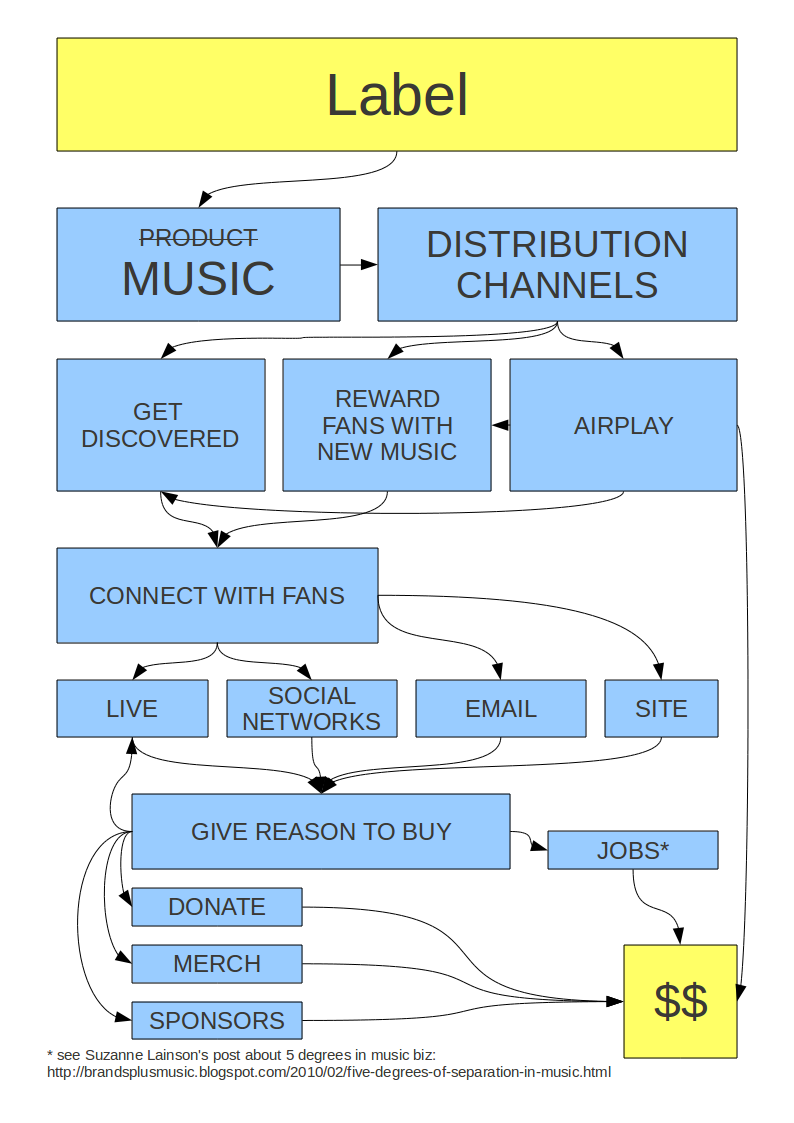 Click picture to enlarge. Click here for Suzanne Lainson’s post, mentioned at the bottom of the model behind the asterisk.
 I’m writing this post in English for two reasons. The first is that I find it easier to express myself in English, having lived abroad a lot over the last years. The second is that the eyes of pirates worldwide are upon us!
 Via
Via  You might have noticed it’s gone a bit quiet here. That’s because I’m busy as communication manager for the