While I do not know much about the match-industry, I imagine it’s in decline. In societies where easier solutions such as lighters are cheap, why use matches. The other day I had a marketing idea, and since I don’t know anyone in the match industry, I’ll just put the idea up here for grabs.
I think you can mass-market matches and give them a sexy image. First of all, you would use a slogan such as “[Brandname], the original matchmaker” to hook into the singles lifestyle trend, which is part of the greater megatrend of individualization. Then you capitalize on a huge opportunity that I feel has not been capitalized on properly (at least in Europe).
The smoking ban annoyed many, but it also created smoking areas inside or outside clubs. The social dynamics of smoking areas are great; it’s a new and easy way to meet people in bars or clubs. So for your commercial, you show pretty boy/guy and a pretty girl in such a smoking area and one of the two strikes a match… Insert cheesy catchphrase like “Every time a match is struck, a match is made. [Brandname], the original matchmaker.” One should position the match as genuine, fashionable, sexy, original, authentic, individualistic, determined… Let’s face it, typical plastic lighters are just boring.
You can also do a lot when it comes to product design. For instance, on the back of the pack there will be certain instructions (which will differ per pack… let’s say 15-20 different packs). The match will be split into two colours. For instance normal colour on the upper half and blue at the bottom half. When you light something and blow out the match, you break it in two with your match. The one that has the other person’s colour on their half of the broken match, will have to perform the instructions on the back of the pack.
For every one of these ideas, I have another 10 and I didn’t spend much time thinking about this yet.
I think it’s time the match reinvented itself. The next time I use a match, I would like it to be a match made in heaven.
😉
By the way, if anyone in the match industry reads this (I can’t imagine, but who knows)… I’m almost done graduating, so if you want to execute this get in touch with me and let’s work together and let’s turn your industry upside down.
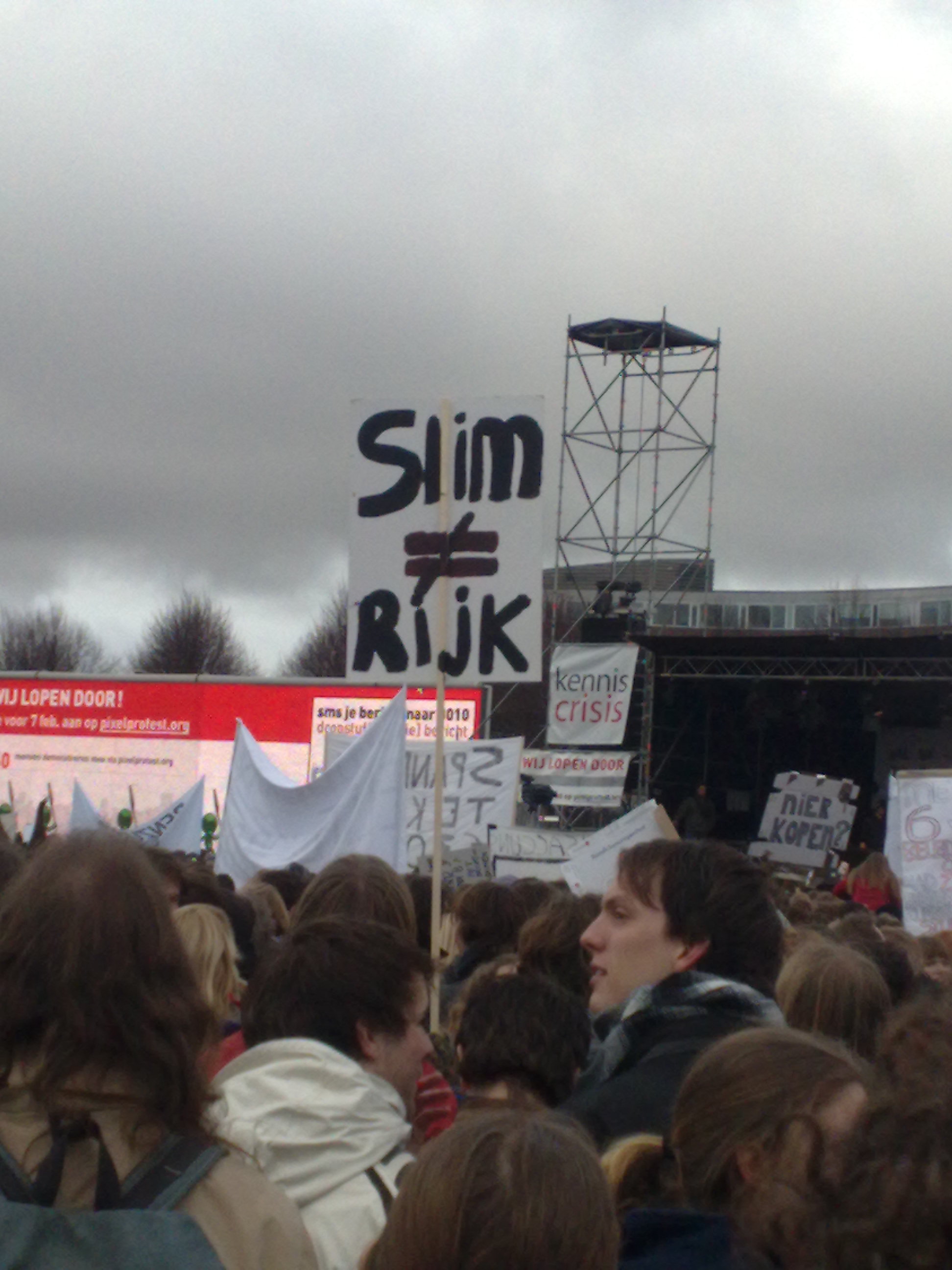
Leading up to the organized student manifestation against the financial cuts in higher education, there were a bunch of news reports about there being ‘signals‘ that radicals would come and hijack the protest and try to create riots. Radicals was obviously never defined, but at the time I didn’t think much of it. A little while later, I realized what a genius piece of spin-doctoring it had been.
What the message did, was create an expectation of radicals getting violent. For one, radicals can mean football hooligans, for another it can be anarchists, or communists, or foreigners, or anything else which they perceive as dramatically different than them. The manifestation itself was more like a political rally more suitable for election time. When students decided to go to the political quarters to let themselves be heard, they were met by police and violence ensued.
The spin makes it seem like the violence was caused by radicals. I think it was caused by upset students. The difference?
For any government, it’s important to create the impression that the general population is content with the government. The label ‘radicals’ was defined by a set of actions and expectations (mainly disobedience and perhaps violent actions or rioting), so when normal people acted this way, they became radicals. This makes sure that ‘normal people’ don’t identify with these radicals (formerly known as normal people).
Identification creates understanding creates support. The last thing a government which plans to make drastic financial cuts and reforms wants, is people supporting a disobedient protest movement.
Most of the (25) people arrested last Friday were obviously not radicals. They were students. They were normal people (they still are). They were people like you and me.
I go through huge amounts of links and information each day when it comes to the music business, but this is by far the coolest and funniest way of getting your music discovered I’ve seen in a very long time. (OK Go, eat your heart out)
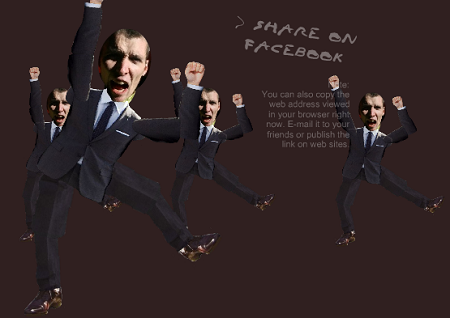
The idea of The Ugly Dance is very simple. You go to the site, upload your picture and you can choose all kinds of maniacal ways of dancing. Here’s me dancing like nobody’s watching:
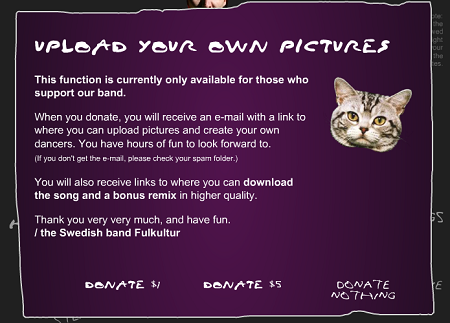
It’s a project by Swedish band Fulkultur and appears to have been around for about half a year now. Obviously, this type of thing spreads. Getting your music heard by a lot of people (and what a catchy song it is). When I wanted to create a second dancer (to send to a friend), I got the following message:
A very reasonable thing to ask… and since I was in such a great mood and figured the donation would not be much effort anyway, I went ahead and gave them some money, even though I think clicking the Donate Nothing button would still allow you to create more dancers (can anyone verify this?).
These videos are the result of the ECOSYSTEM at work!
Perfect example of using something viral to getting your music discovered, but also creating a movement which is easy to join, because it’s obvious what you have to do to participate (also read Derek Sivers’ post about this). Not sure if they’re making any money out of it directly (from the donations), as it might take quite some bandwith to keep this site online, but at least indirectly, by creating an ecosystem and giving them what they want (new music, live shows, merchandise, signed albums, perhaps an Ugly Dance at your own party?).
I’ve been writing a lot about the concept of the ecosystem lately (don’t worry if you haven’t been following, it’s explained again in this post), but only applied to the music business. Obviously, this can be applied to any type of brand, service or product which has a ‘fan’ potential.
A good example of this application of the ecosystem is with companies stimulating their employees to blog. In a reply to a question about this on Quora (GO SIGN UP!), I wrote the following:
What has been enabled in recent years, is the socialization of brands.
It’s no longer about one-way communication via TV and other media, not even about two-way communication (like customer service, mail, emails), but about non-linear many-to-many communication. This creates a new situation.
What few companies could successfully do pre-digital age, almost any company can do now. Starbucks had a massive following and ‘fanbase’ before the digital age, but now all of the members of this following (or ecosystem as I like to call it) can be connected to each other.
The following can be turned into a community. Now, why is it good that large organisations encourage their employees to blog?
These organisations have to be part of their own ecosystem. This works best when it’s done authentically and genuinely (such as via employees). This will strengthen the ties between your ecosystem and the brand, which adds tremendous value for the brand (as well as the customers). It’s a bit of a cliché phrase, oft-repeated by ‘social media experts’, but one has to be part of the conversation.
A brand that is well-connected with their users or customers, is a flexible brand. In times of rapid change, the greatest strength if flexibility. No matter how strong your pillars are… If they’re rigid and get torn down, they will break and shatter.
James Hargreaves made a good addition, which simplifies it even further:
Just to add in more laymen’s terms, a blogging employee adds the ‘human’ element to the ‘face’ of the business, showing a non-corporate means of communicating with consumers, clients, etc.
I firmly believe that anything that can be done digitally will change the system it’s part of, whether that’s a political, economic or social system. The ecosystem is one of the basic rules and models for success in the digital age (if one thoroughly understands the concept, which is easier for digital natives than others). This is not just about the music industry; if your industry has not been impacted yet and part of it is digitizable, then it will be impacted.
I listen to a lot of music and I come across songs probably unintentionally borrowing elements from each other every now and then. One of the most obvious examples I’ve run into lately is the case of i Square vs Calvin Harris though.
First there was Calvin Harris‘ I’m Not Alone, who composed a catchy tune with a melody that just really stuck! Maybe a little too much…
And then there was i Square’s Hey Sexy Lady.
OOPS!
How does this keep happening? Nobody involved at any point said: “hey, you know what, you know why you suddenly felt so inspired with that melody? It’s because you heard it when Calvin Harris’ track was playing somewhere.” Oh, and Magnetic Man’s I Need Air also sounds quite similar.
Or maybe they licensed it. I don’t know. Terribly uncreative though. 😉
Plagiarism?
Another recent scandal is the Usher vs The Simpsons / Homer Simpson situation by the way.
When I first heard deadmau5‘ work 3 or 4 years ago, I was immediately excited. Here was a guy doing something new, developing a sound that was completely his own. Even though he was only known by perhaps a few dozen people per country, it was obvious that this guy was going to be influential and blow up.
He has pulled it off in a spectacular way (awesome branding) and when I finally started following him on Facebook, I was thrilled with his level of engagement with his fanbase, or ecosystem (remember?).
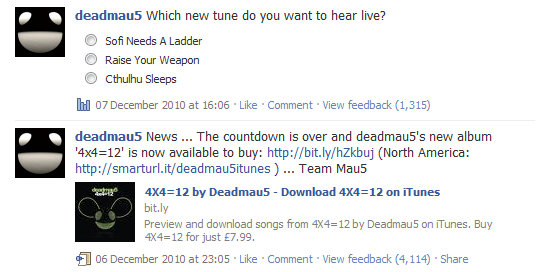
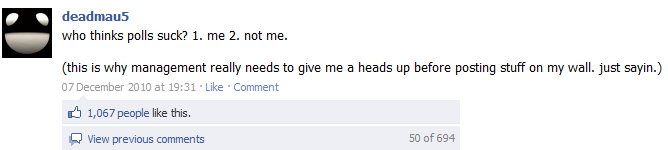
In the beginning of December, this interesting development took place, where deadmau5′ marketing team decided they should get involved in communicating to his fans.
Apparently deadmau5 didn’t like the fact that his management was disturbing the trust and rapport he had built up with the ecosystem, because those status updates were followed by deadmau5’s:
Then he checked the backend of his Facebook page…
Excellent choice, in my opinion. This is the best thing he could do to earn back the trust of the ecosystem, because you really don’t want to get on the bad side of the ecosystem. The ecosystem can reject you, the ecosystem can move on, the ecosystem doesn’t need YOU in order to survive.
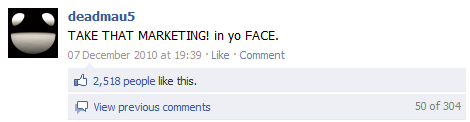
And the cool thing is, he wasn’t thinking about marketing or self-preservation or strategy in the process of making his choices. It’s just him, genuinely. And I guess the status update he posted 1 minute later shows just that:
Lesson learned: keep it personal and have fun in the process!
Oh, and I do not recommend everyone to get into a fight with their management, because you can get fired from your label, but maybe you’re better off without that particular label anyway.
This case-study is about Shpongle, a much respected group of musicians, in a very specific niche: psychedelic chill-out, but attracting many fans of other genres too and is generally categorized as ‘electronica’.
A while before they released their latest album ‘Ineffable Mysteries From Shpongleland’, it leaked onto filesharing networks and fans of Shpongle started discussing the new album on the internet forum of Shpongle’s record label, Twisted Music. Obviously, Simon Posford, the main person behind Shpongle and owner of the Twisted Music label, was very unhappy about this and lashed out:
“So some fucker has released the album on the internet already…. thanks a lot, whoever it was… Maybe twisted will still recoup, maybe not… all i know is that we are teetering on bankruptcy, and are seeking deals elsewhere…. the 12 loyal fans on this forum are not enough to sustain a record label…. How much do you think Twisted has in the bank account? Have a guess? More than $10,000 ? More than $20,000 ? Well it is actually less than $1,000….. Raj and i haven’t even been paid our advance for this album…. All the artists on twisted are seeking deals with other labels now… We can’t pay a label manager, and we can’t pay the artists…. always putting our hope in ‘just ONE more release’…. “We’ll be ok if the DVD sells”….“Surely the Shpongle CD will sell, right?”
[…]
This sucks, for Twisted, for myself and Raj who have spent 3 years working on the album…. Just as i started looking around and posting on this forum again, i remembered why i shouldn’t bother…. I’m outta here… Soon to be followed by Younger Brother [another project by Simon Posford] and probably Twisted…
Enjoy.”
He got understandably emotional, but misdirected his anger towards perhaps the most dedicated fans: those who really cannot wait until the release and decided to preview it. After all, Shpongle hadn’t released an album in four years and their following is quite fanatical about their music. Later in the same forum topic, he adds some more thoughts which are also relevant to this case study:
“It’s all very well to speculate, but i can tell you as a fact, we made more money before file sharing… we could survive… now not so…. and i think you will find it the same all over the music business… the argument that “file sharing is promotion” is probably valid…. in fact, i agree…in a way it serves a similar purpose to radio…. but the argument that “file sharing is promotion and therefore you will sell more CDs” is clearly absolute bollocks, otherwise the music industry would be booming right now!
[…]
Also i’m sorry that “And if it weren’t for the internet, I would have given up on music entirely”…. for me, the internet makes me want to give up music wink But i guess i’m from a different generation…. I started making some of the trance that probably fills your 100Gigs hard drive before i’d even heard of the internet… and i didn’t need the internet to find a deep love of music… the rush of buying a new vinyl, of collecting every release/picture disc by my favourite artists…. discovering new music i liked, all underground, no radio-plugged mix CDs or whatever… ALL without the internet!”
Later on in the topic, which currently carries over 600 replies, fans started to suggest ideas to Simon. They encouraged each other to buy more merchandise, replace old t-shirts or hoodies, buy an extra album to give to a friend and they came up with ideas to help out Simon Posford, Shpongle, and Twisted Music.
And it seems Simon has also learned from the fact that you indeed will not sell more CD’s even when filesharing is good promotion, as he noted. Being a fan myself, I was very delighted to receive a newsletter, one year after the leak, which featured some interesting new business models and experiments. It does a few things very well and I’ll highlight this bit by bit. The opening paragraph is as follows:
“Dear Twisted fans,
The new Prometheus album has been doing very well on Beatport with 4 of his tracks reaching the Top10 of the electronica charts. If you haven’t got your copy yet then Benji and Twisted would be happy if you could get onto Beatport and purchase at least the electronica tracks. We’d love to see him get to Number 1!
Ott is beginning his 6 date tour of the USA starting tonight! You can see and buy tickets to all his tour dates at the bottom of this newsletter. You can also join his Facebook Fan Page here.
We’ve also got two new tracks of Younger Brother and Shpongle available as a free download, keep reading to find out how to get hold of them.”
What a dramatic change of tone, compared to the rants on the forum. This is how you connect with fans! First of all, it acknowledges fan support in terms of chart positions and makes a polite request (as opposed to lashing out or guilt-tripping fans, like on the forum). Also, it tries to unite the fans and give them a purpose; a mission. People love accomplishments, individually or in groups, if only for the little dopamine rewards our brains release.
They then give the fans more information and ways to connect with one of the labels artist’s and finally reward fans with free music. That’s a great way to open a newsletter.
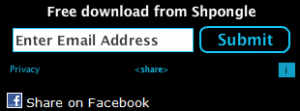
As for the free tracks, the newsletter featured two images with links to the place to download the song. Once on the page, the page showed a download button, which when clicked, becomes a box in which people must enter their email address (as seen on the left). So actually, they can see which email addresses support which artists, but also, when people choose to use one of the share buttons, they help Twisted Music get more email addresses than just the ones they already had for the newsletter.
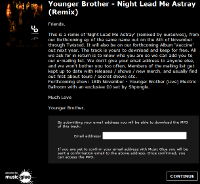
Younger Brother’s page was a little more complex (see screenshot on the right), with more information, but basically boils down to the same thing.
The newsletter then continues with another exciting way of dealing with the reality created by the internet, which is crowd-funding:
“Many of you have already pledged on the Younger Brother album ‘Vaccine’ . We’re working with pledge to raise money and to set up the best possible foundation to promote and release the record next year.
We’re calling on the loyal and faithful to help. In exchange we’re offering loads of interesting things from studio time with the band to limited artwork and access to rehearsals.”
Again, a great way to involve fans and offer them something exciting. It basically offers them a reason to do it for themselves, instead of telling them to please buy a CD because the label needs it (see forum post). Some of the ‘items’ on the list for people that pledge: signed CD (£15), new album and entire back catalogue (£25), coming to one of their rehearsals (£40), studio workshop (£300), being in one of their videos (£150), a unique personal remix of your favourite track of the album (£600), and much more.
The newsletter closes with more standard stuff, such as tour dates and the like.
RECAP
The strategy here is simple, yet complex. First of all, the label releases some very unique, high-quality music, which has given them a fanatical and evangelical following (Seth Godin would call this a tribe). Secondly, this following, together with the label, has turned into an ecosystem; when things were not going well, the ecosystem started figuring out ways in which it could survive as a whole. Thirdly, Simon Posford started paying close attention to his tribe and started catering directly to their needs. When reduced to a communication and business strategy, it becomes the formula of CwF (Connecting with Fans) and giving fans a RtB (Reason to Buy).
Giving away free songs is a good example of connecting with fans by rewarding them. The clearest reasons to buy in this mailing are the mission to get one of the label’s artists to number 1, as well as all the rewards for pledging money for the new album.
It is important to note that this should not be done to generate profit, but should genuinely be done to please the fans and to give them what they want. I thoroughly believe that if you betray your fans’ trust, you will lose them and your (potential) income.
Since we all know anyone that releases a tune towards the end of the year, automatically forfeits their right to be included in lists like this, I present to you, without further ado, my Top Ten Tunes of 2010!
Awesome bootleg with some of the best remixes of Duck Sauce’ Barbra Streisand tune, making it a remix of a remix of a remix of a remix? Anyway, banging electro, oldskool disco vibes, dubstep, breakbeat… It’s all there!
Bit hard to put a genre label on this track, but if I had to, I’d say it’s a garage track with the mellowness of a good dubstep track, but with the groove of an atmospheric drum & bass tune. If you like closing your eyes and floating away into space, carried on a bassline, but guided by more high-pitched melodies… Look no further. (more…)
Just as the video game industry has continually adapted and reinvented itself in the last few decades – arcades to consoles to mobile to online to apps to ad-supported and so on – the music industry must learn to quickly spot new consumer trends and behaviors, and then adapt the technology and business models to turn those trends into new revenue streams.
Consumers like to be social while they are entertained. This was always true to a degree, but now even the solo-music device (the portable player) has been flipped to become the most social device (thank you, iPhone apps).
Consumers expect to personalize everything. We always saw it in mix tapes and remixes, but that was the domain of hardcore music lovers. Now, personalization is just an expected standard feature.
Consumers don’t simply want to socialize, they want to compete. Socializing isn’t simply about talking to each other and sharing, it’s about showing who is king of the hill.
My thoughts: YES! Exactly.
The huge advantage games have over music, is that games are designed to be interactive (since games were invented), while music has lost much of its interactivity since the invention of recording technologies. While the gaming industry has always had its eyes on interactivity, the music biz completely forgot about this, which brought out a very awkward situation when it was forced upon the music biz (eg. suing fans, going bankrupt, stifling innovation).
I think the best business model is an INTERACTIVE business model. This doesn’t mean that the music itself has to be interactive, but the experience of the music, the music-fan, the artist-fan, the label-fan, and the fan-fan relationship should be as interactive as possible. This interactivity is much easier to monetize and much more rewarding for fans to engage in (and also for the artists).
Some examples: Music to fan, fan to music interactivity: a service that easily lets people make a mixtape of their favourite songs. Free to stream and share, and very cheap to download for high quality audio. Eg. 1 or 2 dollars per half hour / 7 songs. The service automatically detects intro’s, outro’s, bpm’s and keys and decides how best to merge them, if people don’t like it, they can edit it themselves via an interface such as the MixMeister one. This is not really viable for a label (not the core business), but a great idea to license one’s music to if such a service was developed.
But as a label you could also just create a site where people can buy an album in the original version, or play with the a capella’s and (extra) instrumentals, to personalize it in their own way and then buy that version. If you create something awesome, you inspire others to want to create as well, so give them a hand 🙂
Something I noticed after making this write-up, the blog’s author company does a great job at providing this music-fan interactivity too. Go check MXP4 out!
Artist-fan interactivity: wow, so many business models can be tied to this one! First of all, one should always be connecting with fans, because you can monetize the relationship. Attach freemium models and you’re getting somewhere. Example: give away your album for free, sell a high quality digital copy for cheap, sell a traditional CD with cool booklet for double, sell it with an autograph for 50% more… want a special greeting from the band’s favourite member on YouTube (see the Old Spice channel for examples)? Buy 2 CD’s! Or whatever (play around with the formula’s to see what works best for you). Endless opportunities.
Label-fan interactivity: many many possibilities here. For instance, invite people to actively participate in the development of new artists… Every label can have its own ‘X-Factor’ type of stuff. Get that sponsored, get income. Get people actively involved, and committed to getting their favourite artist signed (or new album developed and released) and they’ll do the promotion for you and probably spend money on some premium product too (or you can give it away if you’re really impressed by the job they’re doing as promoters).
Fan-fan interactivity: create a tribe, as Seth Godin would put it. When Die Antwoord suddenly blew up, everyone was going to their website to check out the album, because they could stream it there, but it was not yet for sale. The missed opportunity there: they had all those people sharing the same enthusiasm and passion at the same time, but they were left unconnected. What you could do for an online album release party: make a stream of the album that is set to start at a certain time. The stream is static, but you let users chat with one another. To chat, they have to use Facebook Connect or Twitter to log in (making it easier to connect with one another). If fans are connected, they will stimulate each other’s passion.
Of course you could also make some badge system, as a label, where you give people badges for attending x shows by label artists, buying x stuff from the website, getting x new active members to the community, etc etc. The badges can then be cashed in for a guest list spot (let them bring a friend, to create a new fan) or for % off, on the merchandise.
Plus you can keep leaderboards and do some very special things for the biggest fans!
Man, the music biz could be so awesome right now. It is time to WAKE UP!
I’m trying to figure out how to get data from a particular database and so far it’s #fail. Hopefully someone here can be of help.
1) I asked people where they bought music online. Only the people that buy music online, filled this one in (so some people skipped the question). Multiple answers possible.
2) I asked everyone what kind of music they’re into. Multiple answers possible.
My theory is, that people of one particular type of music (electronic mainly (like house, drum ‘n bass, etc.)), buy music at different places than people that mainly listen to other styles. I know if I take an average of the whole group, I should have a good number to test it against. It probably wouldn’t really matter if I include the electronic music listeners or not.
Anyway, I’ve been messing around with SPSS for half an hour now and cannot figure out how to pull the data out. I know exactly what the table I want should look like… but I have no idea how to construct it.
Any tips? Don’t mind if it’s via Access/Calc queries. Just want to get the info out.
The hypothesis is valuable for my thesis, but not vital… so if it’s really complicated, don’t worry. I’ll graduate with or without the hypothesis 😉
 While I do not know much about the match-industry, I imagine it’s in decline. In societies where easier solutions such as lighters are cheap, why use matches. The other day I had a marketing idea, and since I don’t know anyone in the match industry, I’ll just put the idea up here for grabs.