Year: 2011

  • Why The Internet Has Been Awesome For Both Musical Artists and Fans

    Excerpt from my newest article on Techdirt, refuting pop music critic Simon Reynolds’ claims that the internet has been mostly bad for musical artists and fans. I think the opportunities artists have these days are amazing and highlight that in my response to Reynolds.

    In fact, people have a much larger chance to make a living from music these days. This can be witnessed very clearly in electronic genres, where it is the norm for people to start as ‘bedroom producers’ and, if they’re good enough, they’ll get picked up by blogs, then labels and will then be able to build a proper studio and make a living from touring. If they’re good enough, according to fans and curators within their niche – not according to label execs or music journalists. Anyone can become a producer and anyone that manages to find an audience and connects with them properly has the opportunity to start making a living from it. It’s not easy, but at least it’s not a lottery.

    Read the entire article on Techdirt: Why The Internet Has Been Awesome For Both Musical Artists and Fans.

  • Presenting my music biz thesis: marketing music through non-linear communication

    Hi there!

    It has been two years, but my thesis is finally ready for public release. Today I am very excited to present to you the final result of this research.

    The Answer is the Ecosystem: Marketing Music Through Non-Linear Communication

    The music business has had particular trouble adjusting to the realities of the digital age, so I set out to develop a model that fully integrates all of these realities in order to help out artists and labels. Not only is it valuable for the music business, but for many other fields, especially those touched by new opportunities and difficulties arising from the web.

    I encourage you read, share and remix my thesis, which is available at:
    http://basbasbas.com/thesis

    If you have any feedback or questions, email me at .

    Best,
    Bas Grasmayer


    Blog // Facebook // LinkedIn // Twitter


    In short

    Click any of the links throughout this summary to jump right into the related section of my thesis. The designer, Ryan Van Etten, did an awesome job at creating a great platform for the thesis’ content.

    The research revealed that convenience is one of the most important factors for music consumption. Due to the fact that the music industry has lost control over the distribution of their content, this desire for convenience has resulted in piracy. Meanwhile, consumers are replacing traditional media with new media with the percentage of respondents who have never bought a physical CD increasing per generation. People have different expectations as to what price is reasonable for different products. An important trend being that people enjoy consumption that feels like free, which has made that which is easily copied cheaper and that which can’t be copied more expensive. Although consumers like ‘free’, even consumers that frequently pirate music often regularly spend money on music.

    As a solution to these challenges, the author recommends that artists and labels starts integrating the concept of the ecosystem into their communication strategy. The ecosystem is an active fanbase which is interconnected through non-linear communication. This means producing a ‘story worth telling’ to turn the internet’s non-linear communication and loss of control over distribution into an opportunity to get discovered. The second step is retaining the attention by connecting with listeners and connecting them to each other like the host of a party would with guests. Turning the ecosystem into a fun party helps energize the fanbase and amplifies the aforementioned ‘story worth telling’. Marketing opportunities come from listening to the ecosystem and releasing the products they want, as opposed to the classic approach of pushing the product that you want them to buy. Internet-enabled concepts such as pre-ordering and digital releases allow labels and artists to offer the ecosystem abundant choice to play into all the different expectations regarding price and product characteristics. This most likely will involve a mix of (feels like) free and publishing products or services that are better than free.

  • How Not to Be a Social Media Expert

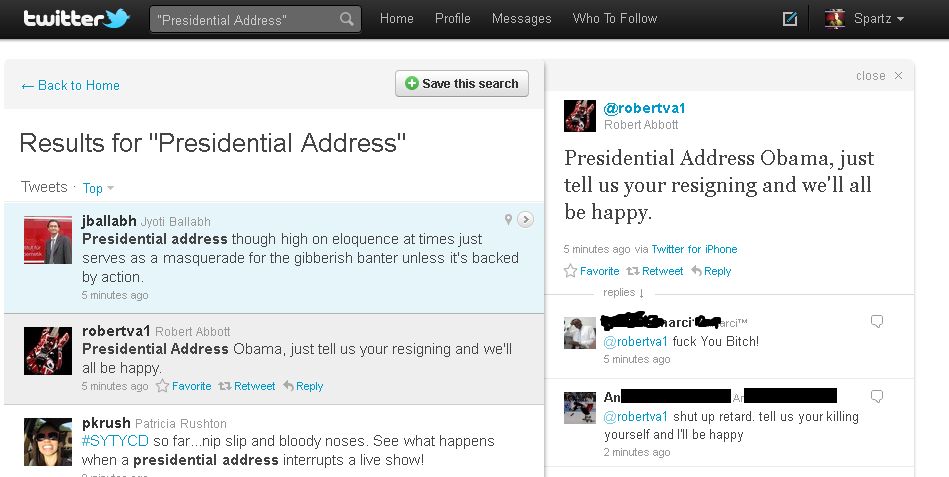
    The recent Presidential Address regarding withdrawals from Afghanistan spawned loads of reactions on Twitter. One of them was from a boy who seemed to be from the Christian-right side of the political spectrum, which simply called for Obama stepping down. I notice it, probably because I didn’t like the attitude, but when I clicked it I saw that there were others that didn’t like the comment too. However the top-reply is from a (probably self-proclaimed) ‘social media expert’ (it says “Fuck you bitch”).

    While I get that this is the internet, where trolling, cursing, insults and threats are far from uncommon… I was surprised to find out that the first insult came from someone who describes himself as a “Social media expert, your spokesperson, and lover of humanity.”

    May the Flying Spaghetti Monster have mercy on the poor soul that hires this person to manage their social media.

  • My views on “The Next MySpace”

    Why do we need a “next Myspace” anyway? At the last edition of SF MusicTech, I heard a great quote which I’m not sure who to attribute to (sorry), but someone stated that the music industry is trying to find “new ways to do old things, while it should be finding new ways to do new things”. The rise of the internet has meant a fragmentation and loss of control over the music landscape. MySpace was a stronghold for online music for a while, until that landscape got further fragmented too. The closest we will ever get to a “next MySpace” will be either a music network or a social network that manages to gather, organise and integrate the fragments in spectacular fashion. That, however, is still radically different, since it only unites the decentralized. Meanwhile further fragmentation is unpreventable. 

    Click here to read the full article on Hypebot.

  • Thesis Excerpt: The Price and Value of Music

    Just heard a great audience comment on the livestream of the Rethink Music Conference in Boston:

    Value is not price. Price comes from value but u have to think of redefining value outside of price.

    Thanks to Eric Hellweg for eternalizing it.

    In trade group IFPI’s Digitial Music Report 2010, the following quote can be found:

    We are in danger of creating a world where nothing appears to have any value at all, and the things that we make… will become scarce or disappearing commodities.

    – Stephen Garrett, Chief Executive, Kudos (source)

    The concept of something becoming free (or feeling like free) decreasing the value of it is an often repeated logic in the music business and needs to be addressed. A lot of the common medicine we use now, used to be a lot more expensive, but their value has remained the same or perhaps even increased due to their availability. It has not become scarce or disappearing as their costs fell; they became abundant and more widely used.

    A report by the trade group Recording Industry Assocation of America reveals that as (physical) CD prices dropped 9% between 1996 and 2006 (inflation-adjusted), concert ticket prices rose 86%, suggesting that that which is easy to reproduce reduces in (commercial) value and that which is not easily reproduced has actually gained commercial value. This has very important consequences for the marketing mix and will be discussed in the solutions section (thesis coming very soon, I promise).

    Some are even suggesting a more radical drop in price for that which is easy to reproduce (this is where the financial cost versus mental cost discussion comes back). Rob Dickins, former boss of Warner Music UK and former chairman of the British Phonographic Industry (BPI), suggested that album prices should be slashed to about 1 euro, arguing that:

    If you’re a fan of REM and you’ve got 10 albums and there’s a new album coming out, you’ve got to make that decision about whether you want it or not. If we lived in a micro-economy, that wouldn’t be a decision. You’d just say ‘I like REM’ and you’d buy it.

    Music manager Jonathan Shalit retorts:

    Right now if you buy a bottle of water it’s £1. A piece of music is a valuable form of art. If you want the person to respect it and value it, it’s got to cost them not a huge sum of money but a significant sum of money.

    Again, the cost/value point is made, but refuted by San Francisco Weekly’s music editor, Ian S. Port:

    Several have argued that selling an album for less than a cup of coffee or a bottle of water would devalue the art of music. But people — at least, young people who don’t buy much music anyway — don’t judge the artistic value of music by what it costs. If they did, they would look down on artists who give away free MP3s and whose albums were obtainable on file-sharing sites. They don’t.

    The devaluing-the-art argument misses two other important points: First, coffee and water bottles can’t be downloaded quickly and anonymously at no cost, while digital music can. Second, paying $3 or $4 for a tangible good (i.e., a cup of coffee you watched a person make especially for you) seems intrinsically reasonable in this day and age, even, I would guess, to a 13-year-old. But paying $10 to download a digital file that’s a copy of a copy of a copy — all of them made at no additional cost — somehow doesn’t.

    And that is basically how I feel about this whole discussion.

  • Catching Up: Ecosystem Music Marketing, Internet Filters, The Clouds and DIY Tips

    Just like a few weeks ago, it’s time to bring you up to date with what I’ve been doing. Showcasing some articles I wrote for Official.fm, Techdirt and Hypebot.

    I did some more writing, but these are the most relevant. Enjoy!

    Keep up with me on Twitter or Tumblr (or Facebook if we have ever physically met).

  • A Catch-Up: DNA-databases, NYT Paywall, DJs Connecting with Fans, and Official.fm

    The busier I get with blogging, the less time I find to blog on here. Classic good news, bad news combination.

    So here’s a quick recap of the articles I wrote, on other blogs, in recent weeks.

    If you really want to keep up with me… Follow me on Twitter or Tumblr (or Facebook if we have ever physically met).

  • The Ugly Dance Case-Study Expanded – Now On Techdirt

    Bas doing the Ugly DanceA while ago I posted a case-study about The Ugly Dance on here as an excerpt of my thesis about marketing music in the digital age. After I published the case-study, the band replied to an email of mine, so I decided to write an expanded version of the case-study for Techdirt.

    You can read the full version over there.

    Here are some excerpts from the band’s email:

    TheUglyDance.com was actually not a result of some great promotional master plan. It just happened.
    On May 17 we released fuldans.se and sent the link to some friends. When I checked the stats a couple of days later a few thousand people had made their own dancers. I could feel something was about to happen. Just the day after someone shared a link on a Swedish blog, and it generated a tsunami of visitors. 30 000 people rushed in in just a few hours. The week after we hade a few hundred thousand hits, and it was a continous struggle to keep the server alive. Two weeks after the release, and 700 000 visitors later, I thought everything was under control. Then the Americans came.
    TheUglyDance.com have had 7 milllion completely unique visitors. A few very kind people have donated, but they are very few. If we should have done anything differently, we should probably have sold T-shirts or something. Something real for the massive amount of visitors to buy.
    .
    Obviously I have one or two ideas of what they could have done and still can do:

    They did a spectacular and exemplary job at getting people’s attention and making the initial connection, but there appears to be no focus at all on retention. There appears to be no link to the band’s MySpace, which they were trying to promote. Due to the fact that most people are on Facebook and Twitter now, I think it would have been a better idea to put those links in the foreground, but most importantly; there has to be a way for people to connect. A simple Facebook ‘Like’ button below the Flash application would have gone a long way.

    From a marketing perspective, asking for a donation or getting people to buy your music out of sympathy is a bad business model. As Mike always says, it’s about giving fans a reason to buy. A good thought experiment is to imagine a totally selfish consumer and to see what you could offer them so that they spend money on you. They should spend it for themselves, not for you.

    This means making sure you retain as much of the original traffic as you can without getting obtrusive. This means shining a light on the early followers and encouraging them in what they do, because they’re helping you amplify your message and are providing social proof. At the same time you should connect these people to each other, forming an ecosystem.

    The business models simply come from listening to the ecosystem and playing into their desires (just like Younger Brother did).
    .
    In the end, giving fans a great reason to buy is the ultimate way of connecting with them.

    But seriously, just head over to Techdirt and check out the full version. While you’re at it, let’s connect: Twitter | Quora | LinkedIn (be sure to include the fact that you found me via my blog when adding me on LinkedIn).

  • Recent articles + news about my thesis!

    Hi everyone!

    I recently started blogging for Techdirt, so keep an eye on that blog or my profile to see more articles by me. Of course, I’ll throw out updates like this one every once in a while, so you don’t have to follow me in 3 different places.

    Two articles I recently did for Techdirt:

    There will also be an expansion of The Ugly Dance case-study soon, so keep your ears and eyes open (I suggest by following me on Twitter).

    The main reason many of the readers of this blog found me, is my thesis on digital communication strategy for the new music business. I am almost ready to publish it and send it out, so if you’re not on my distribution list already, put yourself on there. I promise not to spam you too much. 😉

    Also, I’m moving to Sofia, Bulgaria next week and I would love to find a job that let’s me apply my knowledge and expertise in digital communication strategy and leveraging the power of the ecosystem. If you can help me out or know anyone that can, please get in touch.

    Twitter: @Spartz
    My LinkedIn profile
    Email:

  • Reinventing the Match through Marketing: a Match Made in Heaven

    MatchesWhile I do not know much about the match-industry, I imagine it’s in decline. In societies where easier solutions such as lighters are cheap, why use matches. The other day I had a marketing idea, and since I don’t know anyone in the match industry, I’ll just put the idea up here for grabs.

    I think you can mass-market matches and give them a sexy image. First of all, you would use a slogan such as “[Brandname], the original matchmaker” to hook into the singles lifestyle trend, which is part of the greater megatrend of individualization. Then you capitalize on a huge opportunity that I feel has not been capitalized on properly (at least in Europe).

    The smoking ban annoyed many, but it also created smoking areas inside or outside clubs. The social dynamics of smoking areas are great; it’s a new and easy way to meet people in bars or clubs. So for your commercial, you show pretty boy/guy and a pretty girl in such a smoking area and one of the two strikes a match… Insert cheesy catchphrase like “Every time a match is struck, a match is made. [Brandname], the original matchmaker.” One should position the match as genuine, fashionable, sexy, original, authentic, individualistic, determined… Let’s face it, typical plastic lighters are just boring.

    You can also do a lot when it comes to product design. For instance, on the back of the pack there will be certain instructions (which will differ per pack… let’s say 15-20 different packs). The match will be split into two colours. For instance normal colour on the upper half and blue at the bottom half. When you light something and blow out the match, you break it in two with your match. The one that has the other person’s colour on their half of the broken match, will have to perform the instructions on the back of the pack.

    For every one of these ideas, I have another 10 and I didn’t spend much time thinking about this yet.

    I think it’s time the match reinvented itself. The next time I use a match, I would like it to be a match made in heaven.

    😉

    By the way, if anyone in the match industry reads this (I can’t imagine, but who knows)… I’m almost done graduating, so if you want to execute this get in touch with me and let’s work together and let’s turn your industry upside down.

    or @Spartz on Twitter

    Image shared under a CC license on Flickr by Svenneman.

Related Posts Widget for Blogs by LinkWithin