Tag: students

  • Why the announcement that radicals would hijack Dutch student protests is just spin-doctoring

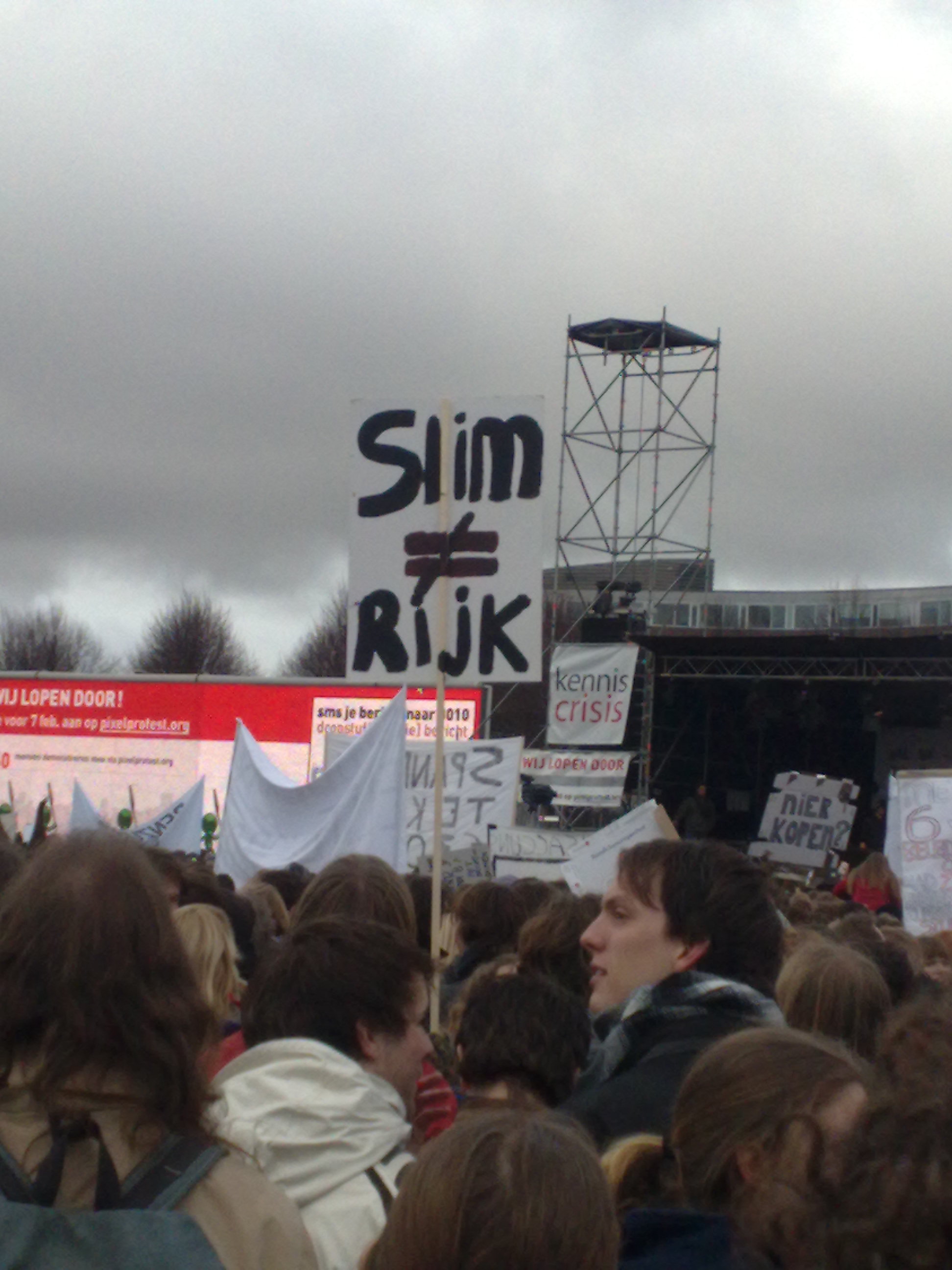
    Protester holds a sign that says "smart does not equal rich"Leading up to the organized student manifestation against the financial cuts in higher education, there were a bunch of news reports about there being ‘signals‘ that radicals would come and hijack the protest and try to create riots. Radicals was obviously never defined, but at the time I didn’t think much of it. A little while later, I realized what a genius piece of spin-doctoring it had been.

    What the message did, was create an expectation of radicals getting violent. For one, radicals can mean football hooligans, for another it can be anarchists, or communists, or foreigners, or anything else which they perceive as dramatically different than them. The manifestation itself was more like a political rally more suitable for election time. When students decided to go to the political quarters to let themselves be heard, they were met by police and violence ensued.

    The spin makes it seem like the violence was caused by radicals. I think it was caused by upset students. The difference?

    For any government, it’s important to create the impression that the general population is content with the government. The label ‘radicals’ was defined by a set of actions and expectations (mainly disobedience and perhaps violent actions or rioting), so when normal people acted this way, they became radicals. This makes sure that ‘normal people’ don’t identify with these radicals (formerly known as normal people).

    Identification creates understanding creates support. The last thing a government which plans to make drastic financial cuts and reforms wants, is people supporting a disobedient protest movement.

    Most of the (25) people arrested last Friday were obviously not radicals. They were students. They were normal people (they still are). They were people like you and me.

  • Bulgarian employees sick a lot, Turkish not – Work mentalities compared

    Graph of average annual sick days taken per employee around the worldResearch done by consultancy firm Mercer for The Economist has shown that out of their selected countries for research, Bulgarians take the most sick days per year.

    Have a look at the graph on the right, you can click it for a larger version.

    Coincidentally, I  don’t just live in the country with the highest number of sick days, but have also lived in the country with the lowest number of sick days taken per year; Turkey. Whereas Bulgarians take an average of 22 sick days per employee per year, Turks take just 5. This might be due to very different work mentalities.

    In Bulgaria there is a saying: “They pretend to be paying me and I pretend to be working.” As you probably know, Bulgaria is a rather poor nation (the poorest of the EU), but besides that I’ve also noticed something else in the work mentality of many people. I’ve heard a lot of expressions of powerlessness. People believe they can’t change things, things are just the way they are… This is logical, given the history of Bulgaria, which consists of 500 years of Ottoman occupation, about 40 years of freedom, followed by roughly 50 years of a communist system.

    I’m not saying everyone in Bulgaria is like this, but having worked in Bulgaria, I completely understand the above mentality… The pay for most jobs is quite low and when you try to make a difference, it’s really tough to seriously get things done. The high number of sick days could also be explained in a different way also. Since Bulgaria is a country with a very tough climate and it’s also quite poor, maybe the national health level is not so high. Who knows (research firm Mercer doesn’t).

    For Turkey it’s very different. When I started a job in a restaurant, they wanted me to spend all the time that I wasn’t in university in the restaurant. I was working from 10 in the morning until 10 in the night on Friday, Saturday and Sunday, and was working from 3 in the afternoon until 10 at night on Wednesday and Thursday. I had class from 9 to 5 on Monday and Tuesday and from 9 until 2 on Wednesday and Thursday. Every day I started early in the morning and finished late at night. It was very exhausting. This is the work mentality in Turkey though. They’re not the most effective workers, but they work a lot and they work very hard generally – even when they’re sick.

    It’s a rather dangerous thing comparing Turkey to Bulgaria, so let me add that I don’t think either of the work mentalities is better than the other. The Turkish work mentality is quite fanatical and insane, although worthy of admiration. People seem very stressed and they need a break (come on, let people take a day off when they’re sick). The Bulgarian work mentality is generally lazy and a bit powerless. Most people I know here would agree with me. Bulgarians need to be given the feeling that they can actually change something, can actually make a difference, can actually achieve something, plus they shouldn’t feel like their bosses are “pretending to be paying” them.  The Bulgarians I know that feel like this, are achieving great things and inspire me constantly. An injection of motivation would be great for the work mentality and with recent protests of farmers and students, things are looking up, because who would take to the streets when they feel powerless?

    Bulgarian protestPhoto by kozzmen

    Is your country listed? How do you think your country racks up? What’s the work mentality in your country? Does it match with your own work mentality?

    BasBasBas.com is about my life abroad. I regularly write about my adventures in Istanbul, Bulgaria and travels in the region, but like to ponder about the future also. If you’d like to stay up to date, you can subscribe to my RSS feed or get email updates in your inbox. You can also follow me on Twitter.
  • Marmara Sunset Cruise

    A few weeks ago, or was it a month, we (the exchange students) received a special invitation from the rector of our university (or chancellor/president, if you will). A special boatcruise was planned and we would be having dinner with the rector on the Bosphorus in Istanbul. Amazing!

    Afterwards we would dance and the rector might teach us some Turkish folkdancing. “Wow”, I thought, “it’s really incredible what this university is willing to do for their exchange students”. Everyone was excited about it, partly because of the promise of free food and drinks ;-), and most of the 100 exchange students at Yeditepe University planned on attending.

    On the day of the cruise we arrived and it turned out the boat had already left. Miscommunication. The boat left 2 hours earlier than was announced to us. The university bus took us to another dock where the boat would come to pick us all up. When we got there, the boat was a lot bigger than I anticipated and what surprised me was there were a lot of people on board already…

    We were then told that kids from high schools and their parents were already on board and that the rector had ordered the boat to come pick us up. Great! I let the new information sink for a minute and then realized that it had all been a great PR stunt. There were hundreds of people on the boat and this way Yeditepe could show off their international character. The cruise was quite different from what I expected and definitely not as intimate as it was made out to be, but it helped me achieve one of my goals for Istanbul:

    To party on the Bosphorus! The Bosphorus is the strait that connects the Black Sea to the Marmara Sea (and thus ultimately to the Mediterranean) and runs between the European and Asian sides of Istanbul.

    As we got on we sailed out to the Marmara Sea and saw the Prince’s Islands (I think) and witnessed the beautiful sunset pictured above. Later, as the skies turned dark we sailed through Istanbul. The lights are beautiful and as I’ve said before, the best way to see the glory of Istanbul is from the water. We partied on the deck of the ship with a bit too many high schoolers and very loud Turkish house music. Oh, and free beer (which finished within half an hour) and free wine!

    View the pictures of the trip on Picasa! Pictures of the sunset and the sea and of course the party! Sorry, I don’t have the right equipment to catch Istanbul by night. You’ll have to come and see it for yourself. 😉

    If you took a ferry or boattrip in Istanbul before, how did you like it? What was your experience? In the past I’ve partied in an empty office building, under a bridge, in an abandoned church (controversiaaaaal), a parking lot and in the forrests on a mountain in the Balkan range. What’s the most spectacular location you’ve partied at?

    BasBasBas.com is about a Dutch student living in Istanbul. I regularly write about my adventures in Istanbul and travels in the region. If you’d like to stay up to date, you can subscribe to my RSS feed or get email updates in your inbox. You can also follow me on Twitter.

  • Placement Evaluation!

    Just had a conversation with my academic placement supervisor and it looks like I’ll be getting a very good evaluation for the work placement I did with the Bulgarian National Radio. These are the main things I discussed with him:

    1. what did you learn that you didn’t expect to learn?

    One of the things I really learned was to be flexible. First of all, this was because of working in an institution instead of doing my projects within an academic and theoretical environment. There were a lot of barriers between me and my goals and I had to figure out how to get around that. Another reason why I had to be flexible is because of the organisation being Bulgarian. Meaning that things were often rather rigid and bureaucratic and I had to constantly adapt to the situation and expect to have to adapt and be flexible.

    2. what did you not learn that you had hoped to?

    There was one particular research project I was doing amongst listeners which I would have loved to start sooner, so that I could have executed it on a larger scale and would have learned more about research in the process. I can not go into detail about that on this blog, but planning and looking ahead is the key here!

    3. what would you change about your placement?

    Not much, except I would secure it earlier and prepare more coordination. Have more people who can help me out and secure a part of their time so that they can help me out if it’s necessary. Besides that I would do the research project I mentioned juts now earlier and I would love to do an evaluation of the internal communication of the radio. That is, if there are influential people within the radio who are willing to listen to my findings and are ready to make some changes or do further research based on those results.

    4. what advice would you give to a student going on placement in order to help him/her ave a better experience?

    Be flexible: expect the best and prepare for the worst!
    Be proactive: don’t sit around waiting to get tasks handed out to you. Create your own job! This will make things A LOT more interesting for you as well as for your employer.
    Be valuable: make yourself an asset to the company. Be of value to the company, so that when you leave, the company loses something valuable that they would like to keep or get back. No matter what your plans are, do this! Even if you don’t plan on coming back or are actually planning to never come back; do it!
    Be original: don’t go and don’t do what everyone else is doing. Pick an original company or organisation for your placement. Pick an original destination. This will make you learn so much more, will make you have so much more fun, will make life so much more interesting for you. Besides that, it will impress your host organisation, your professors, your social environment, as well as potential future employers when they see this on your CV! However, if you are not willing to be flexible and proactive then forget it. Go do what everyone else is doing or you will not make it. If you don’t feel like having to make the best out of situations, but prefer to be passive, then you are not fit for the exceptional.

    I hope this helps you out, whether you’re a student looking for a placement or currently on a placement or just someone interested in career strategy. Make sure to come back for more!

    Subscribe to this blog by RSS or subscribe to this blog via email.

Related Posts Widget for Blogs by LinkWithin