Tag: communication

  • Why the announcement that radicals would hijack Dutch student protests is just spin-doctoring

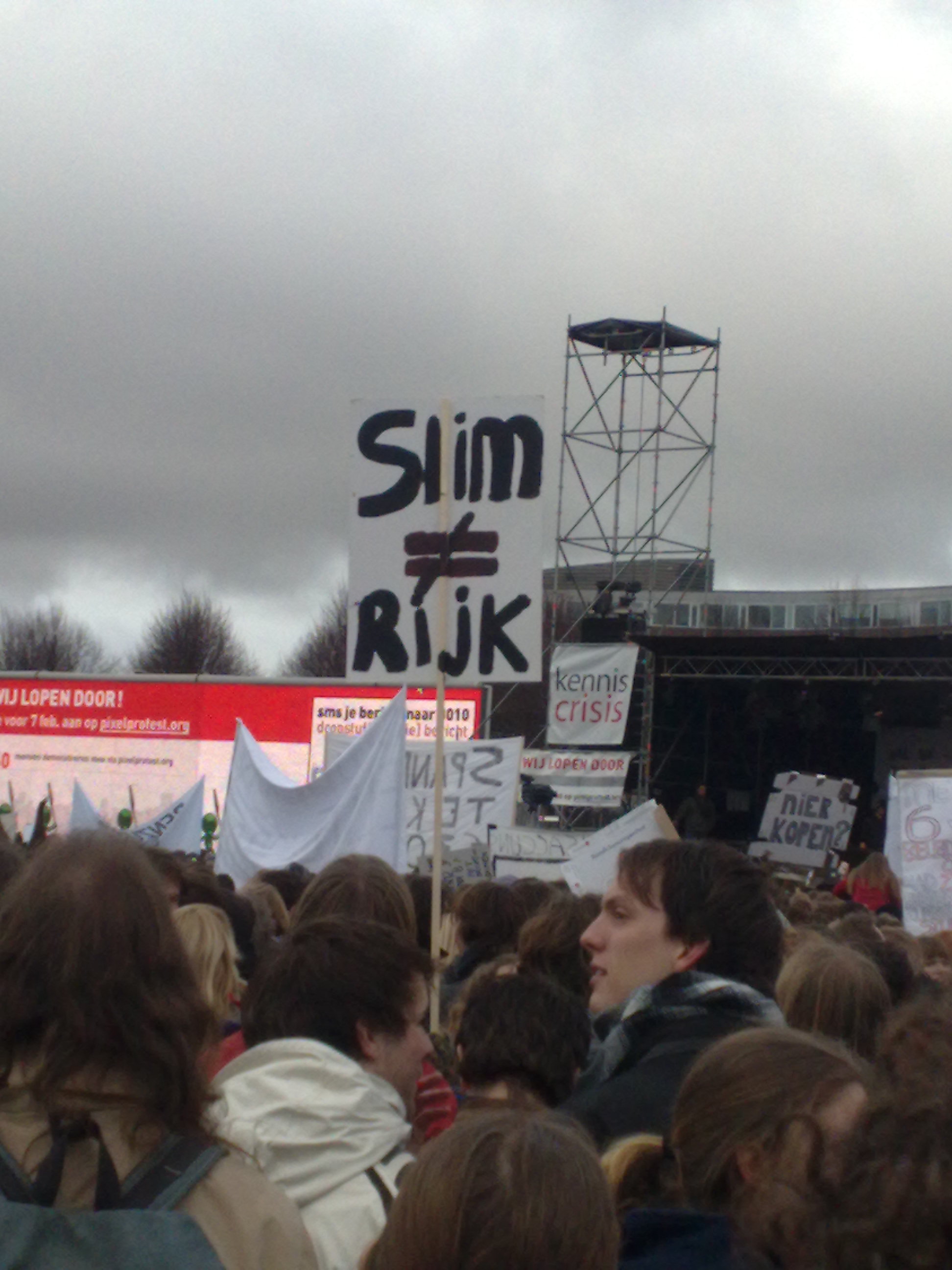
    Protester holds a sign that says "smart does not equal rich"Leading up to the organized student manifestation against the financial cuts in higher education, there were a bunch of news reports about there being ‘signals‘ that radicals would come and hijack the protest and try to create riots. Radicals was obviously never defined, but at the time I didn’t think much of it. A little while later, I realized what a genius piece of spin-doctoring it had been.

    What the message did, was create an expectation of radicals getting violent. For one, radicals can mean football hooligans, for another it can be anarchists, or communists, or foreigners, or anything else which they perceive as dramatically different than them. The manifestation itself was more like a political rally more suitable for election time. When students decided to go to the political quarters to let themselves be heard, they were met by police and violence ensued.

    The spin makes it seem like the violence was caused by radicals. I think it was caused by upset students. The difference?

    For any government, it’s important to create the impression that the general population is content with the government. The label ‘radicals’ was defined by a set of actions and expectations (mainly disobedience and perhaps violent actions or rioting), so when normal people acted this way, they became radicals. This makes sure that ‘normal people’ don’t identify with these radicals (formerly known as normal people).

    Identification creates understanding creates support. The last thing a government which plans to make drastic financial cuts and reforms wants, is people supporting a disobedient protest movement.

    Most of the (25) people arrested last Friday were obviously not radicals. They were students. They were normal people (they still are). They were people like you and me.

  • Politics 2.0

    The influence of new media on current day politics

    An essay by Bas Grasmayer

    The 20th century was the age of mass media. The impact of radio during the first half of the century and that of television during the second brought politics closer to home. Starting from people grouping around the one radio in their neighbourhood, to the radio in their street, until the point that everyone had a radio in their home. The same happened for television and through these media politics entered the living room. Through sound at first, but later through moving images which became more detailed and more accurately coloured over the course of the last century.

    We’re now close to ten years into the new century. Television and radio are still important, but there is a new player in the field of mass media: the internet. This essay will look at how the internet has already influenced politics and hopes to answer, in part, the following question:

    How is the World Wide Web as a medium influencing
    politics and the government right now?

    New Media

    In the 2008 US Presidential elections, politicians were seen embracing new media. Barack Obama became microblogging service Twitter’s most followed user and YouTube set up a site called You Choose ’08 dedicated to the elections. On the latter, campaign teams posted videos hoping they would go ‘viral’, a term used to describe the phenomenon of certain content on the internet being spread out through huge networks of users, which is often initially an exponential process. Ron Paul, who was running to become the Republican presidential candidate, had so much support on the internet that TIME magazine at one point commented that due to “his  success  recruiting  supporters  through  new  social  media  channels” he was “the  new  2.0  candidate”.

    (more…)

  • Placement Evaluation!

    Just had a conversation with my academic placement supervisor and it looks like I’ll be getting a very good evaluation for the work placement I did with the Bulgarian National Radio. These are the main things I discussed with him:

    1. what did you learn that you didn’t expect to learn?

    One of the things I really learned was to be flexible. First of all, this was because of working in an institution instead of doing my projects within an academic and theoretical environment. There were a lot of barriers between me and my goals and I had to figure out how to get around that. Another reason why I had to be flexible is because of the organisation being Bulgarian. Meaning that things were often rather rigid and bureaucratic and I had to constantly adapt to the situation and expect to have to adapt and be flexible.

    2. what did you not learn that you had hoped to?

    There was one particular research project I was doing amongst listeners which I would have loved to start sooner, so that I could have executed it on a larger scale and would have learned more about research in the process. I can not go into detail about that on this blog, but planning and looking ahead is the key here!

    3. what would you change about your placement?

    Not much, except I would secure it earlier and prepare more coordination. Have more people who can help me out and secure a part of their time so that they can help me out if it’s necessary. Besides that I would do the research project I mentioned juts now earlier and I would love to do an evaluation of the internal communication of the radio. That is, if there are influential people within the radio who are willing to listen to my findings and are ready to make some changes or do further research based on those results.

    4. what advice would you give to a student going on placement in order to help him/her ave a better experience?

    Be flexible: expect the best and prepare for the worst!
    Be proactive: don’t sit around waiting to get tasks handed out to you. Create your own job! This will make things A LOT more interesting for you as well as for your employer.
    Be valuable: make yourself an asset to the company. Be of value to the company, so that when you leave, the company loses something valuable that they would like to keep or get back. No matter what your plans are, do this! Even if you don’t plan on coming back or are actually planning to never come back; do it!
    Be original: don’t go and don’t do what everyone else is doing. Pick an original company or organisation for your placement. Pick an original destination. This will make you learn so much more, will make you have so much more fun, will make life so much more interesting for you. Besides that, it will impress your host organisation, your professors, your social environment, as well as potential future employers when they see this on your CV! However, if you are not willing to be flexible and proactive then forget it. Go do what everyone else is doing or you will not make it. If you don’t feel like having to make the best out of situations, but prefer to be passive, then you are not fit for the exceptional.

    I hope this helps you out, whether you’re a student looking for a placement or currently on a placement or just someone interested in career strategy. Make sure to come back for more!

    Subscribe to this blog by RSS or subscribe to this blog via email.

Related Posts Widget for Blogs by LinkWithin