Category: world

  • I’m Fasting in Solidarity with the People of Zimbabwe

    The situation is getting very bad in Zimbabwe. Hyperinflation, lack of clean drinking water or food, violent oppression of citizens, Mugabe is destroying his country through clinging on to his power. We’ve all seen the images.

    I got word from Avaaz that hundreds of activists, including Desmond Tutu, have started a hunger strike in solidarity with the 11 million people in Zimbabwe who can have only one meal per day, or less.

    It’s time for a change. This Sunday, February 1, heads of state are meeting in Ethiopia. A call has gone out for people to fast in solidarity during that day. The pledge is as follows:

    We, the undersigned, pledge to fast for a day in solidarity with the Zimbabwean people. We call on leaders throughout Africa—and the world—to act now to decisively support their struggle for justice, democracy, and survival.

    The fast is just from sun up to sun down. I’ve always wondered about fasting, about ascetics, or Muslims during Ramazan/Ramadan, what they go through. I’m quite sure I won’t enjoy the fast, but it’s for a great cause and after all, I have a choice. Many people around the world do not.

    Take the pledge. Do it with me and 25,000 others. Just for one day, between sun up and sun down, how hard can that be?

    Go to take the pledge now!

    Photo by Sokwanele – Zimbabwe, shared under a Creative Commons license.

    Are you in? Why is this worth fasting for?

    Keep in touch with me next Sunday to see how I’m doing. Follow me on Twitter.

  • Politics 2.0

    The influence of new media on current day politics

    An essay by Bas Grasmayer

    The 20th century was the age of mass media. The impact of radio during the first half of the century and that of television during the second brought politics closer to home. Starting from people grouping around the one radio in their neighbourhood, to the radio in their street, until the point that everyone had a radio in their home. The same happened for television and through these media politics entered the living room. Through sound at first, but later through moving images which became more detailed and more accurately coloured over the course of the last century.

    We’re now close to ten years into the new century. Television and radio are still important, but there is a new player in the field of mass media: the internet. This essay will look at how the internet has already influenced politics and hopes to answer, in part, the following question:

    How is the World Wide Web as a medium influencing
    politics and the government right now?

    New Media

    In the 2008 US Presidential elections, politicians were seen embracing new media. Barack Obama became microblogging service Twitter’s most followed user and YouTube set up a site called You Choose ’08 dedicated to the elections. On the latter, campaign teams posted videos hoping they would go ‘viral’, a term used to describe the phenomenon of certain content on the internet being spread out through huge networks of users, which is often initially an exponential process. Ron Paul, who was running to become the Republican presidential candidate, had so much support on the internet that TIME magazine at one point commented that due to “his  success  recruiting  supporters  through  new  social  media  channels” he was “the  new  2.0  candidate”.

    (more…)

  • The Dutch Tradition of Sinterklaas

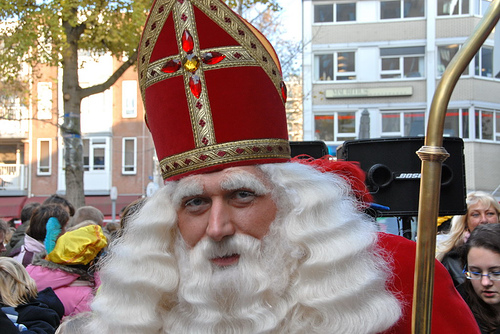
    Photo by FaceMePLS

    Said to be the origin of Santa Clause, the Dutch tradition of Sinterklaas is one of the most typical traditions one can experience in the Netherlands (besides Queen’s Day). Sinterklaas means Sint Klaas, or Saint Nicholas in English. On December 5th, Dutch families get together and exchange gifts. If the family has young children, Sinterklaas himself brings the presents to the door or through the chimney, usually in secrecy (especially when using the latter ;-)) or it’s done by one or more of his helpers. This leads me to the first oddity about this day of the Greek-Anatolian saint, Saint Nicholas of Myra.

    Black Petes
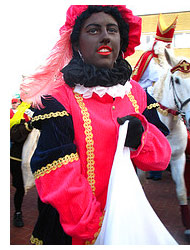
    That’s the name of the helpers. When Sinterklaas comes to Holland on his steamship from Spain in November, he brings along his cheeky helpers which then give out candies to the children. Yes, he’s from Turkey, but comes from Spain, I don’t know why. I suppose he’s an expat like me. Back to the helpers… They have different functions. One is the guiding Pete, the other does poems, the other sings, the other climbs, the other rhymes, the other wraps the presents and they all have nicknames based on their function, much like the Smurfs.

    Originally the Petes looked like south Europeans, but over the course of 50 years, they started getting darker and darker and around 1900 they looked likedarkies‘. Until this day, this is still the day us Dutchies dress up to entertain our kids, as shown on the right (picture by Merlijn Hoek). The Saint and his helper, that was called a servant and a slave in a book that influenced much of current day traditions, are normally seen as friends and the Petes gladly help Sinterklaas, because he’s old and cannot go around the whole country on his own. You can view the 19th century book that established much of the current day Sinterklaas tradition online.

    When people started saying that this is racist, we started saying they’re black because of all the chimneys they have to climb through to deliver their presents. It’s a well-known scientific fact that soot from chimneys of houses with children living in them also causes afros and big red lips. Political correctness created Petes with faces painted in purple, green, yellow, you name it. This was not a big hit. Back to the chimney explanation it is.

    Through the chimney, into your shoes

    When Sinterklaas is in the country in the weeks leading up to the 5th of December, the children are allowed to put their shoe under the chimney twice a week or so, depending on the parents’ generosity (and willingness to spoil their kids). I suppose the tradition varies a bit from home to home, but when I was young my brothers and I would first draw a picture for Sinterklaas. Then before going to bed we’d put one of our shoes under the chimney, with the rolled up drawing in it, a carrot for Sinterklaas’ horse, and we’d sing Sinterklaas songs at the chimney. We would then go to bed and the next morning we’d find a small present (usually candy) in our shoe! Schools and even supermarkets also let children leave their shoe overnight for Sinterklaas.
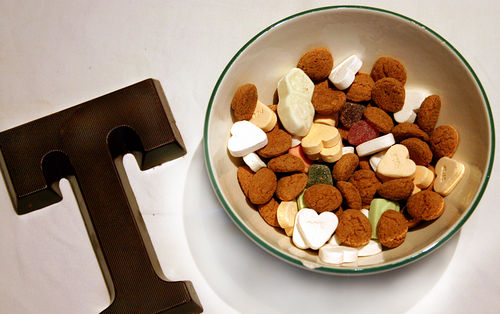
    Photo by poederbach

    Usually the candy you get will be kruidnoten or pepernoten, which are small ginger-bread like biscuits or speculaas-like biscuits (as seen above). You’re also likely to receive a chocolate letter of the first letter of your name. These are cleverly nicknamed “chocolade letters”, because this holiday’s a feast of creativity! I have an aunt whose name begins with the letter I, so when she was young she always got the first letter of her second name, the R. Much bigger, at least to a child, since they all weigh the same. So, candy from the chimney!

    Oh, unless you’ve been a bad child that is.

    Kidnapped and taken to Spain

    Children are warned that if they are not behaving well during the year, Sinterklaas will look in his Golden book and will not be able to find your name (which means no presents). One popular song goes “Wie goed is krijgt lekkers, wie stout is de roe” which means that who is nice will get something sweet, but who’s bad will get a bundle of sticks in his shoe (a roe). If you’ve been particularly bad, you will be put in one of the sacks which Sinterklaas and his jolly slaves Black Petes use to take all the presents to Holland and you will be taken back to Spain. In recent years Sinterklaas has condemned this practice, saying that it was a thing of the past. Still 400 children are reported missing in Holland each year though. What are you hiding Sinterklaasje?

    Presents!

    That’s what he’s hiding. Usually they’re dropped down the chimney overnight and unpacked in the company of family in the evening of the 5th of December. In my youth we’d be at our home with my relatives on the 5th and as my parents were cooking or doing whatever in the kitchen, someone would ring the doorbell and the presents would be there. As we grew older, faster and more familiar with what to expect, my poor parents had to increase their speed to run from the frontdoor around the house and back into the kitchen. If I remember correctly, usually my mom would come into the room and keep us busy for a moment saying “Heeeeeyyyy! Who do you think that is? Could it be…?” andddd it’s a blurry memory, but I think they made us sing a song before having a look at the front door.
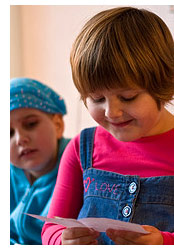
    The presents are often accompanied by poems, composed by the Poetry Pete (or the Rap Pete in families with parents that try to be too hip). The child receiving the gift has to read the often wittily composed poem out loud as seen on the right (picture by hondjevandirkie). The poem often says things about the person receiving the gifts and hints about the content of the wrapping paper.

    The unravelled wrapping paper is usually a welcome and interesting object for pets, cats and dogs alike. I am not aware of turtles’ attitude towards wrapping paper lying all over the living room floor. But then again, I don’t care.

    If the parents actually managed to convince Sinterklaas to come to their home to deliver the presents personally, children are often left arguing at school over who had the real Sinterklaas coming to their home and who had a “helping Klaas” over. It’s very important to be right in this case, even though in the end you’re all wrong. Some kids already know this and spread seeds of doubt among their fellow classmates over the reality of Sinterklaas, those damn fascist toddlers.

    Have fun!

    That wraps it all up (no pun intended). For expats in the Netherlands, you can have a look at the Sinterklaas survival guide on Expatica. For lazy Dutchies, you can make your poems using a Sinterklaas poem generator.

    I wish everybody lots of fun with Sinterklaas this year! Especially my family. Sorry I can’t be there for the festivities for the second year in a row. Last year I celebrated Sinterklaas with some international exchange students while I was living in Sofia, Bulgaria (see the pictures). This year I’m avoiding the tradition – even though I live in Saint Nicholas’ country… Turkey!

    I know similar traditions take place all over the world, especially in Europe. What about in your country? Can you tell me a little about the December traditions where you’re from or where you currently live?

    BasBasBas.com is about a Dutch student living in Istanbul. I regularly write about my adventures in Istanbul and travels in the region. If you’d like to stay up to date, you can subscribe to my RSS feed or get email updates in your inbox. You can also follow me on Twitter.

  • The Other Turkey


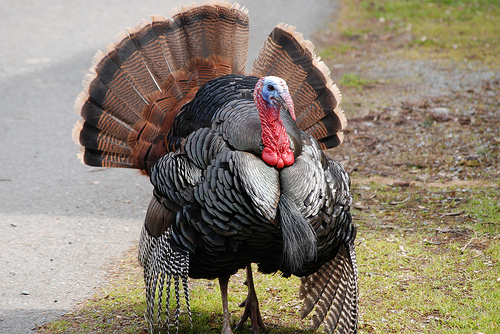
    photo by Steve Voght

    It’s Thanksgiving (more or less) and what’s most commonly associated with Thanksgiving are two things. Naming the things you’re thankful for and turkeys, because what better way to say thanks than to feast with friends and family on bird corpse! Exactly.

    I’ve been asked how to say “turkey” in Turkey. The bird, not the country. I mean, the former being the bird, the latter the country. Why did we ever give these two the same name? Anyway, in Turkey this bird is called “hindi”. They didn’t leave this bird without a country however; India is named Hindistan here.

    As for the consumption of dead bird flesh, here are ten reasons not to eat turkey this Thanksgiving (the bird, not the country. On second thought, don’t eat the country either. Not with me in it.). Let’s let the turkeys have a happy Thanksgiving also! Here are some recipe’s to try out instead:

    In my country the turkey’s not even called something remotely close to the way we call Turkey. How about in yours? Jeez, what interesting questions can one ask their readers about turkeys and Thanksgiving? I really don’t care that much about the tradition. 😉

  • Drugs, Prostitution and Same-Sex Marriage

    That’s the title of a 10-15 minute presentation I’m giving soon for my Intercultural Communication classes at Yeditepe University, here in Istanbul. I designed it in such a way that it can also be enjoyed without my vocal explanations and here it is!

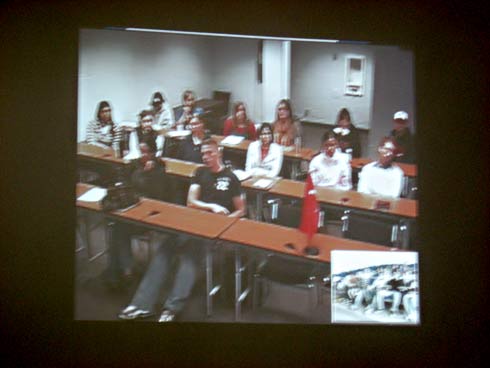
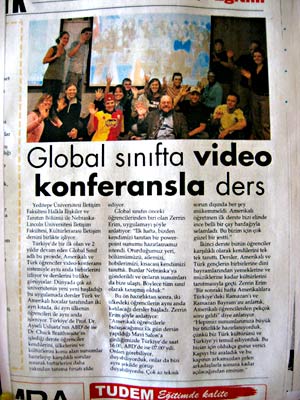
    The Intercultural Communication course is likely to be the most innovative course I’ve taken during my higher education (sadly — universities should make more use of modern technologies). Every Tuesday, we get into a classroom at 4 o’ clock in the afternoon and have a video conference with a class in Lincoln, Nebraska, US. We present ourselves, our culture, customs, daily lives and our countries to each other. It’s fascinating, because both the Turkish class as well as the American class have students from many different backgrounds.

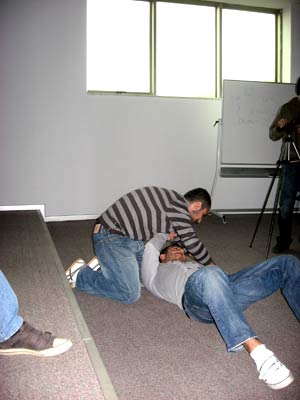
    This part of the Intercultural Communication course, called Global Classroom, has been quite fun so far. We’ve managed to make 2 students from the Nebraskan class dance in front of the camera and they’ve managed to make 2 of our students wrestle in front of the camera (or was it Jiu-Jitsu?).

    There’s only a few sessions left, so I hope I actually get to do my presentation, as our lecturer wanted everyone to prepare one, but there will be no time to actually execute all of them.

    I hope the presentation has given you an insight into Holland’s liberal policies and if you have any questions please feel free to reply. I love answering questions about these issues.

    How about in your countries, how is your government dealing with these issues? What is your personal opinion on these matters? Has the war on drugs failed? Is same-sex marriage morally wrong or is keeping it illegal a form of discrimination? What about prostitution?

  • Obama Elected, The World Rejoices – Turkey, Macedonia Perhaps Not So Much

    Even though sentiments are mixed in the US, around the whole world people have reacted enthusiastically about Obama‘s election. People around the world have had more than enough of Bush’ policies and were hoping for a change. Change being the keyword of Obama’s campaign and McCain being associated with Bush, caused the most people to be more favourable towards Barack Obama. The website If the world could vote? shows that all over the globe, more people were rooting for Obama than for McCain.

    Obama is young, ‘black’, a Democrat and instills hope, whereas McCain was seen as very similar to Bush, partly due to employing similar tactics to the ones of former Republican campaigns.

    One country that seemed significantly pro-McCain on aforementioned If the world could vote? is Macedonia. Why? The Republic of Macedonia borders Bulgaria, Greece, Albania, Serbia and Kosovo. Not the easiest region for a country. Greece refuses to recognize ‘Macedonia’ as their name, one of the reasons being a similarly named province in northern Greece, and Macedonia is thus referred to in the UN as The Former Yugoslavic Republic of Macedonia (FYRM). It’s a very complex issue. McCain has been very outspoken about recognizing Macedonia by its constitutional name, whereas Obama has been more careful about it.

    Randy Scheunemann, a McCain adviser said the following about NATO membership bids:

    On Albania, Croatia and Macedonia, Senator McCain has been strongly outspoken in support for including them. They are ready. In the case of Macedonia, they’ve been a membership action plan for eight or nine cycles.

    With respect to the Greek concerns, the United States recognizes Macedonia under its constitutional name.

    And he certainly hopes that there’s not going to be this throwback to the 19th century style of Balkan politics, and the Greeks throw a red card on the membership of Macedonia.

    Since this is a very big issue in Macedonia, as territorial, cultural and national integrity always are in the Balkans, it’s no wonder people in Macedonia were hoping for McCain to win.

    As for Turkey, people might be happy to see a change in government. Bush’ unpopular policies have led to an increase in anti-Americanism around the world. In June, a Pew poll found that out of 47 countries, Turkish people had the least favourable view of the United States (source: The New York Observer). In that sense, Obama will be a welcome change.

    It is hoped that the new President will aid Turkish efforts against the PKK and the Kurdish insurgency in the Iraqi border area, support the EU’s membership bid and put pressure on European politicians, and support Turkey in its process of becoming a modern, democratic country. It’s not expected that Obama will aid Turkey’s military efforts or put significant pressure on the EU to get them to admit Turkey.

    Moreover, just one day before the elections, Obama renewed his commitment to recognize the Armenian genocide, a very sensitive issue in Turkey. McCain “never pledged to label the Armenian killings as genocide and is seen by the U.S. Armenian community as a politician against or indifferent to Armenian matters” (Turkish Daily News).

    Turkey’s foreign policy adviser to Prime Minister Recep Tayyip Erdoğan said “the formal recognition by the United States of genocide would seriously damage U.S.-Turkish ties and hurt Turkey’s efforts for reconciliation with Armenia” after meeting Phil Gordon last week, a senior foreign policy adviser to Obama.

    Turkey is an important ally (NATO member) and trade partner to both the US and EU, as it has a stabilizing presence in the Middle East, often mediating in Arabic-Israeli talks.

    Looks like Obama will have a lot on his hands when he takes office in January.

    Increase your understanding! Here’s some useful links:

    Like this post? Please give it a Stumble or a Digg or use the +Bookmark button below to add it to any popular social bookmarking service!

    What are your perspectives on this? Have your say in the comments!

    More about Turkey? Subscribe to this blog’s RSS feed or follow me on Twitter! You can also subscribe for email updates.

  • The Inheritance of Loss

    I got tagged by a dear StumbleUpon friend, shpongolina. Usually I don’t participate in this type of things, but because it offers something interesting and it comes from a great person, I’ll make an exception. 😉

    The rules are as follows:

    1. Pick up the nearest book (of at least 123 pages).
    2. Open the book to page 123.
    3. Find the fifth sentence.
    4. Post the next three sentences.
    5. Post a comment and then tag five more people.

    The Inheritance of Loss

    by Kiran Desai

    Gyan was twenty and Sai sixteen, and at the beginning they had not paid very much attention to the events on the hillside, the new posters in the market referring to old discontents, the slogans scratched and painted on the side of government offices and shops. “We are stateless,” they read. “It is better to die than live as slaves,” “We are constitutionally tortured. Return our land from Bengal.”

    I wrote about this book a while ago. I’m ashamed to admit that I’m still reading it. Worse yet, I’m not even halfway through, even though it’s a great book. My excuse is that I’m an expat in Istanbul and there’s just so much to see and do here. 😉

    I love this book, because it talks about life in India at the foot of Mount Kanchenjunga in the north-eastern Himalayas around the time of the Nepalese independence movement in the mid-80s. This is something I knew nothing about in terms of facts, let alone in terms of experience. That’s the awesome thing about books; they let you experience something like you’re there. It’s the power of writing. It’s a very moving story and has many elements in it. Classes/castes, love, freedom, happiness, travel, work, study, war, conflict, poverty – many things which I either have never been in contact with, or that I have always taken for granted.

    You can read more about the author, Kiran Desai, on Wikipedia. Check out the book, including reviews, at Amazon.

    I would like to tag Dori (From A Yellow House In England), Chris (Beyond Taiwan), PJA64X, Emm (Emm in London) and lala (Coastal Commentaries).

    Want to stay up to date on my Istanbul adventures? Follow my Twitter feed, or subscribe to this blog by RSS or email.

  • Georgia affected by Turkey’s ban on Blogger

    Apparently Caucasus Online, an internet provider in Georgia, uses Turkey’s service network, as it is reported that internet users in Georgia are now also unable to visit sites from Blogger and *.blogspot.com domains.

    A solution for Windows users to “unblock” Blogger and YouTube has been posted here:

    Find the file named “hosts” under windows/system32/drivers/etc/
    folder.
    Open this file with Notepad

    Append those lines

    72.14.207.191 blogger.com
    209.85.165.191 www.blogger.com
    208.117.236.69 youtube.com www.youtube.com
    208.117.236.70 youtube.com www.youtube.com

    Save and close it.

    This solved my problems, I posted as if there is no ban.

    More about this solution can be read by clicking here.

    So, no more this:

    This is bad though. It’s one thing that Turkey decides to ban a whole domain based on poor logic, but it affecting people in another country makes it a lot worse.

    Some useful links to unblock YouTube/Blogger (blogspot)/other blocked pages in Turkey (and Georgia):

    Help get the news out. Stumble, Digg, Slashdot, Reddit or Tweet it!

    Stay updated. Follow my Twitter feed, or subscribe to this blog by RSS or email.

  • Letter from Zimbabwe

    Quite a while ago I got in touch with a fellow blogger named Nick, who I met via the wonderful StumbleUpon community. He’s a young guy who got in touch with the United States justice system at a rather early (but common) age. He blogs about how this all happened and about life in prison. Felonious Ramblings is definitely one of my favourite blogs and recently I saw a very interesting story pop up in my inbox.

    Nick, like me, is quite concerned about various political or humanitarian situations around the world. One of these is Zimbabwe, of which I don’t need to remind you how bad the situation is. A friend of him who was born and raised in Rhodesia (Zimbabwe) forwarded him a letter. The guy is Anglo, meaning British Colonial, but lives in Europe now. His family however is still living in Zimbabwe and is having to deal with president Mugabe’s madness and insane grip on his power. Whoever is not pro-Mugabe, or white, faces serious danger in Zimbabwe.

    Following is an email from the guy’s sister in law. Who wrote this in a bit of a hurry it seems, but still it’s very easily readable and tells a very good story about the situation in this country. It seems like it’s turning into anarchy and it reminds me a lot of the situation displayed in the movie Hotel Rwanda. We cannot let something like this happen again, so I’d like to urge you to read and share. Stumble it, email it, share it on Facebook, Digg it, Buzz it… Whatever’s your preference.

    Dear all,

    It has been quite a weekend. We were made very aware of impending problems on our Mount Carmel farm before it even started. Various letters came in as well as verbal warnings from concerned people all over the district. People were told that Mt. Carmel cattle and potatoes would be dished out to them.

    The election campaign is being fought on “one hundred percent empowerment” ie. taking everything that belongs to people who are not black and giving it to Party faithfulls. The Party has got nothing else to offer the people…

    People were told if they did not come they would be beaten. President Mugabe arrived in our little town of Chegutu that afternoon and people were only informed that morning.

    (more…)

  • My Interview about Wilders

    A few weeks ago I was interviewed about my views on the Geert Wilders movie Fitna by Alex, a PR professional, journalist and blogger from Bulgaria. I have a strong opinion about this, so when he asked me, I immediately told him yes and we made it happen. It was published a while ago and now I figured it’s time for a crosspost.

    What were the first consequences of the Geert Wilders video “Fitna” in Holland?

    Well, the first consequences actually came before the film was released. For about three months, we’ve been waiting for this film, not knowing what would be in it. Given the statements Wilders had made in the past though, a lot of people were worried that it might be very offensive to Muslims and spark riots in some of the immigrant areas of our cities.

    So the main consequence was a lot of fear and a big debate about Islam and it’s position in our society and western society – and how far the freedom of speech goes.

    After the release it stayed pretty calm. I think it’s less bad than what was expected or feared for and the tension really seems to be gone now. Or in the background.

    Was it changed because of that Armageddon-expectations? And in fact this couldn’t be the main version?

    I doubt it. If those expectations had come true, Wilders could have said “Look! I was right.”

    I don’t think it was in his interest to tone his film down. I would find it hard to believe he would done that, it’s not his style.

    Do you feel kind of disappointed of the final result?

    Partly. I was expecting a well produced film, though this is cut and pasting with fragments we have all seen numerous times, probably hundreds, in the case of the 9/11 footage even thousands of times. I am happy that he didn’t go as far as others said, because that could have caused national problems as well as international problems for the Netherlands (politically as well as economically). Some countries were threatening with boycotting Dutch products for instance.

    Can you find Wilders right in any of his statements expressed in the movie?

    Yes, with regards to Islamic extremism being a problem we need to be concerned with, like any form of extremism. No, with regards to the fact that he doesn’t limit his judgment to the small group of the 1 billion Muslims that is extreme, but is generalizing all Muslims.

    Although he himself claims he doesn’t; he is talking about the Islam, not the Muslims. I think that’s just a childish point, because when speaking about a faith in this way, you automatically talk about its followers.

    You’ve lived in Bulgaria for about an year. What makes Wilders differ from Volen Siderov?

    Well, I lived there a half year, and I assume Volen Siderov is from Ataka (?), but I didn’t get enough of an impression of him or them to say anything about that. Sorry.

    I do think Bulgaria is in a very different position than Holland though. Since the Islam in Holland came through immigrants; in Bulgaria through occupation by Turkey. If I wasn’t misinformed, at least.

    Can we expect that Geert Wilders will be treated like they did to Theo van Gogh?

    Times have changed a bit and both are different. Since the politician Pim Fortuyn was assassinated, politicians have been getting a lot more security. Since Theo van Gogh, any politician that makes sensitive statements regarding Islam gets more security. Theo van Gogh didn’t have this, as far as I know.

    Geert Wilders has a secret address and has to change from residence every so often (I don’t know and I think they keep it secret for his safety). But yes, he is under threat and I’m sure that there are some crazy people who would try to get him if they just saw the chance to do it.

    It can be either Muslims who think he has insulted their faith/prophet, or people who don’t like his angry and right-wing tone (which can be extreme at times) and are concerned about the future of the Netherlands or just personally upset by him.

    http://bigtandem.wordpress.com/2008/04/03/bas-about-wilders/

Related Posts Widget for Blogs by LinkWithin