With this article I want to achieve two things. Firstly, I want to give foreigners a look into the national affairs of the Netherlands regarding the public freedoms we enjoy and the recent political trends. Secondly, I hope to inspire Dutch citizens to ACT, to change something and to turn current trends around.
Being a Dutchman living abroad gives me a different scope or perspective on current events in the Netherlands. The Netherlands are changing from the liberal country it used to be and losing more and more of its identity. This, for me, is signified by two events in political decision making:
- The parliament moving to ban the use of psilocybin mushrooms;
- The parliament moving to ban squatting.
 In recent years, Dutch populist politicians have been trying to win votes by claiming they want to win back the “Dutch identity”. Charismatic politician Pim Fortuyn, who was assassinated by an animal rights activist before the elections, started this trend by saying Holland is full – a politically sensitive statement that had until that point always been dismissed as right-wing extremism. Through his wit and charisma, Pim Fortuyn prevented this from happening, also having a left-wing history, fighting for student rights in his younger years. After the 2002 elections, more politicians stepped through the door which had long been closed. They want tougher rules for immigration, illegal immigrants, foreign cultures ‘invading’ Holland and influencing our norms and values, et cetera. Now, being a Dutchmen, I don’t know what the Dutch identity is they’re talking about and using as an excuse. Holland has always been an internationalised country and that is our identity; we are people of the world. Recent events caused me to change my mind.
Holland is an international country as I said, and internationally, the Dutch identity is a liberal one. The same politicians that want to protect the Dutch identity are the ones that want to ban psilocybin mushrooms and squatting. Two of the things that separate us more from the rest of the world, give us more of a distinction – an identity – than any wooden shoes, tulips or watered down village-traditions have done in the last 60 years.
 In the 1960’s, a counterculture movement called the Provo’s, provoked society and politics to review their standards by provoking violent responses from authority, through the use of non-violence. The most famous event of theirs being when in 1966 Dutch Queen Beatrix married Prince Claus (former Wehrmacht-soldier). Amongst the rumours they spread were that the drinking water would be containing hallucinogens or that the sugar cubes given to the horses would contain LSD. These claims turned out to be false, but they got attention from the world press through setting off a smokebomb while the royal couple was riding their horses with golden carriage through the streets. The police, by Dutch standards, responded very violently and the Provo’s welcomed this to make their point to the whole world.
 The Provo-movement eventually disbanded and dissolved into the hippie-movement of the seventies, which later grew into the squatting movement of the 1980’s. The economical climate was definitely not at its best time, there was a shortage of residential buildings in the main cities, but (because of the economical climate) there were also a lot of buildings which were empty. The squatters then started inhabiting these and a movement was formed with a rather distinctive anarchistic accent. Some of these places are homes to give-away-stores, illegal radio stations, vegan restaurants, or have expositions or free parties.
The Netherlands is one of the few countries where squatting is not banned by law. If a building is empty for more than 12 months and the owner cannot show that it will be used in the near future, it’s legal for the squatters to live there. The only obstacles are the breaking and entering, but the law for this can only be enforced when caught red-handed (the idea is to get a bed, table and chair in as fast as possible so that they can show they live there, which makes them squatters and not burglars). The other obstacle is a law that states one cannot live in buildings which are not defined as residential buildings.
 In recent events, the residents of one squatted building in Amsterdam that was to be evicted put up a trap which was supposed to let the roof collapse on top of whoever would enter the building. This led to politicians having a second look at squatting and moving to ban it. A majority of parliament is currently for a ban. Those who oppose the parliament’s reaction say that this is a matter of law and not politics. The perpetrators should be tried, not the law. These reactionary politics are typical of the current political climate in the Netherlands. Another example of this is the current discussion on psilocybin mushrooms.
 On the 24th of March, 2007, a French tourist killed herself by jumping from a bridge. It is said she had used mushrooms when she jumped. A spokesman for the opium-affairs department of the ministry of Public Health, commented that “They say she used mushrooms, but there has been no section or toxicological research.” The Coördinationpoint for the Assessment and Monitoring of new drugs (CAM) stated that this was not the girl’s first attempt to kill herself. Reacting to this event, the Dutch government, as well as the parliament, has proposed the banning of all psilocybin mushrooms.
Since this event with the French tourist, more events have taken place with tourists reacting badly to mushrooms, usually combining it with alcohol or other drugs (something which is strongly advised against). By request of the minister of Public Health, the CAM research into the dangers of mushrooms. They concluded that these are the risks involving mushrooms:
- Health of the individual: no risk.
- Public health / society: minimal risk.
- Public order / safety: minimal risk.
- Criminal involvement: no risk.
The CAM advised against a ban on mushrooms for the following reasons:
- The smartshops selling the mushrooms might replace them by substances which carry more risk;
- It will lead to shrooms being sold in tablet-form, like XTC pills;
- Users would pick mushrooms in nature, which could lead to serious problems if they mistake the wrong type of mushrooms for the ones they are looking for;
- Users might switch to other drugs, which might be more interesting from a criminal perspective and possibly carry more risk for usage… Leading to more danger to the public;
- The banning of mushrooms is a rather tough sanction given the current problems its causing;
- Maintaining a ban would bring costs.
According to the national organization of smartshops (VLOS), its research showed that it’s mainly tourists causing the problems and incidents. The reason why a rising trend has occurred since 2005 with regard to these incidents, according to them, is a 30% increase in tourists in Amsterdam and a change in the composition of the tourists, due to low-budget airlines, cheap citytrips, etc. These tourists are often there for just a weekend and are in a ‘rush’ to take the mushrooms before they leave. This leads to irresponsible behaviour and a higher number of incidents. They also claim that this is almost completely limited to Amsterdam, the main attraction for drug tourists. The mayor of Amsterdam, Job Cohen, has proposed to sell mushrooms only after a certain waiting time (2 days for example), so that it can’t be a hasty decision and consumers have the time to find out more about taking mushrooms in a safe environment.
The Dutch minister of Public Health however has proposed to ban the sales of mushrooms altogether and will confer with his colleague, the minister of Justice, to turn mushrooms into harddrugs – making them equal to cocaine, heroin and crack.
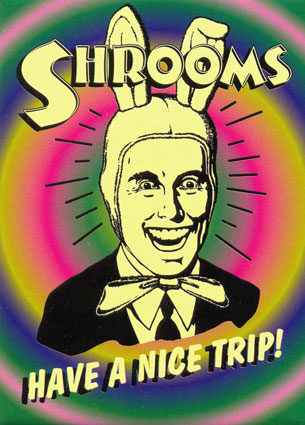
Now I’m going to ask some questions here, because why did he ask the CAM for advice in the first place, if he was going to go along with moving to ban it anyway? The CAM has labeled his decision as a political one, not an informed one based on the facts their research showed. Since this announcement an organisation called Red De Paddo (Save The Shroom) has started to get people active. Through their website over 40.000 people sent emails to the parliament calling for a more informed decision regarding the ban of mushrooms. They also organized a protest on the main square in Amsterdam (‘de Dam’) which was attended by a few hundred people. One of the speakers there, Peter Bronkhorst, was a Provo-activist who actually threw the smokebomb at the royal wedding in 1966. I’m sad to report that he passed away not even a week after the demonstration on the 2nd of November.
Now I personally cannot understand that everyone’s acting so surprised regarding the illegalisation of squatting and psilocybin mushrooms. I cannot understand why there were only a few hundred people at the demonstration. I cannot understand why there has only been one demonstration so far. I cannot understand why there were no 24/7 demonstrations outside the ministry of Public Health or the parliament.
What has happened to the squatting spirit, the hippie spirit, the Provo spirit? We have gotten lazy in our position of luxury and are not willing to fight for what we have. Why do we choose to become active after we have lost it? Are we lazy, scared, both? Why even ban mushrooms altogether if it’s not the Dutch, but the tourists causing the problems? Surely there must be ways to avoid this. Why are politicians that claim they want to protect the Dutch identity actually the ones most out to destroy it? The legality of psilocybin mushrooms and squatting are signs of our freedom, signs of our ‘Dutchness’. Freedom is a cause worth fighting for and this has often been said. Stop listening to the politicians who ban things in the name of cultural identity, freedom or safety. Wouldn’t it be more dangerous to give up freedom for safety, than the security that deed would provide could save us from? Why are freedom and safety even polarized? Why is it a choice between either one of them, we can surely create a world in which we have both… My point is that this is not just about kids wanting to trip, kids wanting to live in buildings for free, besides this squatting offers a high cultural value and mushrooms a spiritual one. It’s not even about that though; it’s about protecting ourselves in a more and more controlling-political climate. We are not safer or better off this way. Look at the most glorious years of the nation post-World War II (and maybe even predating the World War) – they were the most liberal times.
With the passing away of the older generations, it is time for a new generation of activists to step up and to show that we will not give up our rights to politicians who act on anything but facts.
It’s time to organise, it’s time to act and it’s time NOW.
Because if we don’t…
Recap
- The Dutch Provo-movement in the 60s, hippies in the 70s, and squatters in the 80s, have fought for rights which are now being taken away by a lack of action throughout the mid-90s until now;
- All research, including government research, has shown that making mushrooms illegal will cause more danger, not less;
- Where is the logic in a complete ban of mushrooms nationwide, based solely on incidents with tourists who act irresponsibly, impulsively and combine these with other drugs;
- The government and parliament actually going against advice from independent research shows that they do not respect science nor the rights of the individual, this must be stopped NOW;
- We must get organised and start acting to prevent these bans from happening, as well as other attacks on our rights, through creating understanding and support throughout society and the media;
- Stop voting for politicians who solely react to events instead of doing their job properly and treating the cause, not the symptoms. Get others to do the same; no matter their political orientation.
I have absolute faith that these repressive actions of the government will create a new movement like the Provo’s from the 60s or the squatters from the 80s. It would be in Holland’s best interest if this came sooner, rather than later. So we can prevent things from being made illegal, because it’s harder to get something legalised.
Don’t be surprised when you see the government proposing to ban cannabis also. They’re already attacking coffeeshops with the EU imposed smoking bans and under the denominator of ‘preventing drugtourism’. They will increase their pressure and become more blatant about it in the next 4 years. I myself expect them to use situations in which drugged people act crazy or OD in public (caused by their repression of safe drugs) and they will link these situations to cannabis. Likely saying that the use of cannabis has lead these people to use whatever caused the trouble. The cause in the great majority of the cases is, of course, alcohol, but they’ll prefer to tax that more heavily instead of banning it altogether. Mark my words.
Act NOW.

This article was written for Rethos.com: a platform for change where I’m a freelance/volunteer journalist.
And if the title seemed a bit provocative… just honouring the Provo’s 😉


 ” by
” by