Year: 2011

  • Why the announcement that radicals would hijack Dutch student protests is just spin-doctoring

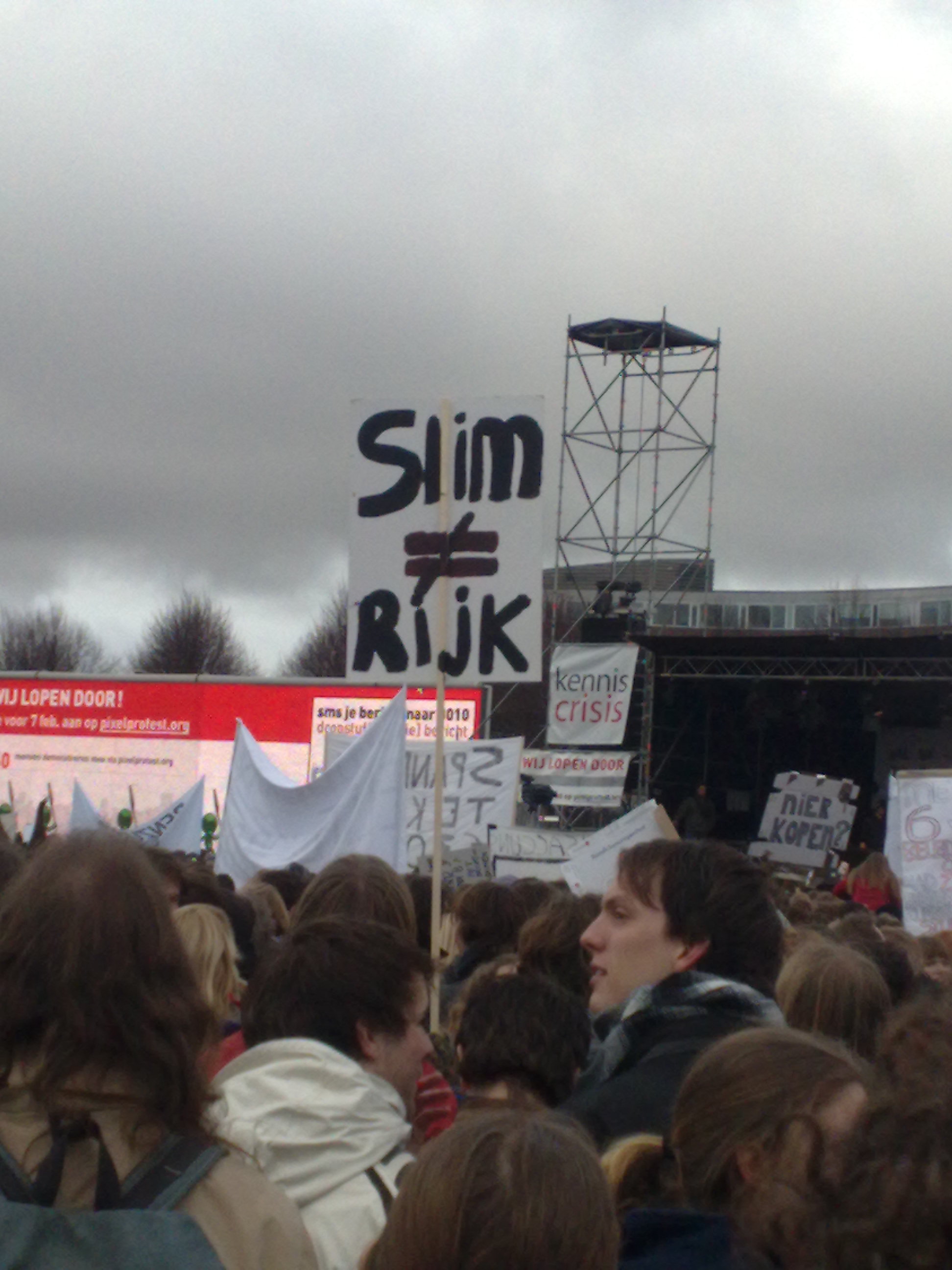
    Protester holds a sign that says "smart does not equal rich"Leading up to the organized student manifestation against the financial cuts in higher education, there were a bunch of news reports about there being ‘signals‘ that radicals would come and hijack the protest and try to create riots. Radicals was obviously never defined, but at the time I didn’t think much of it. A little while later, I realized what a genius piece of spin-doctoring it had been.

    What the message did, was create an expectation of radicals getting violent. For one, radicals can mean football hooligans, for another it can be anarchists, or communists, or foreigners, or anything else which they perceive as dramatically different than them. The manifestation itself was more like a political rally more suitable for election time. When students decided to go to the political quarters to let themselves be heard, they were met by police and violence ensued.

    The spin makes it seem like the violence was caused by radicals. I think it was caused by upset students. The difference?

    For any government, it’s important to create the impression that the general population is content with the government. The label ‘radicals’ was defined by a set of actions and expectations (mainly disobedience and perhaps violent actions or rioting), so when normal people acted this way, they became radicals. This makes sure that ‘normal people’ don’t identify with these radicals (formerly known as normal people).

    Identification creates understanding creates support. The last thing a government which plans to make drastic financial cuts and reforms wants, is people supporting a disobedient protest movement.

    Most of the (25) people arrested last Friday were obviously not radicals. They were students. They were normal people (they still are). They were people like you and me.
  • The Ugly Dance! How to get your music discovered! (Case-Study)

    I go through huge amounts of links and information each day when it comes to the music business, but this is by far the coolest and funniest way of getting your music discovered I’ve seen in a very long time. (OK Go, eat your heart out)

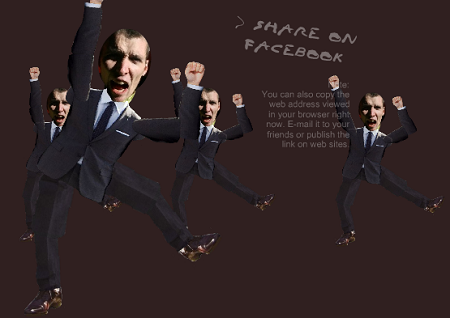
    The idea of The Ugly Dance is very simple. You go to the site, upload your picture and you can choose all kinds of maniacal ways of dancing. Here’s me dancing like nobody’s watching:

    Bas doing the Ugly Dance

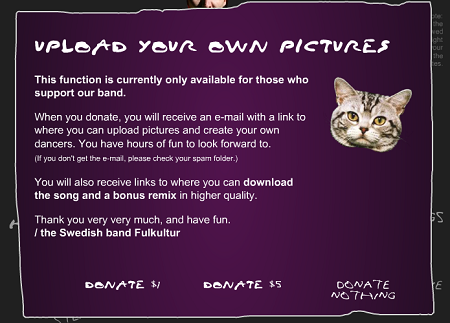
    It’s a project by Swedish band Fulkultur and appears to have been around for about half a year now. Obviously, this type of thing spreads. Getting your music heard by a lot of people (and what a catchy song it is). When I wanted to create a second dancer (to send to a friend), I got the following message:

    Donate and get music + VIP service!

    A very reasonable thing to ask… and since I was in such a great mood and figured the donation would not be much effort anyway, I went ahead and gave them some money, even though I think clicking the Donate Nothing button would still allow you to create more dancers (can anyone verify this?).

    There’s even a bunch of tribute videos and remixes out there (yes, every one of those words links to a unique video, have fun).

    These videos are the result of the ECOSYSTEM at work!

    Perfect example of using something viral to getting your music discovered, but also creating a movement which is easy to join, because it’s obvious what you have to do to participate (also read Derek Sivers’ post about this). Not sure if they’re making any money out of it directly (from the donations), as it might take quite some bandwith to keep this site online, but at least indirectly, by creating an ecosystem and giving them what they want (new music, live shows, merchandise, signed albums, perhaps an Ugly Dance at your own party?).

    If you haven’t done it yet, go create your own Ugly Dance!

  • Companies, employee blogs and the ecosystem

    I’ve been writing a lot about the concept of the ecosystem lately (don’t worry if you haven’t been following, it’s explained again in this post), but only applied to the music business. Obviously, this can be applied to any type of brand, service or product which has a ‘fan’ potential.

    A good example of this application of the ecosystem is with companies stimulating their employees to blog. In a reply to a question about this on Quora (GO SIGN UP!), I wrote the following:

    What has been enabled in recent years, is the socialization of brands.

    It’s no longer about one-way communication via TV and other media, not even about two-way communication (like customer service, mail, emails), but about non-linear many-to-many communication. This creates a new situation.

    What few companies could successfully do pre-digital age, almost any company can do now. Starbucks had a massive following and ‘fanbase’ before the digital age, but now all of the members of this following (or ecosystem as I like to call it) can be connected to each other.

    The following can be turned into a community. Now, why is it good that large organisations encourage their employees to blog?

    These organisations have to be part of their own ecosystem. This works best when it’s done authentically and genuinely (such as via employees). This will strengthen the ties between your ecosystem and the brand, which adds tremendous value for the brand (as well as the customers). It’s a bit of a cliché phrase, oft-repeated by ‘social media experts’, but one has to be part of the conversation.

    A brand that is well-connected with their users or customers, is a flexible brand. In times of rapid change, the greatest strength if flexibility. No matter how strong your pillars are… If they’re rigid and get torn down, they will break and shatter.

    James Hargreaves made a good addition, which simplifies it even further:

    Just to add in more laymen’s terms, a blogging employee adds the ‘human’ element to the ‘face’ of the business, showing a non-corporate means of communicating with consumers, clients, etc.

    I firmly believe that anything that can be done digitally will change the system it’s part of, whether that’s a political, economic or social system. The ecosystem is one of the basic rules and models for success in the digital age (if one thoroughly understands the concept, which is easier for digital natives than others). This is not just about the music industry; if your industry has not been impacted yet and part of it is digitizable, then it will be impacted.

  • How does this keep happening? 2 songs, 1 melody…

    I listen to a lot of music and I come across songs probably unintentionally borrowing elements from each other every now and then. One of the most obvious examples I’ve run into lately is the case of i Square vs Calvin Harris though.

    First there was Calvin Harris‘ I’m Not Alone, who composed a catchy tune with a melody that just really stuck! Maybe a little too much…

    And then there was i Square’s Hey Sexy Lady.

    OOPS!

    How does this keep happening? Nobody involved at any point said: “hey, you know what, you know why you suddenly felt so inspired with that melody? It’s because you heard it when Calvin Harris’ track was playing somewhere.” Oh, and Magnetic Man’s I Need Air also sounds quite similar.

    Or maybe they licensed it. I don’t know. Terribly uncreative though. 😉

    Plagiarism?

    Another recent scandal is the Usher vs The Simpsons / Homer Simpson situation by the way.

  • Thesis Excerpt: Connecting With Fans deadmau5-style (Mini-Case Study)

    When I first heard deadmau5‘ work 3 or 4 years ago, I was immediately excited. Here was a guy doing something new, developing a sound that was completely his own. Even though he was only known by perhaps a few dozen people per country, it was obvious that this guy was going to be influential and blow up.

    He has pulled it off in a spectacular way (awesome branding) and when I finally started following him on Facebook, I was thrilled with his level of engagement with his fanbase, or ecosystem (remember?).

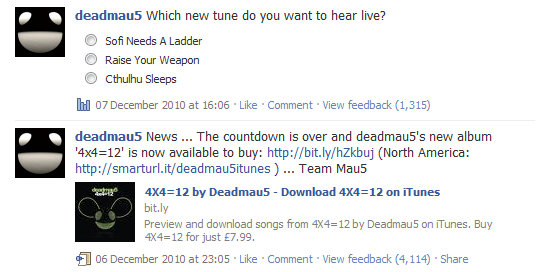
    In the beginning of December, this interesting development took place, where deadmau5′ marketing team decided they should get involved in communicating to his fans.

    Poll: what is your favorite track on the new deadmau5 album?

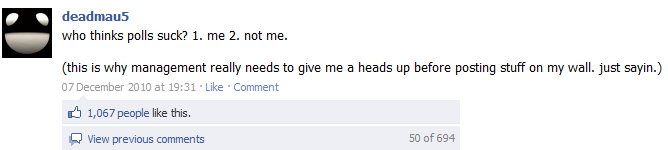
    Apparently deadmau5 didn’t like the fact that his management was disturbing the trust and rapport he had built up with the ecosystem, because those status updates were followed by deadmau5’s:

    Who thinks polls suck? 1. Me. 2. Not me.

    Then he checked the backend of his Facebook page…

    deadmau5 removing page admins

    Excellent choice, in my opinion. This is the best thing he could do to earn back the trust of the ecosystem, because you really don’t want to get on the bad side of the ecosystem. The ecosystem can reject you, the ecosystem can move on, the ecosystem doesn’t need YOU in order to survive.

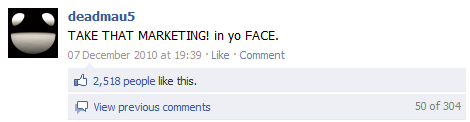
    And the cool thing is, he wasn’t thinking about marketing or self-preservation or strategy in the process of making his choices. It’s just him, genuinely. And I guess the status update he posted 1 minute later shows just that:

    Take that marketing, in yo face!

    Lesson learned: keep it personal and have fun in the process!

    Oh, and I do not recommend everyone to get into a fight with their management, because you can get fired from your label, but maybe you’re better off without that particular label anyway.

    Now, let’s chat on Twitter.


    P.S. Ok, it’s not a thesis excerpt, but it will find its way into my thesis somehow. Click here to subscribe to email updates on my thesis (for excerpts, subscribe to this blog or just bookmark it).

    P.P.S. Yeah, the formatting and text sizes are a bit off. I suck at screenshots, sorry. 😉

Related Posts Widget for Blogs by LinkWithin